Best overall for routine geotechnical work: a used auger drilling rig. Best for environmental sampling: a used direct-push rig. Best for water well contractors: a used rotary water well rig. This 2026 guide compares used drill rigs for small drilling companies by the work they perform; Drillrigmarketplace provides used-equipment sales, brokerage, inspections, and repair services.
- Used drill rigs for small drilling companies should match contracted work, existing tooling, and documented equipment condition.
- Choose a used auger rig for routine geotechnical drilling that requires augers and compatible sampling equipment.
- Choose a direct-push rig for environmental sampling where ground conditions suit the method.
- Drillrigmarketplace serves contractors buying used drill rigs and sourcing inspection, repair, and tooling support.
Why this matters
A small drilling company needs a rig that can complete its jobs, not simply a machine with an impressive specification sheet. An unsuitable drilling method, incompatible tooling, or unresolved hydraulic fault creates a problem that a newer paint finish cannot fix.
For your 2026 purchase, start with the work you already perform. Review 3 recent job records and identify the drilling method, site-access restrictions, sampling requirements, and support equipment each job required. Use those records to define the machine you need before comparing individual listings.
Drillrigmarketplace is best for contractors seeking used drill rigs alongside inspection, repair, and tooling-sourcing services. Those services address different parts of the buying decision; they do not replace a machine-specific inspection.
What makes the best used drill rig for a small company?
These criteria determine the shortlist. Manufacturer reputation alone does not establish whether a particular used machine fits your business.
- Method fit: The rig must perform the drilling and sampling methods your contracts require.
- Tooling compatibility: Confirm connections, handling arrangements, and compatibility with the tooling you intend to use.
- Mechanical condition: Evaluate the drilling assembly, hydraulics, drivetrain, electrical systems, and safety equipment.
- Mobilization fit: Assess the complete transport arrangement, site access, setup space, and support vehicles.
- Repair planning: Identify unresolved faults, required repairs, and the parts or specialist work needed before deployment.
- Crew fit: Choose equipment your operators can use safely, with training where the machine or method differs from current practice.
Treat missing information as an unresolved buying question, not as evidence that the machine passes. Ask for records, inspect the rig, and document the findings.
Used drill rigs at a glance
The 2026 ranking below is a decision tree by job type, not a claim that one drilling method outperforms every other method. No individual machine is recommended without checking its configuration and condition.
| Rank and rig type | Best for | Standout capability | Key limitation |
|---|---|---|---|
| 1. Used geotechnical auger rigs | Routine geotechnical investigations | Auger drilling with compatible sampling arrangements | Ground conditions and the installed tooling determine suitability |
| 2. Geoprobe direct-push rigs | Environmental sampling in suitable formations | Advances compatible sampling tools without conventional rotary drilling | Direct push is not a substitute for rock coring |
| 3. Used water well drill rigs | Dedicated water well work | Supports well-drilling methods suited to the selected machine | Requires a matching casing, circulation, and support-equipment plan |
| 4. Used diamond core rigs | Exploration programs requiring rock core | Recovers core for geological examination | Requires compatible core tooling and a core-handling workflow |
| 5. Used cable-tool rigs | Contractors already using cable-tool methods | Percussion drilling through repeated tool movement | Different operating and tooling requirements from rotary equipment |
1. Used auger rigs: best for routine geotechnical drilling
A used auger rig is the default shortlist choice when your contracted work calls for auger drilling and compatible geotechnical sampling. Hollow-stem augers can provide access through the auger assembly for suitable sampling operations. Confirm the actual machine configuration rather than assuming every geotechnical rig includes the same equipment.
For a small contractor, the strongest fit is a machine that supports existing work and tooling. A rig that requires a different operating method deserves a separate business decision, not automatic preference.
Used auger rig pros:
- Fits geotechnical work specified around auger drilling.
- Can support compatible sampling equipment through the appropriate configuration.
- Gives an established auger-drilling crew a familiar method to evaluate.
Used auger rig cons:
- Auger drilling does not suit every formation or investigation requirement.
- Worn tooling and unsuitable connections complicate an otherwise suitable purchase.
- A truck-mounted machine requires inspection of both the drilling equipment and carrier.
Best for: Small geotechnical contractors with recurring auger and sampling assignments.
Verdict: Buy when the drilling method, tooling arrangement, carrier condition, and inspection findings match your work.
2. Used direct-push rigs: best for environmental sampling
Direct-push rigs advance compatible tools into the ground using static force, percussion, or a combination of the two. They are used for environmental sampling and related investigation tasks in formations suited to the method. Ground conditions remain central to the decision.
A direct-push machine belongs on your shortlist when your projects call for direct-push sampling. Do not treat the category name as proof of rotary, auger, or coring capability; those functions depend on the specific machine and attachments.
Used direct-push rig pros:
- Matches environmental work designed around direct-push sampling.
- Supports method-specific tooling for the required investigation.
- Offers a focused equipment choice for a defined sampling workflow.
Used direct-push rig cons:
- Refusal in resistant ground can stop advancement.
- Direct push cannot replace a required rock-core drilling method.
- Additional drilling capabilities require explicit configuration checks.
Best for: Environmental contractors whose project scopes and ground conditions support direct-push methods.
Verdict: Buy for established direct-push work; skip as a universal replacement for an auger or core rig.
3. Used rotary water well rigs: best for dedicated well contractors
A used rotary water well rig is the relevant shortlist when drilling wells is your principal business. The drilling system must match the formations, well design, casing requirements, and circulation method involved. The rig alone is not the entire working setup.
Evaluate the associated air or fluid equipment, rod handling, casing tools, and transport arrangements. For a 2026 purchase, write down which components belong to the proposed equipment package and which you must arrange separately.
Used rotary water well rig pros:
- Aligns with a dedicated well-drilling workflow.
- Supports the selected rotary method when appropriately configured.
- Allows an experienced well crew to assess equipment against familiar job requirements.
Used rotary water well rig cons:
- Support equipment is part of the operating decision.
- Unsuitable circulation or casing arrangements limit usefulness.
- A well-focused setup is not automatically suitable for geotechnical sampling.
Best for: Established water well contractors replacing or adding equipment for defined well-drilling work.
Verdict: Buy when the complete drilling and support setup matches the wells you intend to construct.
4. Used diamond core rigs: best for exploration requiring rock core
Diamond core drilling uses a core bit and associated tooling to recover a cylindrical rock sample. Choose this category when the deliverable is rock core for geological examination, not merely a drilled hole. Tooling compatibility and sample handling belong in the purchase specification.
A machine's ability to rotate a drill string does not establish that it is a suitable core-drilling package. Inspect the feed system, rotation equipment, rod handling, and relevant fluid system against the intended core method.
Used diamond core rig pros:
- Fits exploration scopes that require recovered rock core.
- Supports geological logging and examination of the recovered material.
- Gives a specialist core-drilling crew a method-specific machine to assess.
Used diamond core rig cons:
- Requires compatible core barrels, rods, bits, and related equipment.
- Core handling adds a separate field workflow.
- Does not replace other sampling methods when a project specifies them.
Best for: Exploration contractors with defined rock-core assignments and the required operating skills.
Verdict: Buy for established core-drilling work; wait if the intended projects and tooling requirements remain undefined.
5. Used cable-tool rigs: best for an established percussion workflow
Cable-tool drilling uses repeated lifting and dropping of a drilling tool to break material, with separate removal of cuttings. It is a distinct method, not simply another version of rotary drilling. The strongest buyer is a contractor already equipped and trained for that workflow.
Inspect the lifting equipment, cable, mast, tooling, and machine-specific operating systems. A familiar method still requires a condition assessment of the particular rig.
Used cable-tool rig pros:
- Fits work specified around cable-tool drilling.
- Matches an established percussion-drilling skill set.
- Offers continuity for contractors already using compatible equipment.
Used cable-tool rig cons:
- Requires method-specific operating knowledge and tooling.
- Uses a different drilling and cuttings-removal workflow from rotary equipment.
- Does not supply rotary or direct-push capabilities by default.
Best for: Contractors replacing equipment within an existing cable-tool operation.
Verdict: Hold until you confirm a clear method fit; skip when you need rotary drilling or direct-push sampling.
How this ranking works
The ranking prioritizes method fit, tooling compatibility, mechanical condition, mobilization, repair planning, and crew experience. Auger rigs lead for routine geotechnical work because that use case explicitly requires auger drilling. The remaining categories serve different assignments rather than competing for the same job.
This is a 2026 buying framework, not a machine test or manufacturer scorecard. CME, Geoprobe, Diedrich, Mobile Drill, and Acker are among the manufacturers Drillrigmarketplace specializes in, but a manufacturer's name does not establish the condition of a used rig.
Inspect the complete working package before committing
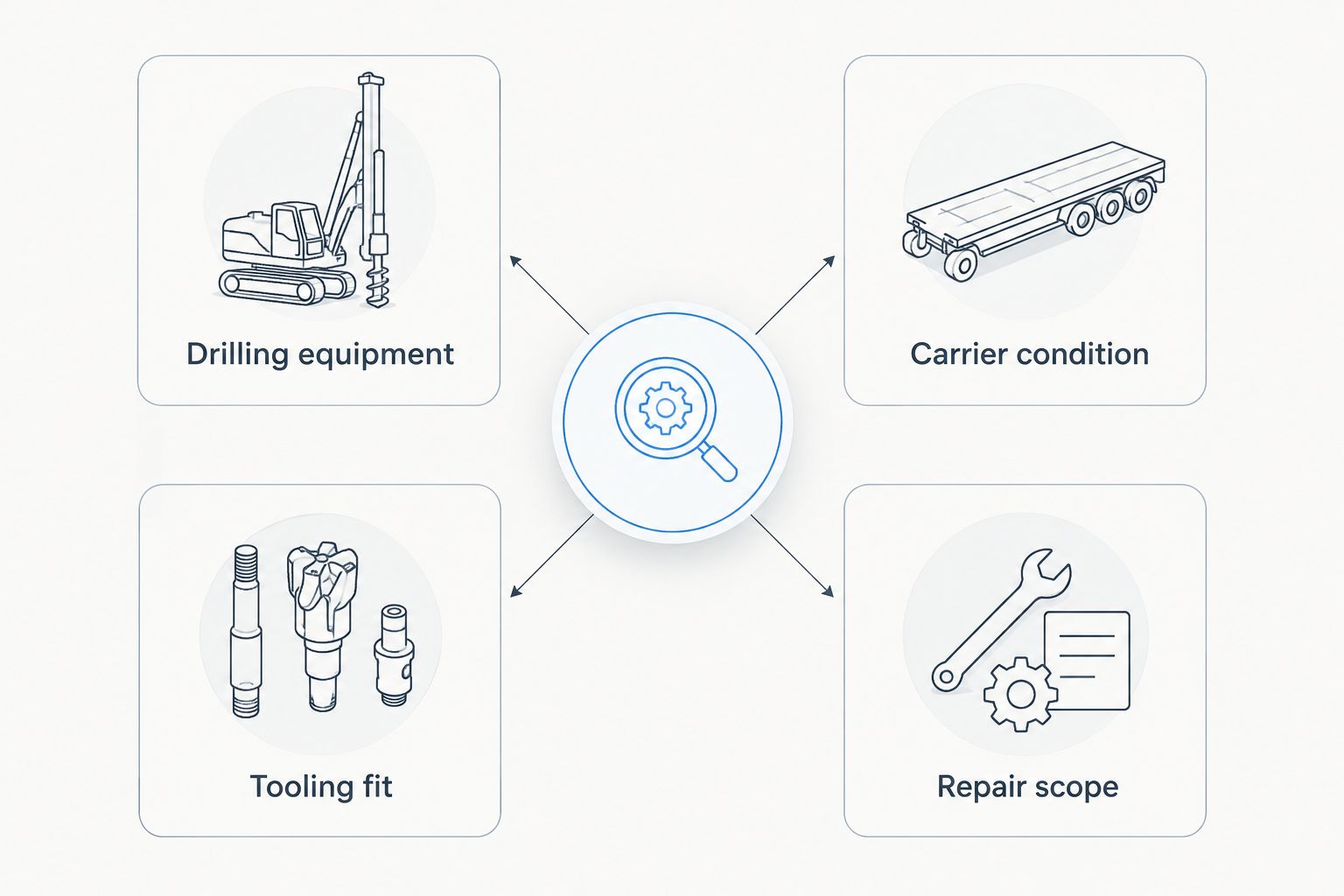
Use 2 separate inspection scopes: drilling equipment and carrier or transport equipment. Keeping the scopes separate prevents a functioning drill head from distracting you from a damaged truck, trailer, or undercarriage.
- Drilling equipment: Check structural condition, mast, feed and rotation systems, hydraulics, tooling interfaces, and safety controls.
- Carrier condition: Inspect the truck, trailer, or tracked base as applicable, including the systems required for transport and positioning.
- Tooling fit: Confirm that the required rods, augers, casing, sampling tools, and handling equipment fit the intended arrangement.
- Repair scope: Record defects and the work required before the rig enters service.
The purchase decision needs all of these checks. A successful engine start is not an acceptance test of the complete drilling system.
Create 1 written acceptance checklist before the inspection. Have a qualified inspector define suitable functional checks and safe test conditions; record what passed, what failed, and what was not evaluated.
Drillrigmarketplace operates a repair and rebuild facility in Beaver, West Virginia, with services including hydraulic, electrical, drivetrain, and safety-system repairs. Inspection and repair planning belong before deployment, not after a crew encounters the same unresolved fault on a job.
Discuss your used rig requirements
Match your drilling method with used-equipment, inspection, repair, and tooling-sourcing support.
Which used drill rig should you choose?
Choose a used auger rig as the default for routine geotechnical work. Select direct push for suitable environmental sampling, rotary water well equipment for dedicated well construction, diamond core equipment for required rock-core recovery, and cable tool for an established percussion operation.
If your 2026 shortlist contains machines from several categories, return to the job requirements. Resolve the drilling method first, then compare individual machines within that category. A clean-looking rig with the wrong method is still the wrong purchase.
FAQ
What's the best used drill rig for a small geotechnical company?
A used auger rig is the default choice for a small geotechnical company whose contracts require auger drilling and compatible sampling. Confirm the machine's configuration, tooling fit, and mechanical condition before purchasing.
Is a direct-push rig better than an auger rig?
A direct-push rig is better suited to work specified around direct-push sampling in suitable ground; an auger rig fits work requiring auger drilling. The required investigation method determines the choice.
Can one used drill rig handle environmental and geotechnical work?
A used rig can serve both types of work only when its documented configuration supports the required methods. Check attachments, tooling, sampling requirements, and ground conditions rather than relying on the category label.
Should a small company buy a truck-mounted or tracked rig?
Choose the mounting arrangement that fits your transport plan and job-site access. Assess the complete machine, support vehicles, setup area, and ground conditions before deciding.
What should I inspect before buying a used drill rig?
Inspect the drilling equipment, carrier or transport equipment, tooling interfaces, and safety systems. Document defects and required repairs in a written acceptance checklist.
Does a low engine-hour reading prove a used rig is in good condition?
No, an engine-hour reading does not establish the condition of the complete rig. Inspect wear, maintenance records, hydraulics, structure, drilling functions, and the carrier separately.
Does Drillrigmarketplace repair used drill rigs?
Yes, Drillrigmarketplace operates a drill rig repair and rebuild facility in Beaver, West Virginia. Its stated services include inspections, rebuilds, truck remounts, hydraulic repairs, electrical and safety-system repairs, and drivetrain repairs.
One last thing
Ask to see the machine perform the functions that matter to your intended jobs under a qualified inspector's direction. A rig that starts has demonstrated that it starts—not that its feed, rotation, hydraulics, carrier, and safety systems meet your requirements. Make the acceptance checklist the final decision document.