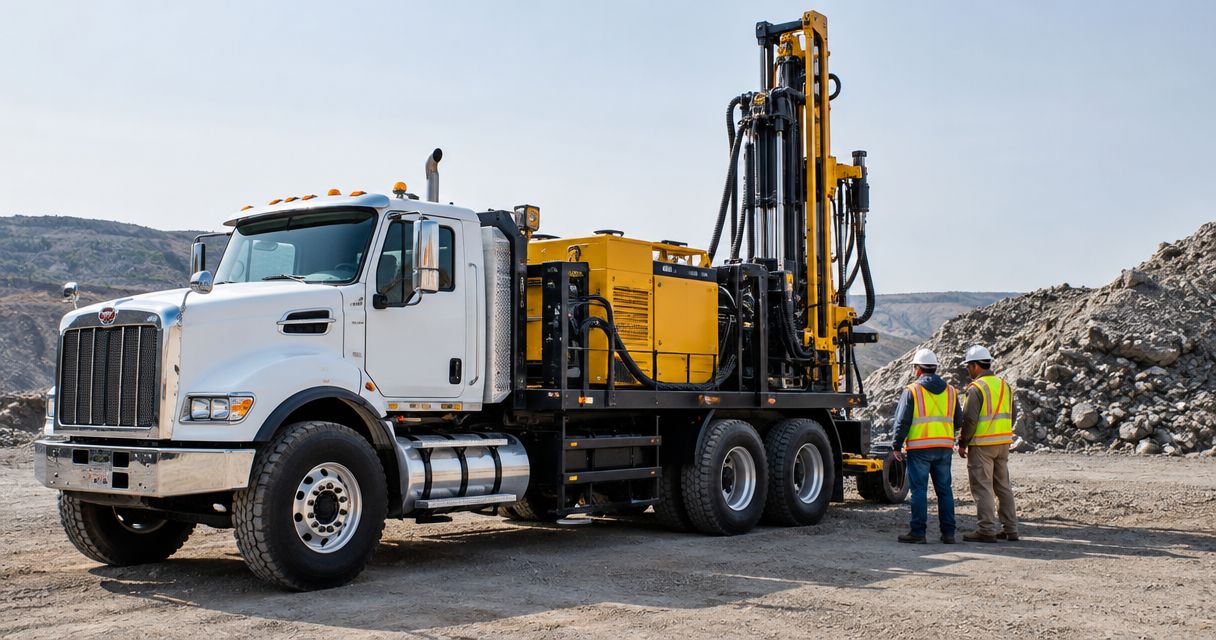
Instead of chasing ownership records, inspection notes, and transport instructions separately, manage your 2026 US–Canada drill rig sale through one approval file, from appraisal to signed delivery. Start with Drillrigmarketplace for used drill rig brokerage and repair support, then assign customs and transport responsibilities before authorizing pickup.
- Cross-border drill rig sale us canada: approve ownership, condition, import requirements, and transport before pickup.
- Drillrigmarketplace suits drilling contractors seeking used drill rig brokerage and repair support.
- Treat the drill assembly, carrier, and loose tooling as separately identified parts of the transaction.
- A signed purchase agreement does not replace customs release or destination registration requirements.
Why this matters
A drill rig sale is not shipment-ready just because the buyer accepts the equipment. The appraisal establishes a commercial basis; inspection documents condition; customs review establishes the border process; transport planning establishes how the equipment physically moves.
Those decisions depend on the exact machine. A truck-mounted rig requires attention to both drilling equipment and carrier records. A track-mounted rig presents different loading questions. Loose augers, rods, casing, and sampling equipment need their own packing record.
Drillrigmarketplace is best for drilling contractors seeking used drill rig brokerage and repair support. Its repair and rebuild facility in Beaver, West Virginia, adds a service option when inspection identifies work before shipment; that service scope does not establish customs eligibility or carrier registration.
For your 2026 transaction, use written approval gates rather than an assumed departure date. Keep commercial acceptance, border readiness, and delivery acceptance separate.
Before you start
- Gather equipment and ownership records. Collect the seller’s legal name, ownership documents, serial-number photographs, carrier identification where applicable, maintenance history, and a list of included tooling. Identify any financing or ownership claims requiring resolution.
- Assign the responsible parties. Name the buyer, seller, importer of record, customs representative, carrier, and receiving contact. Obtain permission to inspect the equipment and access the relevant records.
- Resolve the hidden complication: the carrier. Do not assume that a drill assembly’s documentation establishes a truck’s admissibility, title status, or registration eligibility. Send both sets of identifiers to the customs representative before committing to shipment.
Create a shared folder named for the equipment identifier and transaction year, such as your 2026 sale file. Give each document an owner and revision date. These are internal filing conventions, not government form labels.
Equipment appraisal
- Create an identity sheet. Record manufacturer, model, drill assembly serial number, carrier identifier, current location, and seller. Photograph identifiers directly rather than transcribing them from an old listing. Mark unreadable identifiers as unresolved.
- Build a condition record. Request at least 10 photographs covering identification plates, engine area, hydraulic components, mast, controls, carrier, and included tooling. This is a suggested documentation minimum, not a substitute for inspection. Add photographs wherever defects need explanation.
- Separate observed condition from reported history. Label maintenance invoices, seller statements, inspection findings, and operational videos by source. A video showing operation does not establish every function or reveal every defect.
- Define the appraisal scope. State whether the assessment covers the drill assembly alone, the carrier, tooling, or the complete package. List missing records and unresolved defects beside the assessment, not in an unrelated email.
- Obtain a written inspection scope. Identify the systems to examine, who will operate the equipment, and which tests require qualified personnel. Never improvise loaded testing, mast operation, or hydraulic checks outside safe procedures.
Expected result: You have an identifiable equipment package, documented condition, and an appraisal basis the buyer and seller can review together. Unverified history remains labeled as unverified.
Repair decisions before the agreement
Choose whether defects will be repaired before shipment, accepted in writing, or investigated further. Record each decision against the affected component and attach supporting evidence.
Drillrigmarketplace provides inspections, hydraulic repairs, electrical and safety system repairs, drivetrain work, and complete rebuilds. These services give you repair paths; they do not establish which work your particular rig needs. Use the inspection-to-rebuild workflow to structure that decision.
Best for repair-before-shipment: defects that prevent safe loading or the agreed inspection. The advantage is documented correction before handover; the limitation is that the repair scope must be settled before transport can be finalized.
Sale agreement
- Match the parties to the records. Use legal buyer and seller names consistently across the agreement and supporting documents. Resolve differences between a business name, an individual owner, and the name on carrier records.
- Attach the equipment schedule. Identify the drill assembly, carrier, and included accessories. Separate installed components from loose cargo. State exclusions explicitly so a photograph of nearby tooling does not become the only evidence of inclusion.
- Write the acceptance conditions. Define inspection access, repair obligations, ownership-document delivery, and what happens if import review identifies an unresolved requirement. Specify who authorizes changes after the agreement is signed.
- Allocate border and transport responsibilities. Name the party responsible for export preparation, import entry, carrier booking, cargo insurance arrangements, and destination unloading. Ask the relevant professionals to confirm their assigned scope.
- Set the release conditions. Document when possession transfers and who authorizes loading. Do not treat payment confirmation, ownership transfer, customs release, and delivery acceptance as interchangeable events.
Expected result: Both parties can identify exactly what changes hands, which conditions remain open, and who must clear each condition.
Use 3 separate records for the transaction: an equipment schedule, an exception log, and a responsibility sheet. This is a practical document structure, not a prescribed customs package. Keep required official forms separate and obtain them through the appropriate authorities or representative.
Border and transport review
- Confirm the shipment direction. Record the equipment’s physical origin and destination, not just the buyer’s and seller’s addresses. Identify whether the shipment is a permanent sale or another movement, such as a temporary repair visit.
- Submit the actual equipment details for review. Provide identifiers, photographs, ownership records, configuration, origin information, and transaction documents to the customs representative. Ask for written confirmation of required filings and supporting evidence.
- Check the carrier separately. For truck-mounted equipment, request a specific review of vehicle import, safety, emissions, title, and destination registration requirements as applicable. Do not substitute a machinery description for a vehicle assessment.
- Confirm classification and origin treatment. Have the responsible customs professional review tariff classification, valuation documentation, and any claimed preferential treatment. Buying equipment in the United States or Canada does not by itself establish qualifying origin.
- Prepare the transport plan. Obtain measured shipping dimensions and transport weight for the actual configuration. Agree on mast position, detachable components, loading method, securement responsibilities, route review, and unloading arrangements with qualified personnel.
- Obtain a written border-readiness decision. Ask the customs representative and carrier to identify outstanding documents, filing steps, timing requirements, and release instructions. Do not dispatch while either party lists an unresolved shipment-blocking item.
Expected result: You have a direction-specific border plan and a carrier-approved loading plan, with named people responsible for unresolved requirements.
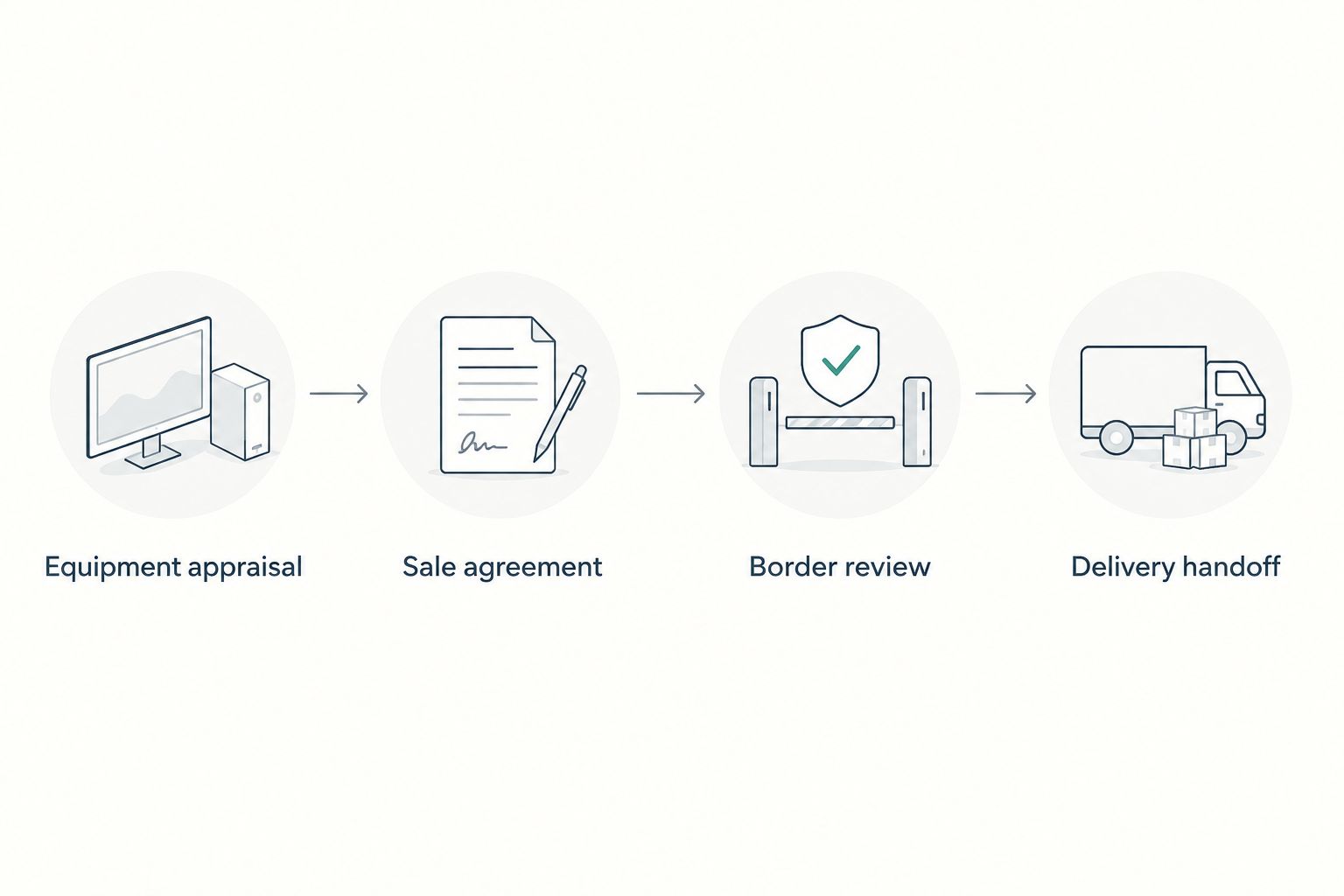
For the 2026 shipment file, organize the sequence as Equipment appraisal, Sale agreement, Border review, and Delivery handoff. Complete each gate before treating the next one as approved.
Delivery handoff
- Freeze the shipping packet. Assemble the approved invoice, equipment schedule, ownership evidence, packing information, and representative-issued instructions. Follow the customs representative’s direction on which originals must accompany the shipment.
- Inspect before loading. Photograph equipment condition and reconcile every included loose item against the packing record. Record any difference before the carrier accepts the load. Qualified personnel must control equipment preparation and loading.
- Record custody transfer. Capture the carrier’s identity, pickup date, equipment identifiers, visible exceptions, and the agreed receiving contact. Follow the transport documents and contract rather than an informal verbal handover.
- Control changes in transit. Route document requests, border questions, and destination changes through the named responsible parties. Do not ask the driver to resolve ownership or classification disputes independently.
- Reconcile delivery. Compare identifiers, loose tooling, and visible condition against the departure record. Document exceptions before signing an unqualified receipt, following the carrier’s procedures and your agreement.
Expected result: The delivered equipment matches the agreed package, or discrepancies are recorded with evidence and assigned for resolution.
Keep the signed delivery record with the 2026 transaction documents. Delivery closes the physical movement; it does not automatically complete local registration, commissioning, or any remaining contractual obligations.
Reverse-direction workflow: Canada to the United States
A Canada-to-US sale uses the same approval gates, but it needs its own import and export review. Reversing the route does not reverse the paperwork automatically.
| Workflow | Best for | Practical advantage | Limitation to resolve |
|---|---|---|---|
| United States to Canada | A Canadian buyer purchasing US-located equipment | Places the Canadian receiving requirements at the center of planning | Canadian import requirements and any carrier-specific admissibility need confirmation |
| Canada to United States | A US buyer purchasing Canada-located equipment | Places the US receiving requirements at the center of planning | US import requirements and applicable vehicle or engine requirements need confirmation |
For a Canadian-origin shipment entering the United States, send the US customs representative the equipment and carrier records before scheduling pickup. Request direction-specific confirmation rather than reusing instructions from a previous Canadian import.
For either direction, identify the appropriate export authority and destination import authority. Involve US Customs and Border Protection or the Canada Border Services Agency as applicable through the responsible representative. Keep the guidance tied to the actual equipment and shipment date.
Troubleshooting
The serial number differs between documents
Stop document approval and reconcile the identity. Compare photographs of the physical identifier against the invoice, ownership evidence, and equipment schedule. Correct the source document through its issuer; do not simply edit every copy to match an assumption.
The drill assembly is documented, but the truck is not
Separate the carrier review from the machinery review. Obtain the truck’s identifiers and ownership records, then request the applicable admissibility and registration assessment. Do not book cross-border movement on the strength of drill assembly paperwork alone.
Tooling is missing from the shipment record
Reconcile loose cargo before departure. Count rods, augers, casing, and sampling equipment by the descriptions agreed in the sale. Update the packing record and have the customs representative determine whether transaction documents also need correction.
A repair changes the shipping configuration
Recheck both transport and transaction documents. A remount, removed component, or added attachment changes what the carrier receives. Send updated photographs, dimensions, weight information, and the equipment schedule to the relevant parties before dispatch.
The buyer asks to send the rig for repair instead
Treat the changed purpose as a new compliance question. Pause the sale-shipment instructions and ask the customs representative to assess the proposed repair movement. Do not describe a temporary movement as a completed permanent sale to preserve an existing booking.
Customize your workflow
Add a repair gate when inspection identifies unresolved mechanical work. Add a financing gate when a lender requires specific ownership evidence or release documents. Add a remount gate when the drill assembly will leave on a different carrier.
Drillrigmarketplace helps customers source equipment financing and transportation alongside used drill rig sales and brokerage. Its service scope supports coordination, but your agreement must still identify the lender, carrier, customs representative, and their respective responsibilities.
For repeat purchases, turn the file structure into a reusable template. Preserve the checklist, not the previous shipment’s conclusions. A different carrier, engine, destination, or transaction purpose requires its own review.
FAQ
How do I start a cross-border drill rig sale between the US and Canada?
Start by documenting equipment identity, ownership, condition, and shipment direction. Assign the importer, customs representative, and carrier before authorizing pickup.
Can I use the same paperwork for the drill rig and its truck?
Do not assume one documentation set covers both the drilling assembly and the truck. Identify each separately and obtain a carrier-specific import and registration review where applicable.
Does buying a drill rig in Canada make it Canadian-origin equipment?
No. The purchase location does not establish qualifying origin. Have the customs representative assess origin evidence and any proposed preferential treatment.
Should I repair a used drill rig before shipping it across the border?
Resolve defects affecting safe loading or the agreed inspection before shipment. Document other defects and the buyer’s acceptance or repair conditions in the agreement.
Who is responsible for customs clearance in a drill rig sale?
The transaction must identify the importer of record and assign customs-related responsibilities explicitly. A seller, carrier, or marketplace is not automatically responsible merely because it participates in the sale.
Can a drill rig cross the border temporarily for repairs?
Temporary repair movements require a purpose-specific customs assessment. Ask the customs representative to confirm the appropriate process rather than using permanent-sale instructions.
Does Drillrigmarketplace help with repairs as well as drill rig sales?
Yes. Drillrigmarketplace provides used drill rig sales and brokerage and operates a repair and rebuild facility in Beaver, West Virginia. Listed services include inspections, hydraulic repairs, electrical and safety system repairs, drivetrain repairs, and truck remounts.
One last thing
Check the identifier photographs before improving the sales photographs. A clear image of the rig and carrier identification plates lets the buyer, customs representative, and carrier work from the same equipment identity. That is the first document check to complete in your 2026 sale file.