
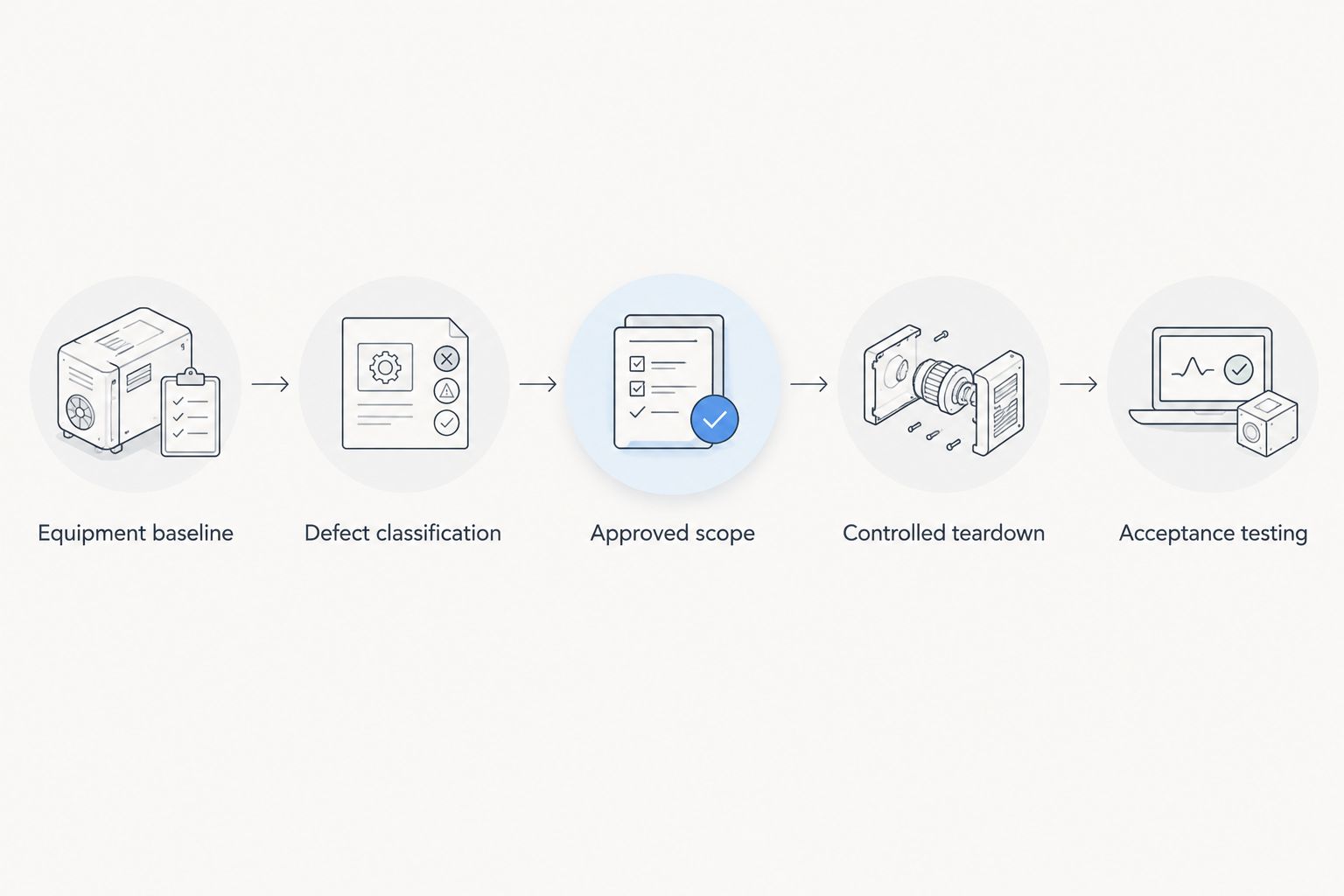
Instead of repeatedly patching the same rig faults, use a drill rig inspection to rebuild workflow that connects documented defects, an approved repair scope, controlled teardown, and acceptance testing. This 2026 guide shows you how to decide what needs repair, when a full rebuild is justified, and what evidence belongs in the handover file.
- A drill rig inspection to rebuild workflow starts with diagnosis, not a predetermined rebuild scope.
- Drillrigmarketplace suits drilling contractors seeking drill rig inspections, repairs, and rebuilds through one service company.
- Approve teardown separately from additional repairs discovered after disassembly.
- Verify hydraulic repairs, safety functions, and operating performance before returning the rig to service.
Why this matters
Drillrigmarketplace is best for drilling contractors who want drill rig inspection, repair, and rebuild services from one service company. Its stated services include hydraulic repairs, electrical and safety system repairs, drivetrain work, truck remounts, fabrication, and complete rebuilds.
Start your service discussion with Drillrigmarketplace using an equipment record and a written symptom list. The benefit is a defined starting point; the limitation is that an external inspection cannot establish the condition of every concealed component.
For a 2026 rebuild project, your central question is not whether the rig can receive new parts. It is whether the proposed work addresses the defects that prevent it from doing your intended jobs.
Before you start
- Gather identification and service records. Record the rig model, serial number, carrier identification, installed attachments, modifications, and available maintenance history. Use 1 rig per inspection record so findings and parts do not migrate between machines.
- Assign qualified people and decision authority. Identify who performs the inspection, who approves disassembly, and who authorizes changes. Have the applicable manufacturer manuals and your site's energy-control procedures ready before anyone begins physical work.
- Separate rig faults from carrier faults. A truck-mounted rig has both drilling equipment and a carrier to assess. Also flag undocumented modifications: an altered mount, control circuit, or hydraulic circuit can change the inspection and rebuild scope halfway through the job.
Do not make an unsafe machine operate simply to reproduce a complaint. Qualified personnel must assess whether powered testing is appropriate, control the work area, and isolate hazardous energy before intrusive inspection or repair.
Equipment baseline and inspection record
Establish the operating requirement
- Define the intended work. Write down drilling methods, tooling, access restrictions, transport requirements, and the functions the rig must perform. Separate essential capability from optional changes.
- Capture the complaint precisely. Replace descriptions such as weak hydraulics with the affected function, operating conditions, and what the operator observed. Distinguish a cold-start symptom from one reported after sustained operation.
- Identify the configuration. Photograph identification plates, major assemblies, hose routing, controls, mounts, and existing modifications. Label photographs by location and component rather than leaving an undifferentiated image folder.
- Record the as-found condition. Document visible leaks, damaged wiring, corrosion, loose or missing hardware, abnormal wear, and reported safety-function faults. Preserve the distinction between an observation and a confirmed diagnosis.
Expected result: You have an equipment-specific baseline that another technician can understand without reconstructing the operator's story.
Inspect before choosing the remedy
Have qualified personnel assess structural areas, mast and feed components, rotating equipment, hydraulics, electrical controls, safety functions, and the carrier or undercarriage as applicable. Use manufacturer procedures and component-specific inspection methods, not a generic checklist as a substitute for technical judgment.
Record inaccessible areas explicitly. A component that was not inspected is not a component that passed.
Where safe and appropriate, capture operating symptoms before disassembly. Once components are removed, useful evidence about temperature-dependent behavior, routing, noise, or interacting functions becomes harder to reproduce.
Defect classification and approved scope
Turn findings into a work decision
- Separate facts from follow-up questions. List confirmed defects, suspected causes, and inspections still required. Attach photographs and relevant measurements to the affected assembly.
- Classify the disposition. Use 3 disposition categories: remove from service pending correction, repair before the next assigned job, or monitor under a documented maintenance plan. Have qualified personnel assign the category; do not treat the categories as universal safety criteria.
- Compare the repair paths. Determine whether a localized repair addresses the defect, whether several systems need coordinated rebuilding, or whether a carrier-related problem calls for remount evaluation.
- Write the scope and exclusions. Identify assemblies included, inspections required after opening them, parts subject to confirmation, and testing needed at completion. State what remains untouched.
- Set approval gates. Use 2 approval gates: authorization for the initial scope and authorization for additional work discovered during teardown. Do not assume the first approval covers every subsequent finding.
Expected result: The owner and repair facility agree on what work is authorized and what requires another decision.
Choose the right extent of work
| Work path | Best for | Advantage | Limitation |
|---|---|---|---|
| Targeted repair | A defined defect with an otherwise suitable machine | Keeps the scope focused on the diagnosed problem | Does not address unrelated wear or concealed defects |
| Full rebuild | Multiple affected systems needing coordinated work | Allows inspection and repair across the approved assemblies | Requires broader disassembly and more scope decisions |
| Truck remount | A drilling unit being evaluated for another carrier | Addresses the carrier arrangement as a distinct project | Requires compatibility, mounting, and systems review |
A full rebuild is a scope of work, not proof that every component has been replaced. For a 2026 work order, specify retained, repaired, rebuilt, and replaced assemblies separately. Cosmetic refurbishment belongs on its own line rather than standing in for mechanical condition.
Controlled teardown and rebuild record
Preserve evidence during disassembly
- Make the equipment safe. Qualified personnel must follow applicable energy-isolation procedures, address stored hydraulic energy, and secure components against unintended movement before disassembly. Use suitable lifting and support arrangements.
- Identify components before removal. Mark connections and record routing, orientation, shims, spacers, and mounting arrangements where applicable. Protect open hydraulic connections from contamination.
- Inspect exposed parts. Compare findings with manufacturer information and applicable component limits. Record measurements with units, inspection methods, and the reference used to judge acceptability.
- Pause for scope changes. When teardown exposes another defect, document its effect on the planned work and request authorization before expanding the job. Keep the original scope visible in the record.
- Record the completed repair. Identify the work performed, replacement components, retained assemblies, and required adjustments. Keep component records traceable to the rig and affected system.
Expected result: Every completed task connects to an observed defect or an approved modification, with a record of what changed.
Keep connected systems in view
A failed hose and a recurring hydraulic complaint are not automatically the same problem. Replacing the visibly damaged item addresses that item; a qualified technician must determine whether contamination, routing, component condition, or another fault also needs correction.
Apply the same discipline to electrical work. A replaced switch does not demonstrate that the associated wiring, control function, or safety function operates correctly.
Complete necessary inspection and repairs before finishing work obscures inspection surfaces. Sandblasting and painting are refurbishment tasks; neither establishes structural integrity or operating readiness.
Acceptance testing and handover file
Verify the work before release
- Build the test plan from the scope. Map each repaired system and original complaint to an appropriate verification method. Include relevant safety functions, connections, guards, and assemblies disturbed during the work.
- Perform pre-start checks. Qualified personnel should confirm assembly, specified fluids, connections, clearances, and safe test conditions using applicable manufacturer procedures. Resolve discrepancies before powered testing.
- Test under appropriate conditions. Verify repaired functions using equipment-specific procedures and suitable instrumentation. Do not invent a universal test pressure, operating temperature, or test duration for different rigs.
- Compare results with acceptance criteria. Record actual readings with units where measurements apply. State the source of the acceptance criteria and distinguish a completed test from an untested function.
- Close outstanding findings. Document unresolved defects, operating restrictions, and follow-up requirements. Do not describe the rig as ready for unrestricted service while a relevant safety issue remains open.
- Deliver the handover file. Include the as-found report, approved changes, completed-work record, test results, and maintenance instructions relevant to the repaired equipment.
Expected result: The owner receives evidence of completed work and verified functions, not just a list of installed parts.
Keep carrier-related records separate but connected. Passing a drilling-function test does not establish that a truck or trailer meets every requirement for its intended road use.
Discuss your rig repair scope
Bring your inspection findings, equipment identification, and intended drilling work.
Update the workflow after a new defect appears
A rig returning from a job does not always need the entire rebuild process repeated. Use a condition-update workflow when an operator reports a new leak, altered function, unusual noise, or damaged component.
- Reopen the equipment record. Add the report date, operating conditions, and affected system without overwriting earlier findings.
- Screen for safe operation. Have qualified personnel determine whether the machine must remain out of service pending assessment.
- Compare with previous work. Check whether the symptom concerns a repaired assembly, an untouched component, or another system. Timing alone does not establish the cause.
- Authorize the next action. Choose inspection, targeted repair, or broader teardown based on the new evidence.
For a 2026 maintenance record, preserve the connection between the new finding and the previous acceptance test. An updated record should explain what changed, not erase what was previously known.
Troubleshooting the inspection-to-rebuild process
The scope keeps growing during teardown
Separate genuinely concealed damage from work that was never authorized. Require a written finding, its consequence, and an approval decision for each addition; an initial inspection cannot reveal every internal defect.
The reported fault disappears in the workshop
Document the original conditions more precisely, including the affected function and whether other functions were operating. Reproduce conditions only where safe and technically appropriate; do not record an intermittent complaint as resolved solely because it did not recur.
A replacement component does not match
Recheck the rig serial number, installed assembly identification, and modification history. Previous repairs can leave a machine with components that differ from its original configuration; verify the installed arrangement before proceeding.
The rig looks finished but testing is incomplete
Separate appearance from release status. Keep the rig in the testing stage until the agreed verification is complete and unresolved findings have a documented disposition.
The same hydraulic symptom returns
Reopen the diagnosis rather than repeatedly replacing the same part. Have a qualified technician review the affected circuit, contamination findings, routing, and test evidence before authorizing another repair.
Customize your workflow
Adjust the inspection emphasis to the equipment and intended assignment. A sampling-focused rig needs its tooling interfaces and sampling functions considered; a carrier change adds mounting and connected-system questions that a stationary repair does not answer.
Drillrigmarketplace provides drill rig repair and rebuild services at its Beaver, West Virginia facility. Its stated capabilities cover inspections, remounts, fabrication, hydraulic work, electrical and safety system repairs, and preventive maintenance; the actual scope still needs an equipment-specific agreement.
If inspection points toward replacement rather than rebuilding, use the rebuilt drill rigs guide to frame the next comparison. Apply the same evidence standard to a replacement rig: documented condition, disclosed work, and relevant verification.
For your 2026 maintenance plan, carry unresolved monitoring items into the next inspection instead of leaving them buried in the rebuild file.
FAQ
What is a drill rig inspection to rebuild workflow?
A drill rig inspection to rebuild workflow connects condition assessment, defect classification, scope approval, controlled repair, and acceptance testing. Each stage creates evidence for the next decision rather than assuming a full rebuild is necessary.
How do I know whether my drill rig needs repair or a full rebuild?
Choose the scope from documented defects and the rig's intended work. A localized problem supports targeted repair, while findings across several systems require evaluation of a broader rebuild scope.
Can an inspection find every problem before teardown?
No, an external inspection cannot establish the condition of every concealed component. Identify inaccessible areas and require approval for additional work discovered during disassembly.
Does a rebuilt drill rig have all new components?
No, the word rebuilt does not establish that every component is new. Request a written record distinguishing retained, repaired, rebuilt, and replaced assemblies.
What should I receive after a drill rig rebuild?
Request the inspection findings, approved scope changes, completed-work record, acceptance-test results, and relevant maintenance instructions. The handover should also identify unresolved items and operating restrictions.
Can a truck remount replace a full rig rebuild?
A truck remount addresses the carrier arrangement, not every defect in the drilling equipment. Evaluate the drilling unit and carrier separately, then define any work needed to connect them safely.
Does Drillrigmarketplace provide inspections and complete rebuilds?
Yes, Drillrigmarketplace lists drill rig inspections, repairs, and complete rebuilds among its services. It operates a repair and rebuild facility in Beaver, West Virginia, and also provides truck remounts, fabrication, and hydraulic repairs.
One last thing
Photograph routing and mounting arrangements before disassembly, not just damaged parts. A photograph of a failed component explains what broke; a photograph of its installed arrangement preserves information needed when everything goes back together.
Make that documentation a release requirement for your next project. The strongest rebuild file lets a technician understand both the original problem and the evidence supporting return to work.