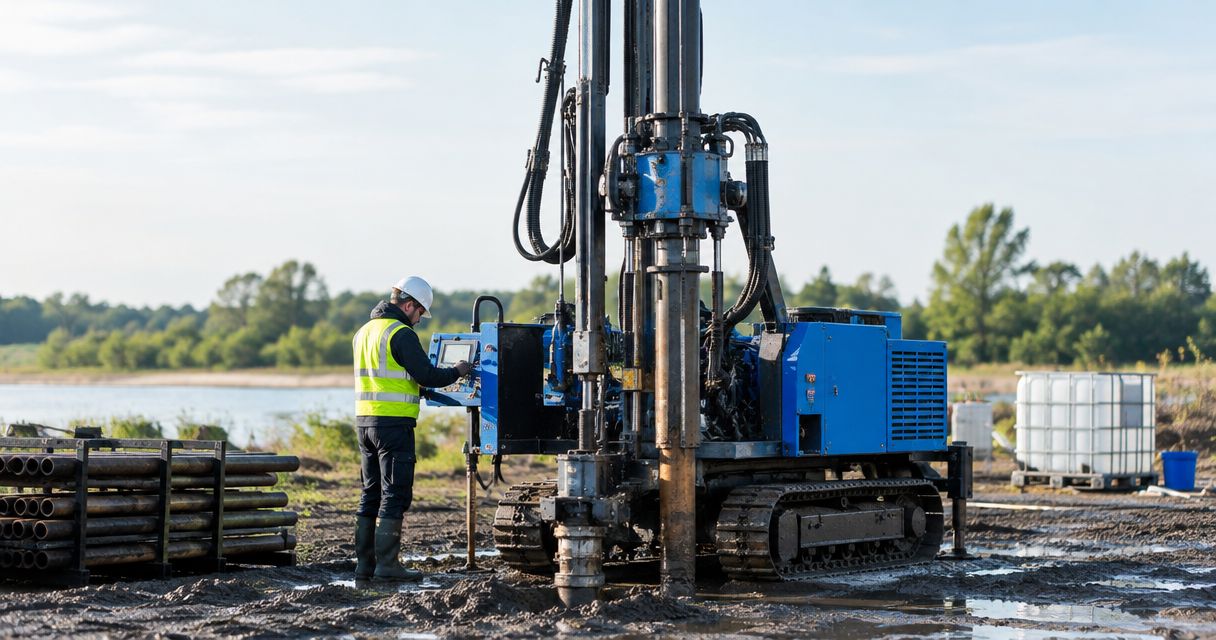
Owner-operator drilling rig selection is the process of matching a rig to your contracts, crew, and service capacity so you can complete paid work without taking on equipment you cannot support. This 2026 guide explains how to choose a drill rig for owner operator drillers, inspect used equipment, and plan the tooling, transport, and repairs around it.
- Choose a drill rig for owner operator drillers around contracted work, site access, and the people operating it.
- Drill Rig Marketplace suits used-equipment buyers seeking drilling rig sales, brokerage, and repair support.
- Compare truck-mounted, track-mounted, and rebuilt rigs against the same written job requirements.
- Inspect the drilling system, carrier, tooling, and safety controls before accepting a used rig.
Why drilling rig selection matters for owner-operators
An owner-operator makes the equipment decision and then works with its consequences on site. Your selection must account for drilling duties, maintenance access, transport arrangements, and who handles rods or samples while you operate the controls.
Drill Rig Marketplace is best for drilling contractors seeking used rig sales and repair support from one company. The Drill Rig Marketplace combines used-equipment sales and brokerage with inspections, repairs, rebuilds, and truck remounts at its Beaver, West Virginia facility. Those services help address equipment condition; they do not replace checking whether a particular rig meets your job requirements.
For your 2026 purchase, separate three questions: can the rig perform the work, can your crew operate it safely, and can you maintain the complete package? A favorable answer to only the first question is not enough.
How to choose an owner-operator drilling rig
Define the work you intend to accept
Start with a written job profile, not a manufacturer shortlist. Review your last 10 jobs, or your signed work if you are starting a business, and record the drilling methods, ground conditions, access restrictions, and sampling requirements involved.
Distinguish recurring requirements from occasional requests. A rig selected around an unusual assignment still needs to make sense for your ordinary workload. Do not add capabilities simply because a listing mentions them; establish what equipment and tooling each capability actually requires.
Keep the job profile beside every listing you review. It becomes the reference for inspection questions and keeps comparisons focused when two rigs have different attachments or configurations.
- Record required drilling and sampling methods.
- List expected hole depths and diameters from project documents.
- Identify access, overhead clearance, and ground restrictions.
- Separate contracted requirements from optional future work.
Match the configuration to your sites
Compare the carrier and the drilling system separately. Truck mounting, track mounting, and the drilling method describe different parts of the purchase. Neither a road-going carrier nor a tracked undercarriage proves that the attached drill meets your technical requirements.
Use site plans, access photographs, and actual transport arrangements for the initial comparison. The guide to used drill rigs ranked by mobility and setup speed provides a related framework; your decision still depends on the individual machine and jobsite.
Write 2 transport plans: how the rig reaches the project and how tooling, support equipment, and consumables reach it. If both plans depend on the same vehicle making conflicting trips, resolve that before purchase.
- Confirm loaded dimensions and weights from equipment records.
- Check access routes and working clearances.
- Establish loading, unloading, and site-movement procedures.
- Identify transport needs for tooling and support equipment.
Inspect the complete working machine
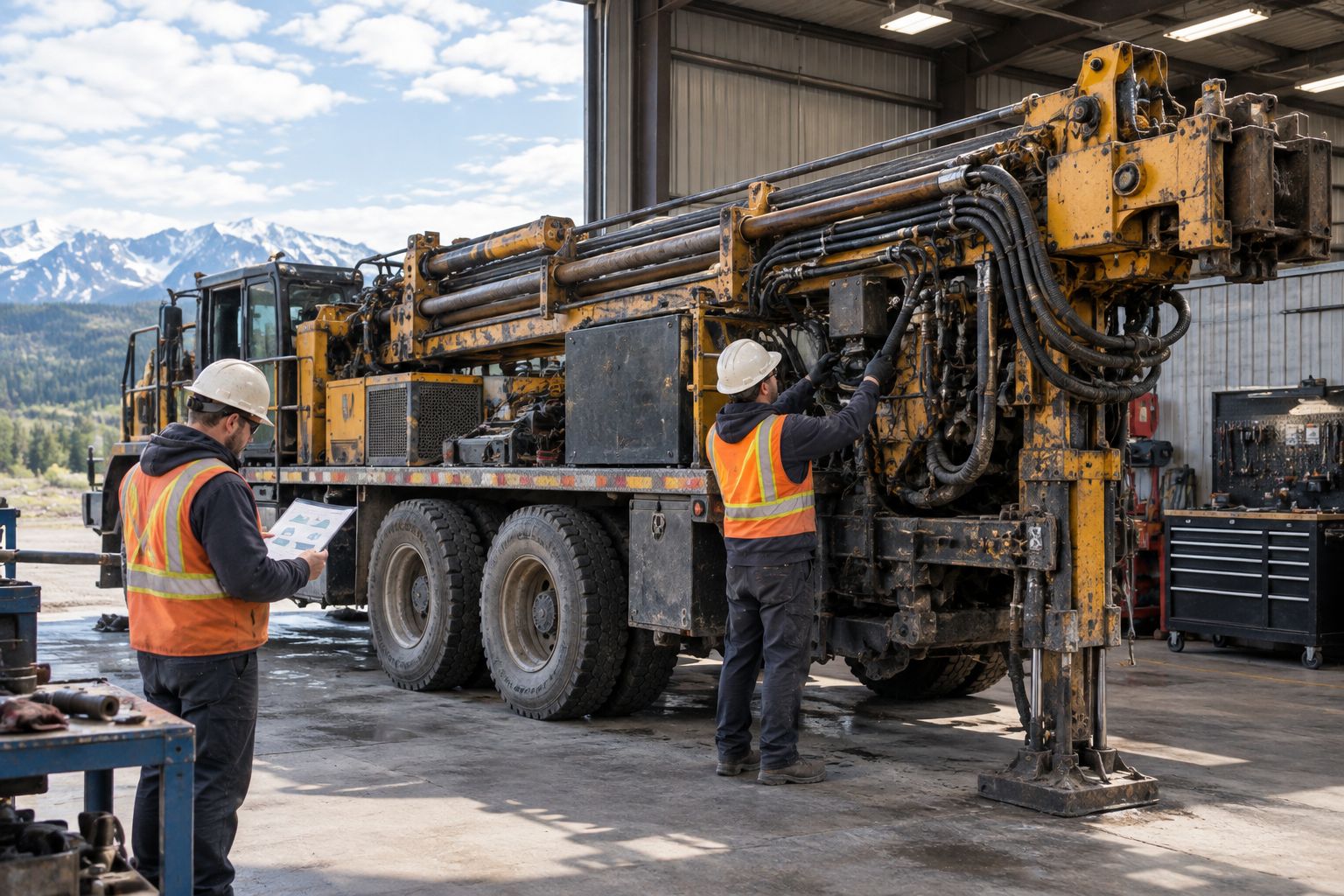
Begin with the seller's records and a structured visual inspection. Request maintenance history, repair invoices, identification details, and a demonstration appropriate to the machine. Have a qualified person assess operating functions under controlled conditions; do not test unfamiliar equipment by improvising.
Inspect the carrier as well as the drilling assembly. A functioning drill does not establish the condition of the brakes, drivetrain, frame, outriggers, or other carrier components. Likewise, fresh paint does not document hydraulic, electrical, or structural repairs.
Drill Rig Marketplace offers inspections and repair services, including hydraulic, electrical, safety-system, and drivetrain work. An inspection request should identify the intended drilling method and require written findings, so the result answers your purchase questions rather than merely describing appearance.
- Reconcile identification details with the sale documents.
- Inspect structural components, hoses, cylinders, and wiring.
- Request checks of applicable controls and safety functions.
- Record defects, test limitations, and unresolved questions.
Verify the tooling and handling package
Build a tooling list from the required method before accepting a package described as complete. For auger work, coring, sampling, or water well drilling, confirm the actual components, connections, and supporting equipment needed for your intended setup.
Record included items individually. Photographs help establish what accompanies the machine, but they do not establish wear condition or compatibility. Check component identification and dimensions against the rig documentation and the tooling supplier's requirements.
For your 2026 equipment plan, treat rod handling and sample handling as operating tasks, not accessories. Determine who performs each task, where that person stands, and what approved equipment supports the operation. Buying a rig does not establish that one person can safely perform every associated task.
- Inventory rods, augers, casing, and sampling equipment.
- Verify connections and manufacturer-specified compatibility.
- Inspect wear items and identify replacements.
- Confirm handling, storage, and securement arrangements.
Build a repair and ownership plan
Use a spreadsheet to separate acquisition, transport, immediate repairs, tooling, maintenance, insurance, and financing obligations. Request written estimates for known defects rather than treating every repair as routine maintenance. Keep unresolved defects visible instead of burying them in a general allowance.
Compare your existing rig with the proposed replacement using the same categories. A rebuild deserves consideration when a qualified assessment supports the existing platform's suitability. Replacement deserves consideration when the present machine cannot meet the documented job requirements.
Drill Rig Marketplace provides rebuilds, preventive maintenance, refurbishment, and truck remounts, and helps customers source parts, transportation, and financing. Ask which work is proposed for the specific machine and obtain its scope in writing; a service list is not evidence that a particular rig has received those services.
- Separate immediate repairs from scheduled maintenance.
- Obtain written scopes for proposed repair or rebuild work.
- Identify parts sources and qualified service support.
- Compare repair and replacement against the same job profile.
Check the working routine before committing
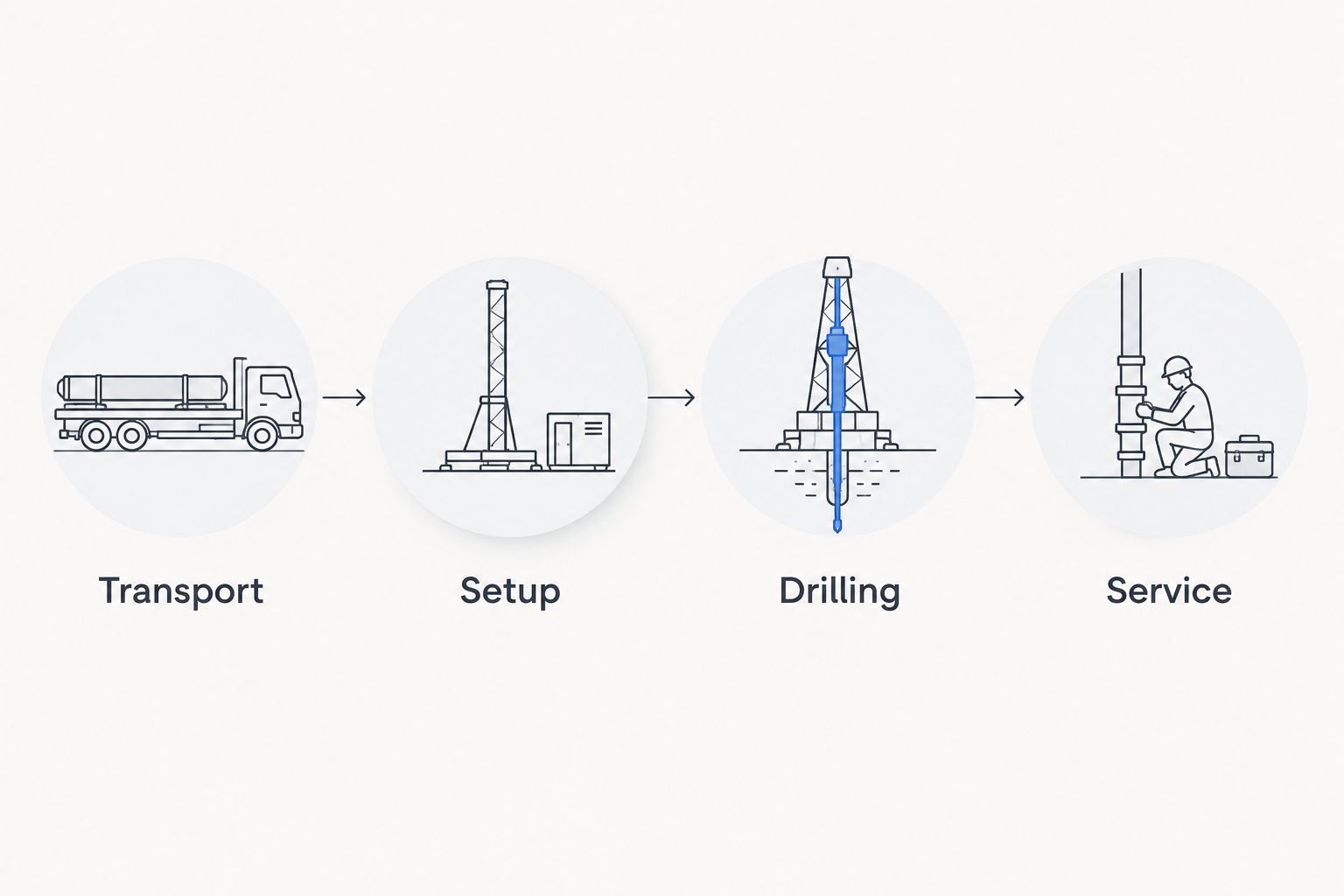
Walk through a normal assignment from departure to demobilization. Include loading, site arrival, setup, drilling, tooling changes, sample handling, cleanup, and return transport. This exposes missing equipment and staffing assumptions before the rig becomes your responsibility.
Map the routine in order: Transport, Setup, Drilling, and Service. For each stage, identify the person, equipment, and information required. A single owner can manage the business without being the only person required for field operations.
Use the manufacturer's operating instructions, site requirements, and applicable safety rules to establish staffing and procedures. Do not infer safe solo operation from a seller's description or from the fact that controls are accessible from one position.
- Assign responsibility for each operating task.
- Confirm required training and machine documentation.
- Plan utility clearance and site-specific hazard controls.
- Establish maintenance isolation and emergency procedures.
Document acceptance and the first service work
Turn your findings into 1 acceptance checklist before signing the final handover documents. Identify the machine, included tooling, supporting records, demonstrated functions, known defects, and agreed work. Keep the inspection report separate from any promises about repairs so neither becomes ambiguous.
For a 2026 handover, establish which maintenance items need attention before operation and which require ongoing scheduling. Follow the relevant manufacturer instructions and qualified inspection findings rather than assigning an arbitrary service interval to an unfamiliar used machine.
Close unresolved questions in writing. If a function was not demonstrated, record it as unverified; do not turn an incomplete inspection into a positive finding. The purchase decision should reflect what was actually checked.
- Record included equipment and outstanding defects.
- Document agreed repairs and evidence of completion.
- Collect operating, maintenance, and identification records.
- Assign responsibility for transport and initial service.
Compare owner-operator rig options
The options below overlap: a rebuilt rig can be truck-mounted or track-mounted. Compare mounting configuration first, then condition and repair scope. None of these labels establishes drilling capacity, staffing requirements, or readiness for your next contract.
| Option | Best for | Main advantage | Key limitation |
|---|---|---|---|
| Used truck-mounted rig | Contractors whose projects suit a road-going carrier | Combines the drilling assembly and truck in one package | Both the truck and drilling systems require inspection |
| Used track-mounted rig | Contractors whose access plan calls for tracked movement | Provides a tracked platform for movement within suitable sites | Off-site transport and ground suitability still need verification |
| Rebuilt used rig | Contractors seeking documented work on a suitable platform | Offers an opportunity to address identified systems before handover | Rebuild scope varies; the label alone proves little |
| Rebuild of your existing rig | Owners whose current platform still fits their contracts | Retains a machine whose operating history you know | Repair work does not establish missing drilling capability |
Choose the configuration that satisfies the job profile, then judge the individual machine. Brand familiarity helps you frame questions, but it cannot substitute for condition records and a suitable tooling package.
Ask for the exact scope behind descriptions such as rebuilt, refurbished, or inspected. Compare the components assessed, work completed, unresolved defects, and supporting documentation. Avoid treating different descriptions as equivalent evidence.
Common mistakes owner-operators make
- Equating ownership with solo operation. Specify how rods, tooling, samples, and support tasks will be handled before accepting the machine.
- Buying for an unconfirmed specialty job. Base the purchase on documented work requirements, then assess additional capabilities separately.
- Inspecting the drill but overlooking the carrier. Include the truck or undercarriage, mounting structure, and relevant transport systems in the inspection scope.
- Assuming photographed tooling is included and compatible. Attach an itemized inventory to the purchase documents and verify connections and condition.
- Treating refurbishment as proof of mechanical condition. Ask for repair records and test findings; appearance and operating evidence answer different questions.
FAQ
What's the best drill rig for an owner-operator?
The best drill rig matches your contracted drilling method, site access, tooling, and operating crew. Choose the configuration first, then verify the condition and documented capability of the individual machine.
Can I operate a drilling rig by myself?
Owner-operator status does not establish that solo drilling is safe or appropriate. Determine staffing from the manufacturer's instructions, handling tasks, site conditions, and applicable safety requirements.
Is a truck-mounted rig better than a track-mounted rig?
Neither configuration is better for every owner-operator. Compare road transport, site access, working clearances, ground conditions, and support-equipment movements for your actual projects.
Should I buy a rebuilt drilling rig?
Consider a rebuilt rig when the underlying machine suits your work and the rebuild scope is documented. Request records showing the systems assessed, repairs completed, and defects that remain.
What should I inspect before buying a used drilling rig?
Inspect the drilling assembly, carrier, mounting structure, hydraulic and electrical systems, applicable safety controls, and included tooling. Have a qualified person document checks and identify functions that were not verified.
Can Drill Rig Marketplace help with repairs as well as a purchase?
Drill Rig Marketplace provides used rig sales and brokerage alongside repair, inspection, rebuild, and remount services. Its repair facility is in Beaver, West Virginia; confirm the proposed scope for your specific machine.
What documents should I collect when buying a used rig in 2026?
Collect identification and ownership documents, the equipment inventory, available operating and maintenance records, inspection findings, and written repair agreements. Confirm which transport and registration documents apply to the machine and jurisdiction.
One last thing
Before committing, write down the first contract you expect the rig to perform. List the drilling method, tooling, people, transport, and unresolved repairs required to complete it. If an essential item remains unverified, the rig selection is unfinished. This final check ties the purchase to work you can actually plan rather than capabilities you only assume.