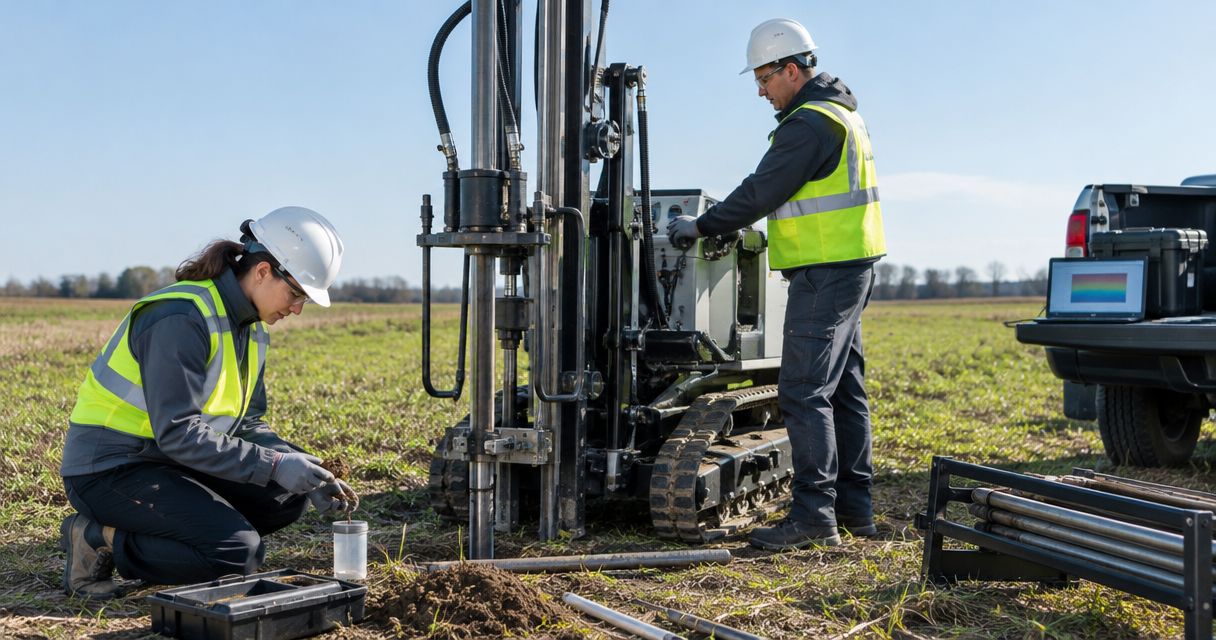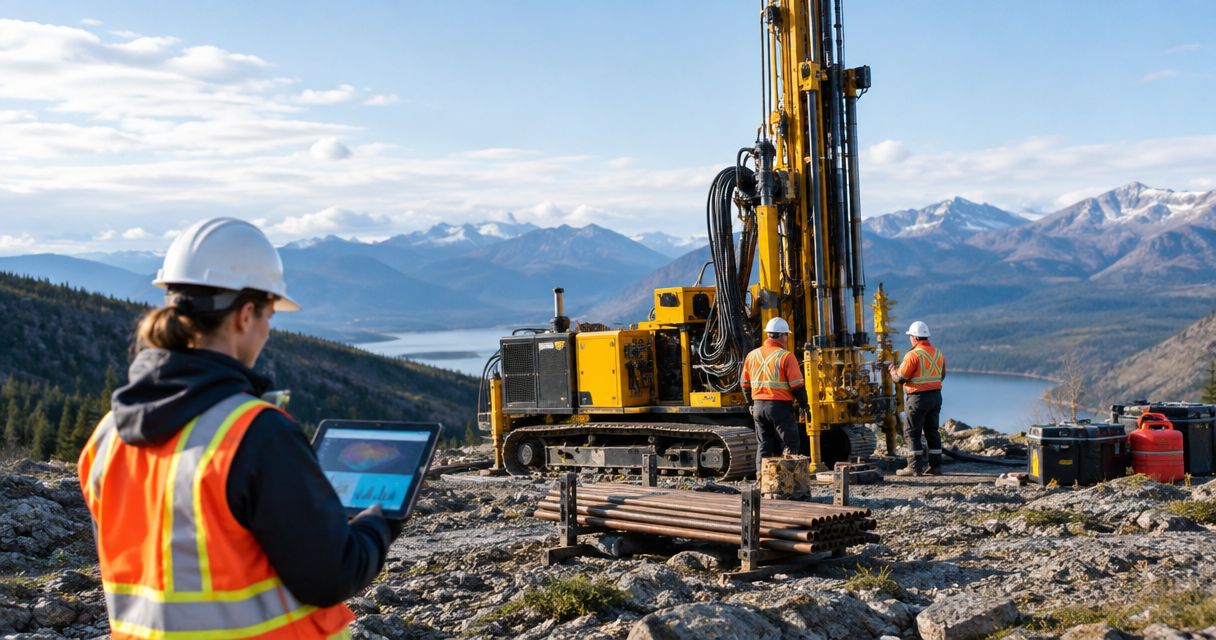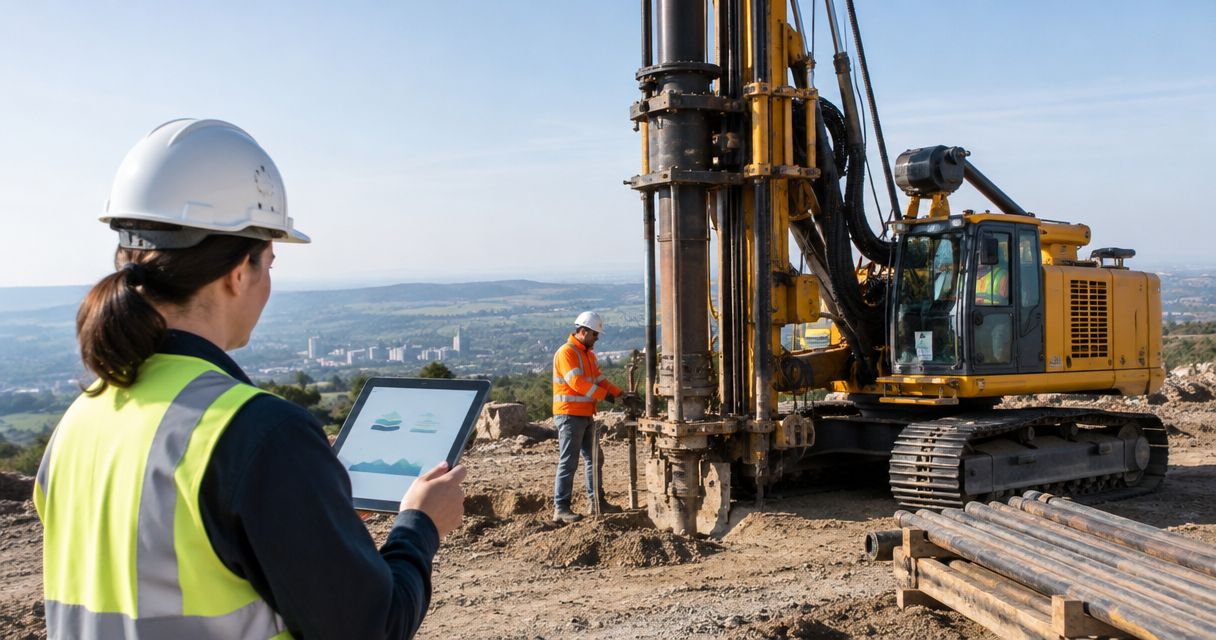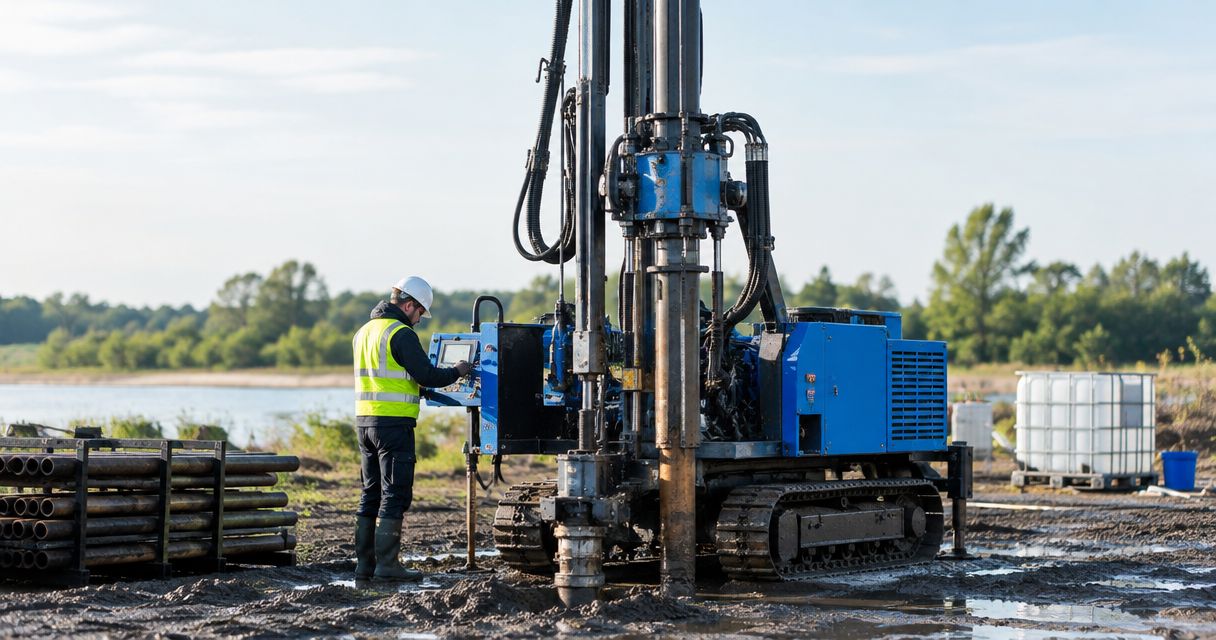
Remediation contractors’ sonic drilling is a method that uses high-frequency drill-string vibration to recover subsurface material and advance casing for investigation and cleanup work. This 2026 guide explains how to select a sonic drill rig for remediation contractors around geology, sample requirements, contamination controls, and site access—not just drilling capability.
- Drillrigmarketplace is best for used-drill-rig buyers who also need inspection, repair, or rebuild services.
- Choose sonic drilling when the investigation requires its sampling and casing capabilities; do not assume every remediation project needs it.
- Evaluate environmental drilling equipment against geology, sample handling, access, and documented mechanical condition.
- Inspect a used sonic drill rig as a complete working system, including the head, tooling, hydraulics, and carrier.
Why sonic drilling matters for remediation contractors
Remediation work joins two requirements: reaching the target interval and producing samples that support defensible decisions. A machine that advances successfully still fails the assignment if sample handling, borehole control, or equipment decontamination conflicts with the investigation plan.
Sonic drilling combines vibration with rotation and downward force to advance tooling. Casing supports the borehole while work proceeds. Its suitability depends on the formation, required diameter, depth, and sampling procedure; it does not remove the need for a site-specific drilling plan.
Drillrigmarketplace serves environmental drilling companies and other drilling professionals. For your 2026 equipment decision, separate the investigation requirements from the purchase decision: establish what the work demands before choosing a machine or seller.
Choose the drilling method before choosing the used rig. Your specification should explain how the equipment will support sample collection, well construction, contamination controls, and safe operation.
How to select and deploy the right sonic rig
Use the following sequence to move from project requirements to equipment acceptance. Keep the decisions in a written file so the superintendent, environmental consultant, operator, and equipment inspector evaluate the same requirements.
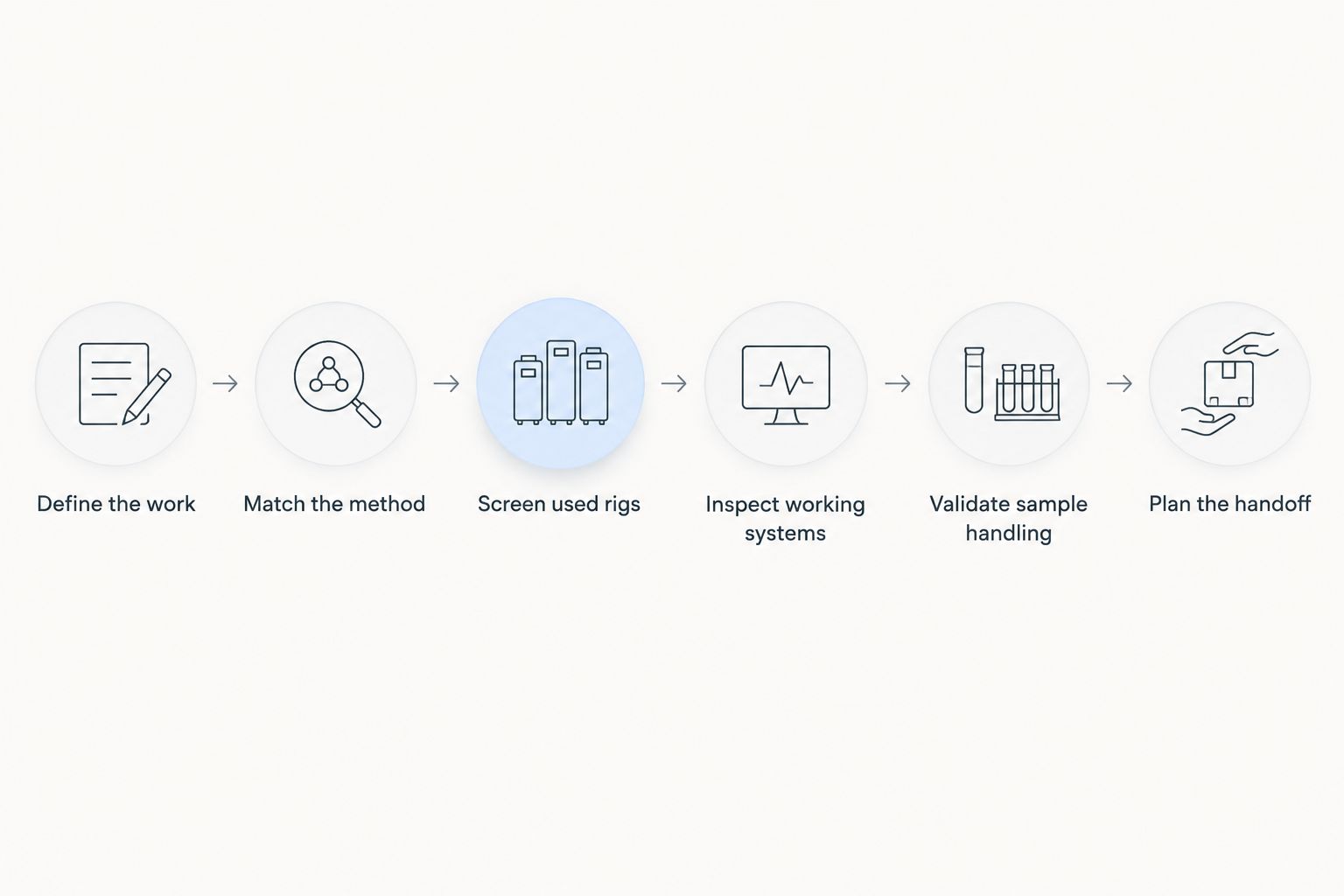
Define the work
Start with the project documents you already have: boring logs, conceptual site models, proposed well details, sampling instructions, and access drawings. Put the requirements into a shared worksheet. Distinguish mandatory capabilities from preferences that make operation easier but do not determine whether the rig can complete the assignment.
For a 2026 fleet decision, build a 12-month workload forecast using your own scheduled and prospective work. Identify recurring assignments separately from unusual projects. Do not let an exceptional borehole dictate the specification for your entire drilling program.
Translate investigation language into equipment requirements. A request for formation samples needs a defined collection and handling procedure; a monitoring well needs a construction detail and an acceptable installation method.
- Record target formations, depths, borehole diameters, and casing requirements.
- Define sample intervals, handling procedures, and analytical requirements.
- Document access width, overhead clearance, working area, and ground conditions.
- Identify utility-clearance, exclusion-zone, and decontamination requirements.
- Separate confirmed project requirements from assumptions needing clarification.
Match the method
Compare drilling methods against the worksheet before comparing machines. Sonic drilling is an option for collecting formation material while advancing casing, but a sonic rig is not automatically the right choice for every environmental boring. Direct-push equipment or hollow-stem auger drilling can fit different investigation requirements.
Review the proposed method with the environmental consultant and the person responsible for accepting the data. Sample heating, disturbance, introduced fluids, and handling procedures all deserve attention where they affect the analytical objective. Do not treat recovered material as analytically acceptable simply because it looks intact.
Best for sonic drilling: assignments whose formation sampling and casing requirements justify the method. Its limitation is that specialized equipment and tooling still need to fit the site, crew, and sampling plan.
- Compare sonic, direct-push, and hollow-stem auger methods against the same requirements.
- Confirm whether fluids are permitted and how they will be managed.
- Resolve sample-temperature and disturbance concerns before mobilization.
- Verify the proposed casing sequence against the well-construction design.
- Document why the selected method fits the investigation objective.
Screen used rigs
Build your initial shortlist manually from equipment descriptions, photographs, maintenance records, and seller responses. Ask for evidence against your specification rather than accepting a general description such as environmental-ready. A listing is a starting point, not an equipment acceptance record.
The guide to used sonic drill rigs provides a focused starting point for the equipment category. Drillrigmarketplace supports used drill rig sales and brokerage, inspections, repairs, and complete rebuilds. That brings equipment sourcing and mechanical work into the same discussion; you still need a machine-specific scope and inspection findings.
Drillrigmarketplace is best for used-drill-rig buyers who also need inspection, repair, or rebuild services. The service offering does not replace checking a candidate’s condition or confirming its suitability for your work.
For each 2026 candidate, organize 3 evidence sets before arranging the final evaluation:
- Identity records: machine identification, configuration, and represented equipment.
- Maintenance records: service history, repair documentation, and known defects.
- Application records: tooling details, operating documentation, and relevant demonstrations.
- Record every unanswered question beside the requirement it affects.
Inspect working systems
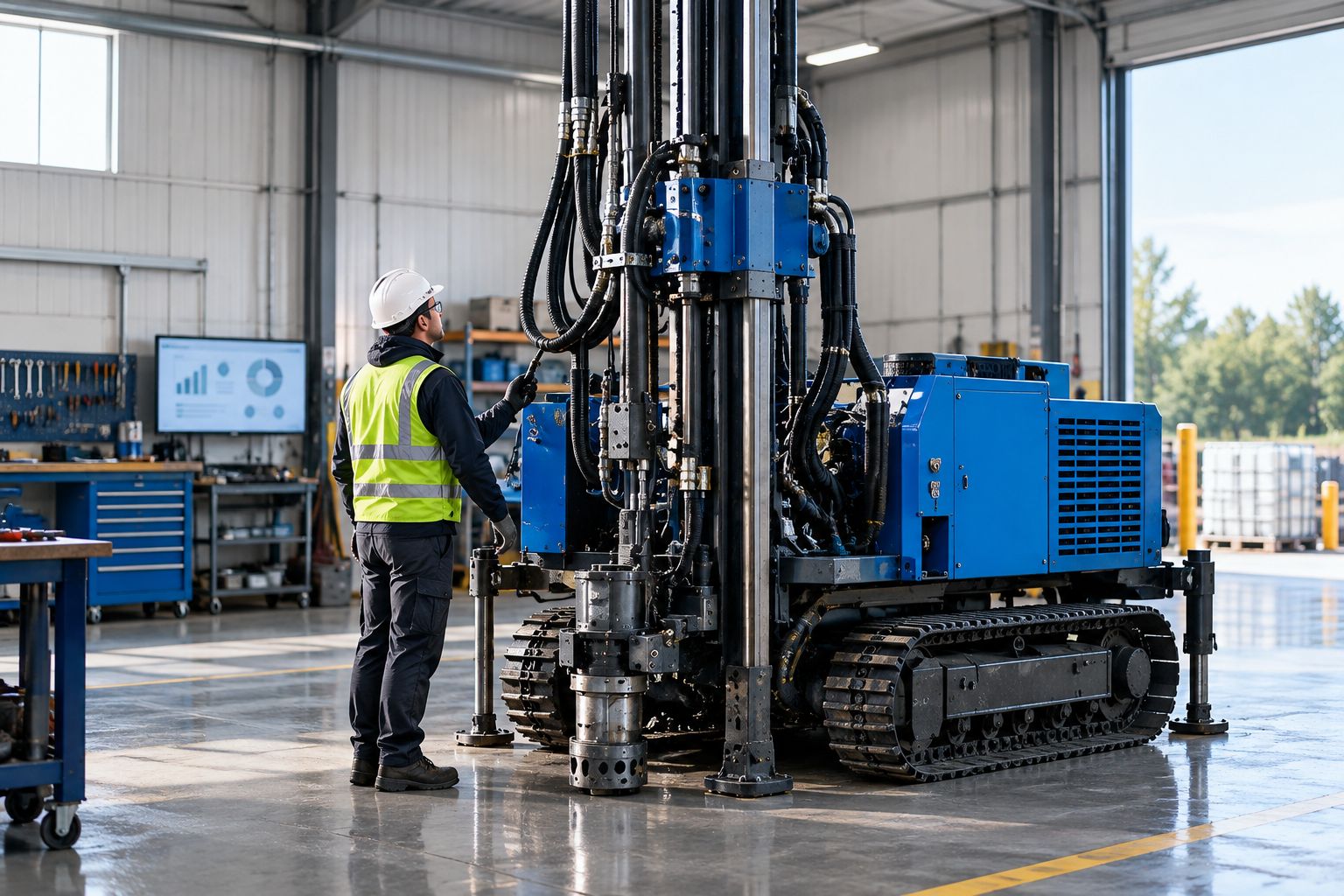
Have a qualified inspector evaluate the sonic head, hydraulic system, mast, feed components, clamps, carrier, controls, and safety systems. Inspect the complete configuration you intend to purchase. A functioning carrier does not establish that the drilling system is ready for the proposed workload.
Request an operating demonstration appropriate to the machine and inspection conditions. Static photographs cannot show every operating fault. Do not ask anyone to bypass guards, defeat interlocks, approach moving tooling, or open pressurized systems to make a demonstration easier.
Treat repair needs as explicit acceptance items. Identify who will complete each repair, what documentation is required, and how the result will be checked. A fresh finish is not evidence that internal wear or a hydraulic fault has been corrected.
- Inspect the sonic head and mounting components for damage and documented repairs.
- Check hydraulic hoses, fittings, cylinders, and connections for condition and leaks.
- Examine mast, feed, clamps, and tooling interfaces for wear or damage.
- Verify controls, guards, emergency stops, and applicable safety functions.
- Record carrier condition, transport configuration, and unresolved defects.
Validate sample handling
Walk through the full sampling cycle before accepting the operating plan: tooling enters the ground, material is recovered, samples are transferred, and equipment is prepared for the next interval. Include the environmental consultant and the personnel who will handle samples. Their procedures must fit the machine and tooling.
For volatile-organic analysis, resolve collection methods and any temperature concerns with the project’s sampling protocol and analytical laboratory. Do not assume that the same handling procedure suits every contaminant or analytical method.
Keep 2 acceptance records: one for mechanical condition and one for the sampling workflow. A rig can pass a mechanical evaluation while the proposed field procedure still needs correction. Conversely, a sound sampling plan does not make defective equipment acceptable.
- Confirm sample-transfer methods, containers, preservation, and labeling procedures.
- Establish decontamination steps for reusable equipment.
- Define handling and containment for cuttings, water, and other investigation-derived material.
- Assign responsibility for recording recovery, intervals, and field observations.
- Resolve procedural exceptions before the crew begins production work.
Plan the handoff
Finish the equipment decision with a written handoff plan covering transport, tooling, operator preparation, and outstanding work. Begin with a shared checklist and the relevant equipment manuals. Confirm responsibilities directly with the seller, transporter, repair provider, and your field team.
Match the delivered configuration to the accepted configuration. If tooling, support equipment, or repairs sit outside the transaction, identify them separately rather than assuming they are included. Confirm manufacturer-specific service needs with the appropriate provider before depending on the machine for scheduled work.
The handoff also needs a stop-work route. Your operator should know whom to contact when a mechanical issue, unexpected formation, or sampling conflict prevents the agreed procedure from being followed safely.
- Confirm the equipment and tooling included in the handoff.
- Document completed repairs and unresolved restrictions.
- Assign transport planning and loading responsibilities.
- Provide manuals, inspection records, and required operator preparation.
- Define escalation steps for mechanical, safety, and sampling problems.
Compare drilling options for remediation work
Select the option that meets the investigation requirements with a workable field procedure. The table compares methods, not individual machines. Actual capability depends on the equipment configuration, tooling, formation, and project design.
| Option | Best for | Main advantage | Key limitation |
|---|---|---|---|
| Sonic drilling | Investigations requiring formation sampling with casing advancement | Combines vibratory advancement with sampling and casing workflows | Specialized tooling, mechanical condition, and sample handling need detailed evaluation |
| Direct-push methods | Suitable investigations using pushed sampling or installation tools | Supports environmental investigation without assuming a full rotary drilling setup | Formation resistance and installation requirements can restrict suitability |
| Hollow-stem auger drilling | Suitable unconsolidated formations and projects designed around auger methods | The hollow stem provides access for compatible sampling and installation work | Difficult formations and borehole requirements can limit the method |
Keep the ownership question separate. Buying a used rig gives you responsibility for maintenance, staffing, transport, and tooling. Using a drilling subcontractor places equipment operation within a contracted scope, but you still need clear sampling requirements and acceptance criteria.
Common mistakes remediation contractors make
These errors weaken a 2026 equipment decision because they disconnect the machine from the investigation it must support.
- Treating recovery as proof of sample suitability. Recovered material still needs to meet the collection, preservation, and analytical requirements. Have the responsible environmental professional approve the procedure.
- Checking access only for the carrier. Include the deployed mast, tooling handling, support vehicles, exclusion zones, and decontamination area. A rig that reaches the location still needs room to work safely.
- Accepting an operating video as a complete inspection. A video documents what it shows, not the condition of every system. Use it to guide questions, then obtain the required mechanical evaluation.
- Buying a rig without matching tooling. Confirm tooling interfaces, condition, and suitability for the planned boreholes. Separate items included in the purchase from items you must source independently.
- Leaving contaminated-material handling until mobilization. Establish containment, storage, characterization, and disposition responsibilities in the project plan before drilling begins.
FAQ
What is the best sonic drill rig for remediation contractors?
The best sonic drill rig for remediation contractors is the machine that meets the project’s geology, sampling, casing, access, and safety requirements. Compare documented configuration and inspected condition rather than choosing by a broad equipment label.
Is sonic drilling better than direct push for contaminated sites?
Sonic drilling is not universally better than direct push for contaminated sites. Select the method around formation conditions, investigation objectives, required installations, and the approved sampling procedure.
Can sonic drilling affect samples collected for volatile-organic analysis?
Sample heating and handling are relevant concerns when evaluating sonic drilling for volatile-organic analysis. Resolve the collection procedure with the environmental professional and analytical laboratory before accepting the method.
What should I inspect on a used sonic drill rig?
Inspect the sonic head, hydraulics, mast, feed system, clamps, controls, safety systems, carrier, and included tooling. Use a qualified inspector and document both operating findings and unresolved defects.
Should a remediation contractor buy a sonic rig or use a subcontractor?
Buy when your documented workload and operating resources support ownership; use a subcontractor when the project is better served by a defined drilling scope. Compare staffing, maintenance, transport, tooling, and sampling responsibilities before deciding.
Does a sonic drill rig eliminate contaminated cuttings and water?
No, selecting a sonic drill rig does not eliminate the need to manage investigation-derived material. Establish containment and disposition procedures for the material generated by the chosen drilling and decontamination methods.
What documents should come with a used sonic drilling rig?
Request machine identification, configuration details, operating documentation, inspection findings, and available maintenance and repair records. Record missing items and determine how they affect equipment acceptance before completing the handoff.
One last thing
Write the rejection criteria before viewing a machine. Identify defects, missing evidence, and configuration mismatches that would stop acceptance. That prevents an attractive-looking rig from changing the requirements your projects actually need.
For your 2026 shortlist, give Drillrigmarketplace the same written specification you use for every candidate. Ask for a documented response to the application, inspection, and repair requirements—not a general assurance that the rig will work.