Mineral exploration companies’ drill rigs are machines that recover subsurface samples with the aim of evaluating mineral targets; choose the drilling method around the sample your geologists need, then match capacity, access, and condition. This 2026 guide explains how to assess used equipment without confusing a rig’s advertised depth with its suitability for your exploration program.
- Choose drill rigs for mineral exploration companies by sample requirements, drilling method, verified capacity, and site access.
- Diamond core drilling preserves rock core; reverse circulation drilling returns cuttings rather than intact core.
- Drillrigmarketplace suits exploration buyers seeking used drill rigs alongside inspection, repair, and equipment sourcing services.
- Require configuration records, condition evidence, and a mobilization plan before approving a used exploration rig.
Why drill-rig selection matters for mineral exploration companies
The right exploration rig produces the required sample under your actual field conditions—not just the deepest advertised hole. Geological interpretation depends on what reaches the surface, how it is recovered, and how reliably the sampling process is documented.
Exploration buyers also have to connect the drilling unit with rods, casing, sampling equipment, support vehicles, and site access. A machine that meets the drilling specification still needs a workable field package.
Drillrigmarketplace provides used drill rigs, brokerage, inspections, repairs, and rebuild services, with a facility in Beaver, West Virginia. The practical benefit is access to equipment sourcing and service support; the limitation is that marketplace representation does not replace verification of an individual machine.
For a 2026 purchase, start with a written drilling specification rather than a manufacturer shortlist. A familiar badge does not establish the condition, configuration, or remaining repair requirements of a used rig.
How to select an exploration drilling package
Define the sample before choosing the machine
Write down the geological question the drilling must answer. If your team needs intact rock for logging structures and lithology, diamond core drilling addresses a different requirement from collecting cuttings for geological and assay work.
Diamond core drilling recovers cylindrical rock samples. Reverse circulation drilling returns cuttings through an inner tube; those cuttings do not preserve intact core structure. Neither method wins universally: the required evidence determines the choice.
Prepare the specification in a shared document before approaching sellers. For background on core-focused equipment, review the guide to used diamond core drilling rigs, then evaluate each candidate against your own program.
- Define whether you need intact core, cuttings, or another specified sample.
- Record target depth, hole diameter, inclination, and expected formations.
- Identify overburden, groundwater, and anticipated hole-stability issues.
- Have the responsible geologist approve the sampling requirements.
Verify capacity in the proposed configuration
Request the manufacturer’s documentation and compare it with the machine being offered. A depth figure without the associated rod size, tooling, drilling method, and operating conditions is not a complete specification.
Check rotational capability, feed travel, pullback, mast configuration, and the supporting fluid or air system. The objective is a matched package: stronger headline specifications do not compensate for an incompatible rod-handling arrangement or missing support equipment.
Use 3 documents for the first technical review: the program specification, the manufacturer’s documentation, and the seller’s configuration record. This is a purchasing checklist, not a substitute for engineering review.
- Match documented capacity to the intended rod and hole sizes.
- Confirm the installed head, mast, engine, and feed-system configuration.
- List required pumps, compressors, tooling, and handling equipment.
- Ask a qualified drilling specialist to resolve specification conflicts.
Map access and support requirements
Walk the proposed access route and record constraints before comparing carriers. Truck-mounted equipment needs a suitable route and setup area; tracked equipment still requires a transport plan and a site assessment.
A tracked carrier does not establish slope suitability or ground-bearing capacity. Evaluate the complete machine using its documentation and a competent site assessment, including overhead clearance and the working area around the mast.
Start with a route sketch and an equipment manifest. Drillrigmarketplace can help source tooling, rods, casing, sampling equipment, and transportation, but each item’s compatibility and inclusion still need written confirmation.
- Record route width, overhead restrictions, turning space, and setup conditions.
- Check transport dimensions and weights against the actual configuration.
- Plan water, fuel, compressor, and support-vehicle access.
- Confirm lifting, loading, and unloading responsibilities.
- Separate included equipment from items you must source independently.
Inspect the drilling unit and carrier separately
Begin with a records review, photographs, and a written inspection scope. Then arrange a qualified physical inspection and an appropriate operating demonstration before committing to a machine.
A clean exterior cannot establish hydraulic, structural, electrical, or drivetrain condition. Likewise, a brief unloaded demonstration does not prove performance under the intended drilling conditions. Agree in advance on what the inspection will examine and what the demonstration can establish.
For a 2026 purchase, organize the inspection around 4 checks: structure, power systems, drilling functions, and safety systems. Drillrigmarketplace offers drill-rig inspections, repair, rebuilds, hydraulic repairs, drivetrain repairs, and electrical and safety-system repairs; define the work scope rather than assuming those services are included with a sale.
- Inspect the mast, frame, mounting points, and visible repairs.
- Examine hydraulic hoses, cylinders, pumps, and evidence of leakage.
- Check engine, transmission, carrier, and service records as applicable.
- Have qualified personnel verify guards, controls, and safety functions.
- Record defects, required repairs, and unresolved inspection limitations.
A useful inspection record separates the drilling equipment from its carrier. Keep the machine shut down and safely isolated for hands-on examination; operating checks belong under a qualified operator’s control.
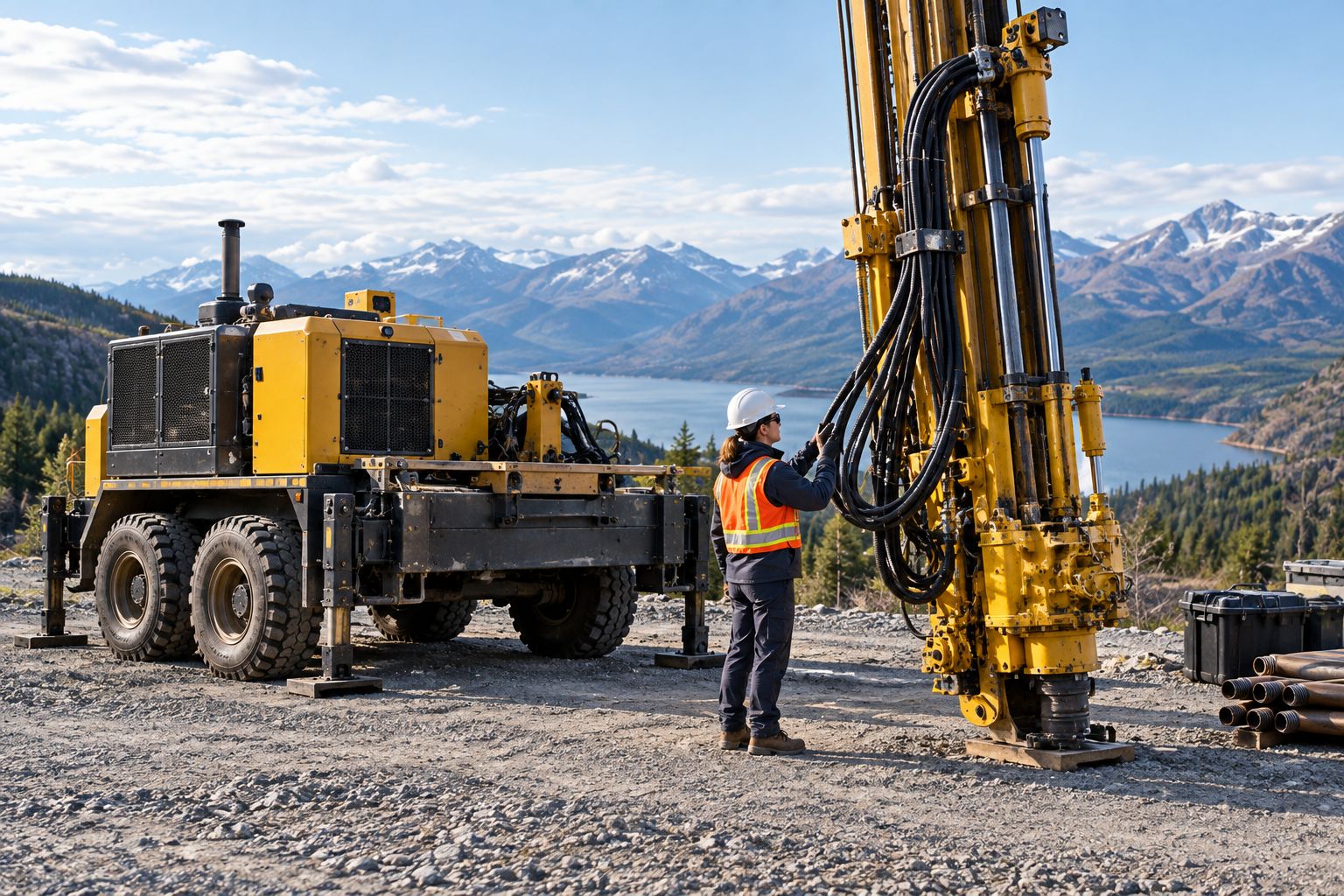
Compare complete field packages
Build a spreadsheet that lists what each offer actually includes. Separate the drilling unit, tooling, support equipment, repairs, transportation, and commissioning responsibilities rather than comparing headline descriptions alone.
A used rig with a clear service history and compatible tooling deserves a different assessment from a superficially similar machine with undocumented modifications. Conversely, a rebuild description means little until you know which components were inspected, repaired, replaced, and tested.
For your 2026 shortlist, compare evidence rather than adjectives such as ready or refurbished. Keep unresolved questions visible until the seller or inspector answers them.
- Inventory rods, casing, core barrels, pumps, and other included equipment.
- Request the scope and records for any claimed repair or rebuild work.
- Separate mandatory repairs from optional refurbishment.
- Confirm loading, transportation, and receiving-site requirements.
- Assign responsibility for commissioning and operator familiarization.
Approve the machine against written acceptance criteria
Make the purchase decision against the original program requirements, not the momentum of negotiations. Record what must be demonstrated, repaired, documented, or supplied before acceptance.
Use 2 approvals: technical acceptance by the responsible drilling or geological lead, and operational acceptance by the person responsible for mobilization and maintenance. These approvals address different questions and should remain separate even when one person holds both roles.
The sequence is simple: approve the sample requirement, verify capacity, inspect condition, and confirm field readiness. A failed requirement returns the candidate to review rather than disappearing into an informal handover.
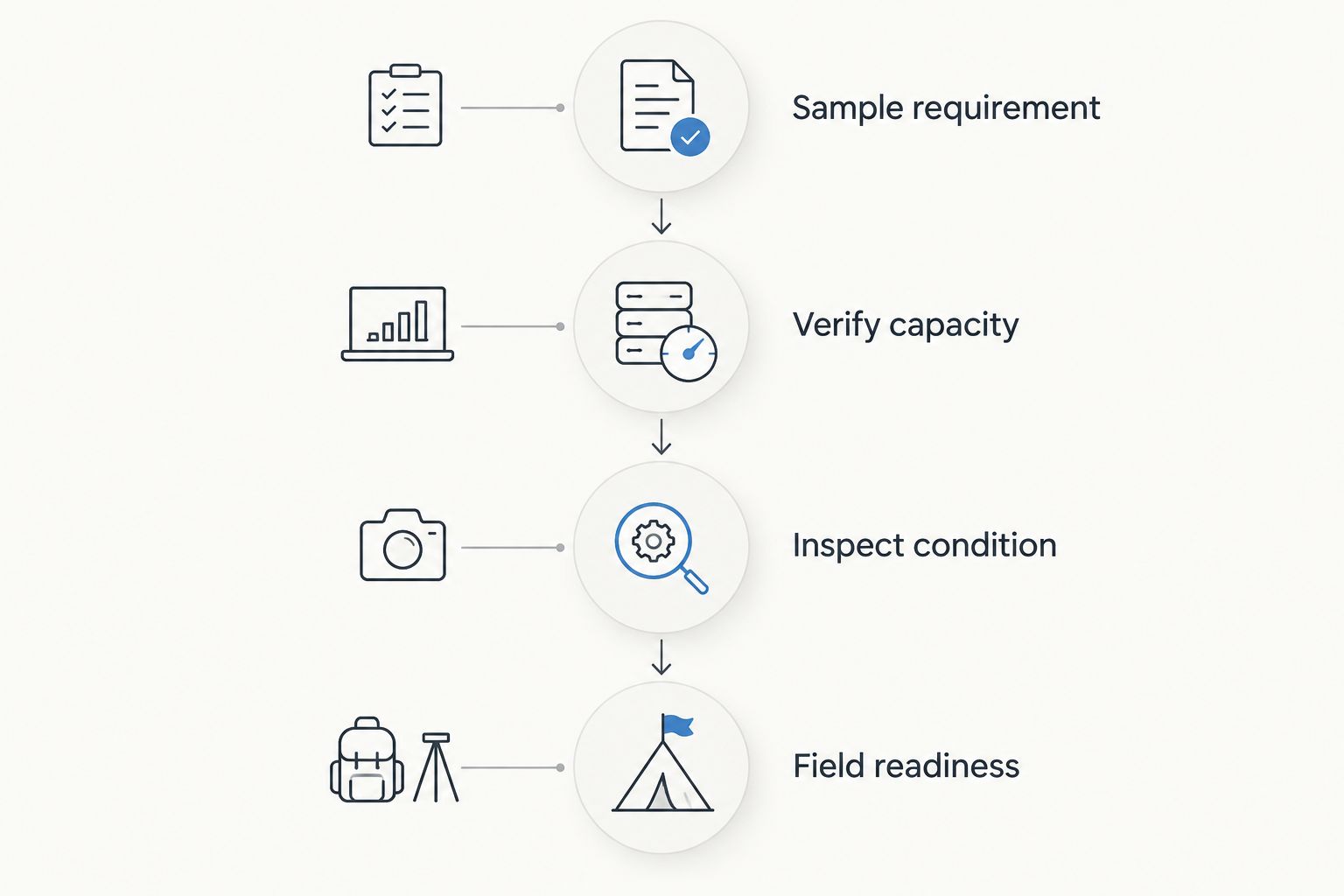
Keep the acceptance record with the equipment file. It gives the receiving team a reference for what was agreed and what remains outstanding.
- Record serial numbers and the agreed equipment configuration.
- Specify the inspection and operating-demonstration acceptance criteria.
- Document promised repairs and the evidence required to close them.
- Confirm included accessories and outstanding exclusions.
- Assign the maintenance and commissioning handover to a named person.
Compare drilling methods for your exploration program
The following comparison separates drilling methods from machine condition. Best for describes the sampling task, not a guarantee that every rig using that method fits your project.
| Option | Best for | Main advantage | Key limitation |
|---|---|---|---|
| Diamond core drilling | Programs requiring intact rock core | Produces core for geological and structural logging | Requires compatible coring equipment and appropriate recovery practices |
| Reverse circulation drilling | Programs specifying drill-cuttings samples | Returns cuttings through an inner tube | Does not provide intact core for structural logging |
| Auger drilling | Suitable shallow overburden investigations | Provides access through formations suited to augering | Is not a substitute for deep hard-rock exploration drilling |
Select the method with the geological lead before narrowing the equipment list. If the program requires both reconnaissance sampling and detailed core logging, document those as separate tasks rather than assuming one machine configuration covers both.
Compare sourcing routes for used exploration rigs
The sourcing route determines who must organize inspection, repair planning, documentation, and transport. It does not establish the condition of the machine.
| Option | Best for | Main advantage | Key limitation |
|---|---|---|---|
| Direct purchase from an equipment owner | Buyers able to manage their own technical assessment | Direct discussion of the machine’s operating history | Buyer must arrange independent verification and service support |
| Drillrigmarketplace used drill-rig sourcing | Exploration buyers seeking equipment sourcing and repair services | Marketplace, brokerage, inspection, and repair services within one business | Individual equipment suitability and service scope still require confirmation |
| Repair or rebuild of an existing rig | Owners with a suitable platform and a defined repair scope | Retains an existing machine while addressing documented defects | Repairs do not automatically change the rig’s fundamental capacity |
Drillrigmarketplace is best for exploration buyers seeking used drill rigs alongside inspection and repair services. Confirm the proposed machine’s exploration configuration and the exact support scope before treating it as a complete solution.
Common mistakes mineral exploration companies make
Choosing depth before sample requirements
A rig that reaches the target but produces the wrong sample does not meet the program. Approve the sampling method first, then verify capacity for the selected tooling and formation conditions.
Treating carrier mobility as site approval
Truck-mounted and tracked configurations solve different transport problems. Neither removes the need to assess access, ground conditions, setup space, and operating restrictions for the actual machine.
Accepting a rebuild label without records
Rebuild work can cover very different scopes. Request component-level documentation and testing records; painting and cosmetic refurbishment are not evidence of repaired hydraulics, drivetrain condition, or verified safety functions.
Forgetting the equipment around the rig
Rods, casing, sampling equipment, pumps, compressors, and handling arrangements belong in the purchase assessment. A machine-only comparison leaves the field package incomplete and obscures what your team still needs to arrange.
FAQ
What are the best drill rigs for mineral exploration companies?
The best drill rigs match the program’s sampling method, hole requirements, access conditions, and support equipment. Diamond core drilling fits intact-core requirements; reverse circulation drilling fits programs specifying cuttings samples. Verify each used machine’s configuration and condition separately.
Is diamond core drilling better than reverse circulation drilling?
Diamond core drilling is better when the program requires intact rock core for geological or structural logging. Reverse circulation drilling produces cuttings instead. Choose the required sample before comparing individual machines.
Should an exploration company choose a truck-mounted or tracked rig?
Choose the carrier that meets the documented access, transport, and setup requirements. Truck-mounted equipment needs suitable vehicle access, while tracked equipment still needs transport planning and a ground-condition assessment. Neither configuration establishes site suitability by itself.
What should I inspect before buying a used exploration drill rig?
Inspect the drilling unit, carrier, structure, hydraulics, powertrain, controls, and safety systems with qualified personnel. Review service records and agree on an operating demonstration appropriate to the intended work. Record anything the inspection cannot verify.
Can a geotechnical rig handle mineral exploration drilling?
A geotechnical rig fits an exploration task only when its verified configuration meets the required method, sample, depth, diameter, and formation conditions. The geotechnical label alone does not establish suitability. Check the installed equipment and manufacturer documentation.
Does rebuilding a drill rig increase its depth capacity?
A rebuild does not automatically increase a drill rig’s depth capacity. Repairs restore or address specific components; capacity changes require technical assessment of the full drilling system. Require documentation for any claimed change in capability.
What records should I request for a used rig purchase in 2026?
Request machine identification, configuration details, manufacturer documentation, service history, inspection findings, and records supporting claimed repairs or rebuilds. Also document included tooling, exclusions, transport responsibilities, and acceptance criteria. Keep unresolved items visible until they are closed.
One last thing
Ask for the tooling inventory before approving the rig. A machine can pass a condition inspection while the proposed package still lacks compatible rods, casing, or sampling equipment for your program.
For your 2026 purchase file, place the approved tooling list beside the drilling specification. That comparison connects what the rig can do with what your crew can actually mobilize.