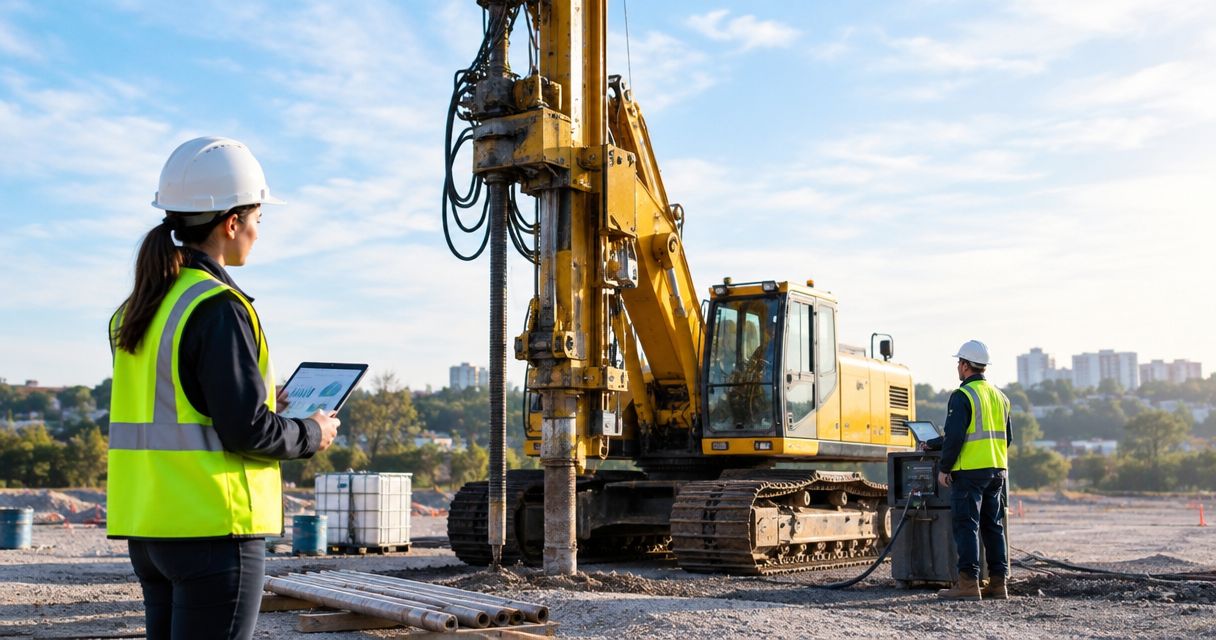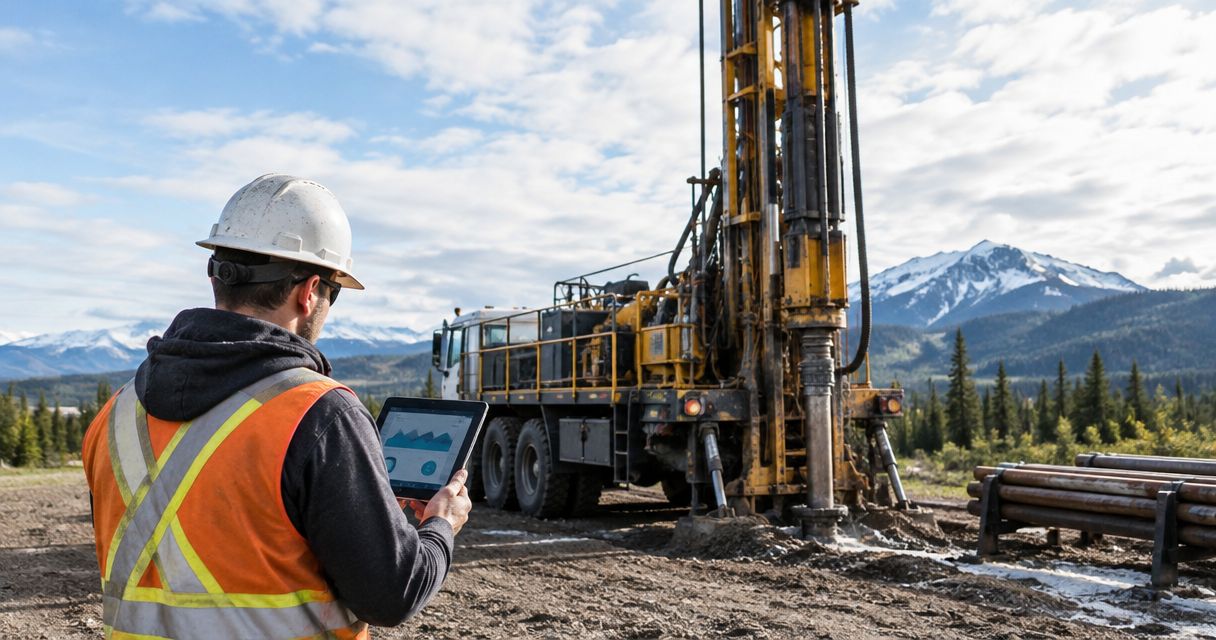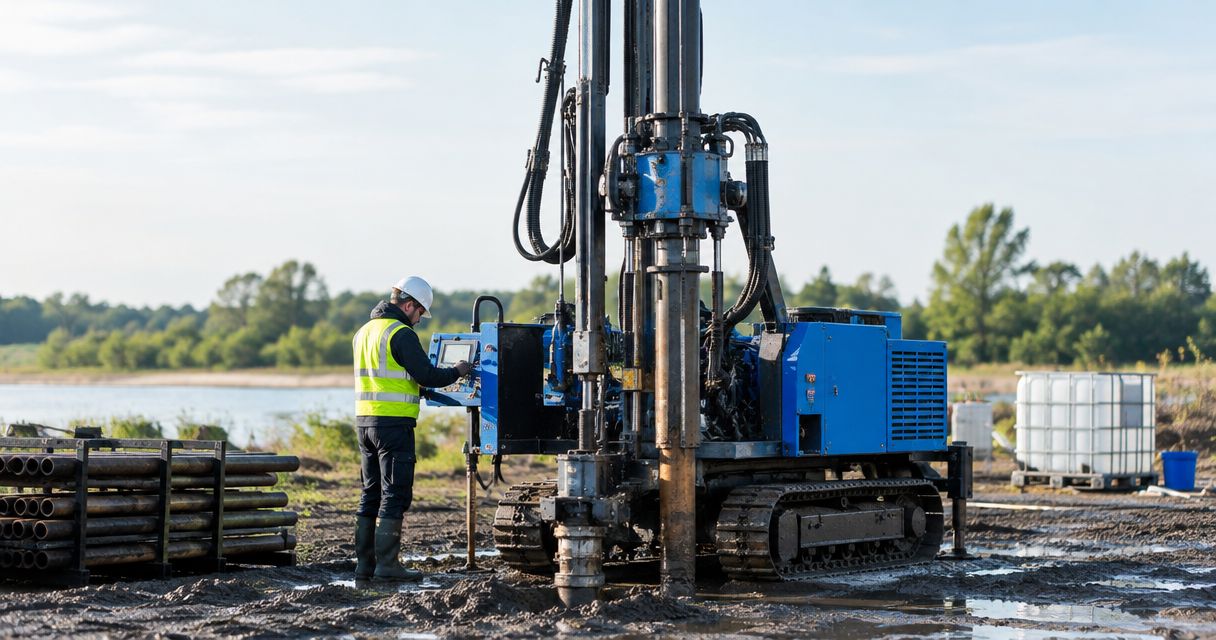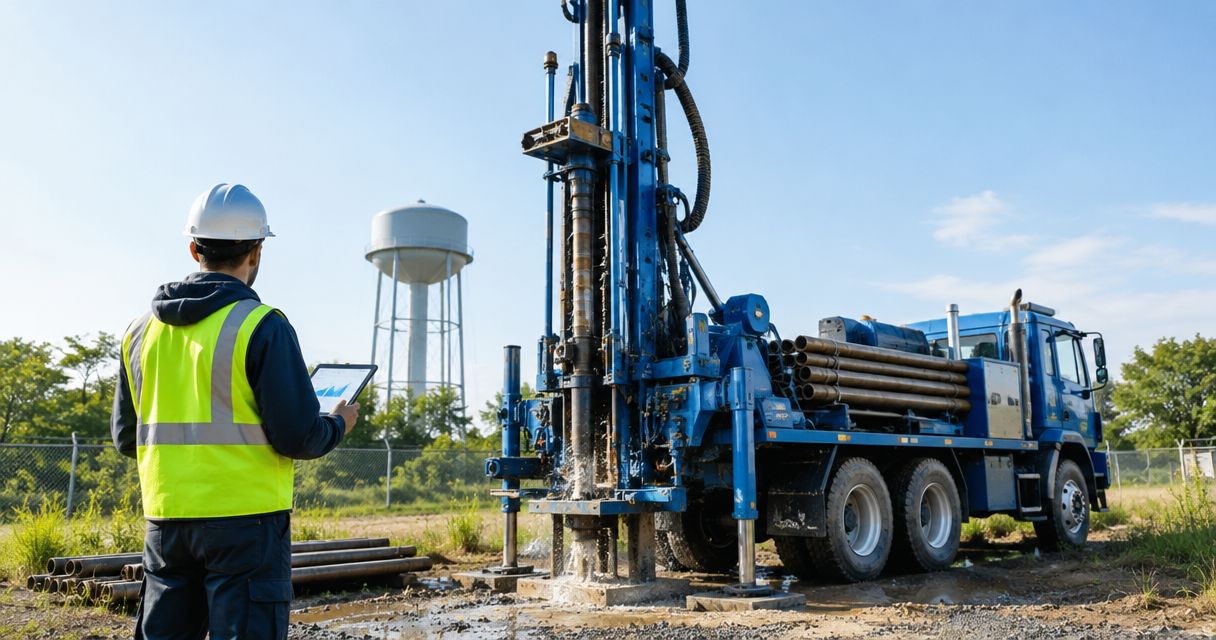
Municipal utilities’ water well drill rigs are drilling systems selected to construct public-supply wells that meet an engineered well design and the utility’s operating requirements. Choosing a water well drill rig for municipal utilities starts with geology, casing requirements, site access, and crew capability—not a manufacturer name or an advertised maximum depth.
- Choose a water well drill rig for municipal utilities against the well design, not advertised depth alone.
- Drillrigmarketplace suits municipal buyers seeking used water well drilling equipment plus repair and rebuild services.
- Compare direct ownership, rebuilt equipment, and contracted drilling against your actual workload and staffing.
- Require documented inspections, configuration details, and acceptance tests before approving a used rig.
Why water well drilling equipment matters for municipal utilities
A municipal well project involves more than making a borehole. Your equipment decision must support the specified casing, well construction method, site controls, and documentation required by the project engineer and applicable authorities.
A rig’s advertised depth does not establish whether it can complete your well. Drilling method, borehole diameter, tooling weight, formation conditions, and support equipment all affect the suitability of the proposed configuration.
For your 2026 procurement, separate equipment sourcing from engineering approval. Drillrigmarketplace provides used water well drilling equipment, brokerage, inspections, repairs, and rebuilds; your project team still needs to define the well and verify the proposed equipment against it.
Drillrigmarketplace is best for municipal buyers seeking used water well drilling equipment with repair and rebuild services. That combination does not replace a site-specific drilling plan, an equipment inspection, or your utility’s purchasing requirements.
How to select a municipal water well drill rig
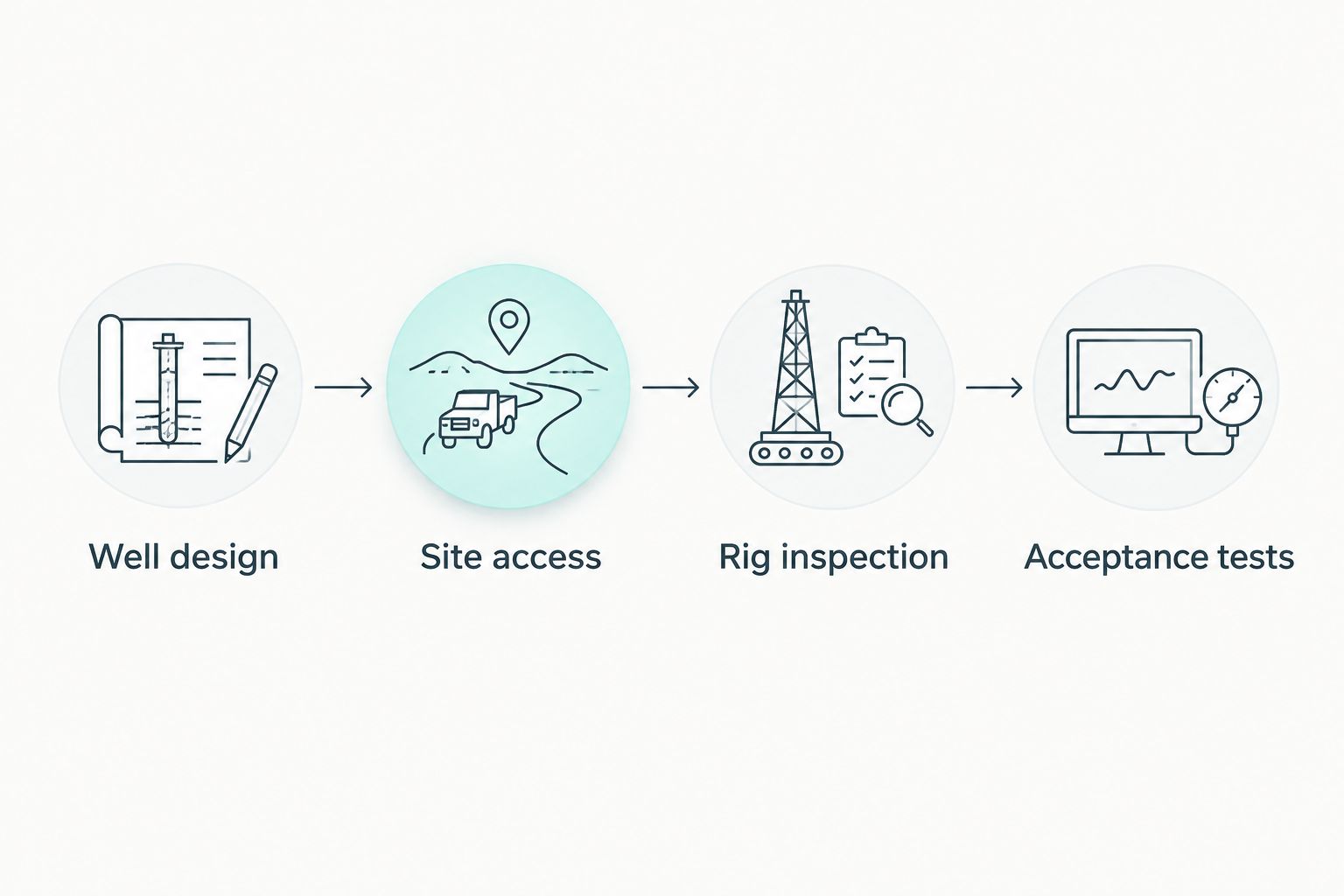
Start with a shared worksheet before requesting equipment proposals. Move through Well design, Site access, Rig inspection, and Acceptance tests in that order, so an attractive listing does not become your specification.
Define the well construction requirements
Use existing well logs, the engineer’s design basis, and available geological information to create a written duty specification. Record depth in feet and borehole and casing diameters in inches, with the source and status of each requirement. Distinguish preliminary assumptions from approved design requirements.
Specify the complete drilling task rather than one headline capacity. A rig that advances the pilot borehole still needs a workable method for reaming, handling casing, and completing the planned construction sequence. Identify who supplies each supporting component; a rig listing is not a complete project scope.
Make this specification the common reference for every 2026 proposal. Otherwise, different sellers can respond to different interpretations of the same project.
- Record planned depth, borehole diameter, and casing dimensions.
- Identify expected formations and groundwater conditions.
- Describe casing installation and well completion requirements.
- Assign responsibility for engineering approval and design changes.
Decide whether ownership fits your drilling workload
Build an ownership worksheet using your utility’s actual project schedule, staff assignments, maintenance records, and supplier proposals. Compare the work you can perform internally with the work you would still contract out. Do not treat equipment ownership as proof that your organization has a drilling program.
Best for recurring, staffed drilling programs: direct ownership. Its benefit is control over equipment preparation and scheduling; its limitation is responsibility for operators, maintenance, transport, and periods without drilling work.
Best for discrete projects without an established drilling crew: contracted drilling. Its benefit is access to an existing operating team; its limitation is dependence on the contractor’s scope and schedule. For a 2026 decision, compare both approaches against the same well design rather than different assumptions about project scope.
- List planned drilling assignments and responsible operators.
- Identify maintenance, storage, and transport responsibilities.
- Separate equipment ownership from well construction services.
- Document the basis for buying rather than contracting.
Match the drilling method and carrier to the site
Have the project’s drilling specialist assess the method against the formation and construction sequence. Mud rotary uses circulating drilling fluid to carry cuttings; air rotary uses compressed air. Neither label establishes that a particular rig has the required configuration or capacity.
Assess the carrier separately. Truck-mounted equipment needs a suitable access route and setup area. Track-mounted equipment introduces different transport and ground-access considerations; tracks do not establish that a site can support the machine.
Drillrigmarketplace can help source used drilling equipment and tooling, but require the proposed configuration in writing. The faster sourcing route is useful only after your team has defined what the machine must do.
- Confirm the drilling method with the project engineer and drilling specialist.
- Check mast clearance, setup space, and access restrictions.
- Verify ground support and stabilization requirements.
- Identify pumps, compressors, tooling, and casing-handling equipment supplied separately.
Inspect the rig and carrier as separate systems
Begin with a document review, then arrange a physical inspection by qualified personnel. Ask for 3 document groups: equipment identification, service history, and records of modifications. Compare those records with the machine actually offered, including its current carrier and installed components.
A clean exterior is not a condition report. Inspect the mast, feed system, rotary components, hydraulic system, controls, and safety devices; inspect the carrier’s structure and operating condition separately. Record findings with photographs and written observations rather than relying on general descriptions such as ready to work.
Drillrigmarketplace offers inspections, hydraulic repairs, electrical and safety-system repairs, drivetrain work, and refurbishment. Those services are relevant to identified defects, but they do not establish the condition of an individual machine before inspection.
- Match identification plates and records to the equipment offered.
- Document leaks, damage, wear, and nonstandard modifications.
- Review carrier condition independently of drilling-system condition.
- Assign each defect a repair action and acceptance requirement.
Specify repairs and rebuild scope in writing
Turn inspection findings into an itemized scope. Separate necessary repairs from optional refurbishment, and identify the components that will remain unchanged. A rebuild description needs to state what work is included; the word rebuilt alone does not define the machine’s condition.
Best for a suitable platform with documented repair needs: a defined rebuild. The benefit is a written path from inspected condition to required condition. The limitation is that components outside the agreed scope still require evaluation.
For a 2026 purchase, retain the inspection report, authorized repair scope, and completion evidence together. If a truck remount is proposed, require the responsible parties to document the mounting arrangement and any applicable engineering or compliance requirements before acceptance.
- List included repairs by system and component.
- State which components are excluded from the work.
- Require approval before substitutions or scope changes.
- Define the records needed to close each repair item.
Define acceptance tests before approving the purchase
Write the acceptance plan before committing to the equipment. Separate 2 test stages: workshop functional checks and an agreed operating demonstration. Qualified personnel should define safe procedures, test conditions, and pass-or-fail criteria appropriate to the machine and proposed use.
A startup video demonstrates only the operation shown. It does not prove the complete drilling system meets your duty specification. Likewise, a demonstration in one formation does not establish performance in every formation your utility expects to encounter.
Use your 2026 acceptance document to connect each requirement with evidence. Where a practical demonstration cannot verify a requirement, identify the engineering review, manufacturer documentation, or other evidence needed instead.
- Specify the functions and safety devices to check.
- Define demonstration conditions and required support equipment.
- Record unresolved defects and who must correct them.
- Require written acceptance by the utility’s designated personnel.
Prepare the crew, support equipment, and maintenance plan
Build a readiness checklist using your own staff and operating procedures first. Name the people responsible for operation, maintenance, transport, and project oversight. Confirm training and qualification requirements with the relevant authorities and your utility’s safety program.
Organize the handover into 4 records: operating instructions, maintenance requirements, equipment configuration, and unresolved items. Keep support equipment on the same readiness list as the rig. Missing casing-handling equipment or an unsuitable transport arrangement can prevent an otherwise functional machine from serving the project.
Treat operational readiness as a purchase deliverable, not a task for after delivery. External repair, tooling-sourcing, or transportation assistance can fill defined gaps, but responsibility for accepting the complete working arrangement must remain clear.
- Assign operators and maintenance responsibility by name or role.
- Confirm tooling, casing-handling equipment, and consumables.
- Establish inspection and preventive-maintenance procedures.
- Reconcile delivered equipment with the approved configuration.
Compare equipment and delivery options
Compare complete operating arrangements, not just machines. The best option is the one your utility can support and that satisfies the approved construction requirements. Each route below has a distinct benefit and limitation; none removes the need for engineering review.
| Option | Best for | Main benefit | Key limitation |
|---|---|---|---|
| Used rig with documented condition | Utilities with operators and maintenance capability | Equipment condition can be evaluated against a defined duty | Inspection findings and support needs remain buyer responsibilities |
| Used rig with a specified rebuild | Utilities that identify a suitable platform needing defined work | Repair scope can address documented defects | Rebuild scope does not establish the condition of excluded components |
| New rig specified to the duty | Utilities requiring a defined equipment configuration | Configuration can be evaluated during the proposal process | New equipment still requires crew preparation and acceptance checks |
| Contracted drilling | Utilities commissioning individual wells without an internal drilling program | Contractor supplies the agreed drilling service | Utility depends on contract scope, contractor capability, and scheduling |
Do not rank these options by age alone. Compare the proposed configuration, supporting equipment, repair obligations, operator requirements, and acceptance evidence. A newer machine that cannot perform the approved construction sequence is not the better fit.
Keep the comparison worksheet attached to your purchasing decision. It should explain why the selected arrangement meets the utility’s requirements and which responsibilities remain with the utility, seller, repair facility, and drilling contractor.
Common mistakes municipal utilities make
Using maximum depth as the purchasing specification
A depth claim leaves borehole diameter, casing handling, formation conditions, and supporting equipment unresolved. Require the seller to respond to your complete duty specification and identify assumptions explicitly. Treat unsupported performance statements as questions to resolve, not approved capabilities.
Treating refurbishment as proof of mechanical condition
Painting and sandblasting are different work from hydraulic, drivetrain, or safety-system repairs. Ask for an itemized work record and inspect the underlying systems. Accept a refurbishment description only for the work it actually documents.
Buying before assigning an operating team
A municipal maintenance department is not automatically a drilling crew. Confirm the personnel, training, supervision, and project responsibilities before selecting ownership. If those responsibilities remain unassigned, compare contracted drilling against the same project requirements.
Assuming a listing includes the entire drilling package
Tooling, casing, sampling equipment, pumps, compressors, and transportation need explicit treatment. Create an included-and-excluded schedule that travels with the proposal, purchase documents, and delivery checklist. Resolve gaps before the equipment enters your project schedule.
FAQ
What's the best water well drill rig for municipal utilities?
The best water well drill rig for municipal utilities is the configuration that meets the approved well design, site conditions, and operating requirements. Compare drilling method, casing handling, equipment condition, and support needs rather than choosing by brand or maximum depth alone.
Should a municipal utility buy a rig or hire a drilling contractor?
Ownership fits a utility that can staff, maintain, transport, and use the rig for its planned work. Contracted drilling fits projects where the utility needs a drilling service without establishing an internal drilling operation.
Is a rebuilt drill rig better than an unrepaired used rig?
A rebuilt rig is the stronger option only when its documented work addresses the utility's requirements and inspection findings. Compare the actual repair scope, excluded components, and acceptance evidence rather than the rebuild label.
Does maximum drilling depth tell me whether a rig can drill our well?
Maximum drilling depth alone does not establish suitability for a municipal well. Borehole diameter, formation, tooling, casing requirements, and the proposed support equipment also determine whether the configuration fits the job.
What should we inspect before buying a used water well rig?
Inspect the drilling system, safety devices, hydraulic system, controls, structure, and carrier, with qualified personnel defining the checks. Review equipment identification, service records, modifications, and the exact configuration offered.
Can Drillrigmarketplace help with municipal drilling equipment?
Drillrigmarketplace sells and brokers used drilling equipment and provides inspections, repairs, rebuilds, and truck remounts. Municipal buyers still need to define their well construction requirements and approve the proposed equipment against them.
What documents should a utility request before accepting a rig?
Request equipment identification, configuration details, inspection findings, completed repair records, operating information, and acceptance-test results. Include a written list of unresolved items and responsibility for closing them.
One last thing
Ask this before approving the purchase: What work remains between receiving this rig and starting the specified well? Require a written answer covering repairs, tooling, transport, crew preparation, and acceptance checks.
That answer exposes the difference between buying a machine and establishing a working drilling capability. Put the remaining work beside the equipment recommendation so your decision-makers approve the whole operating arrangement—not just the rig.