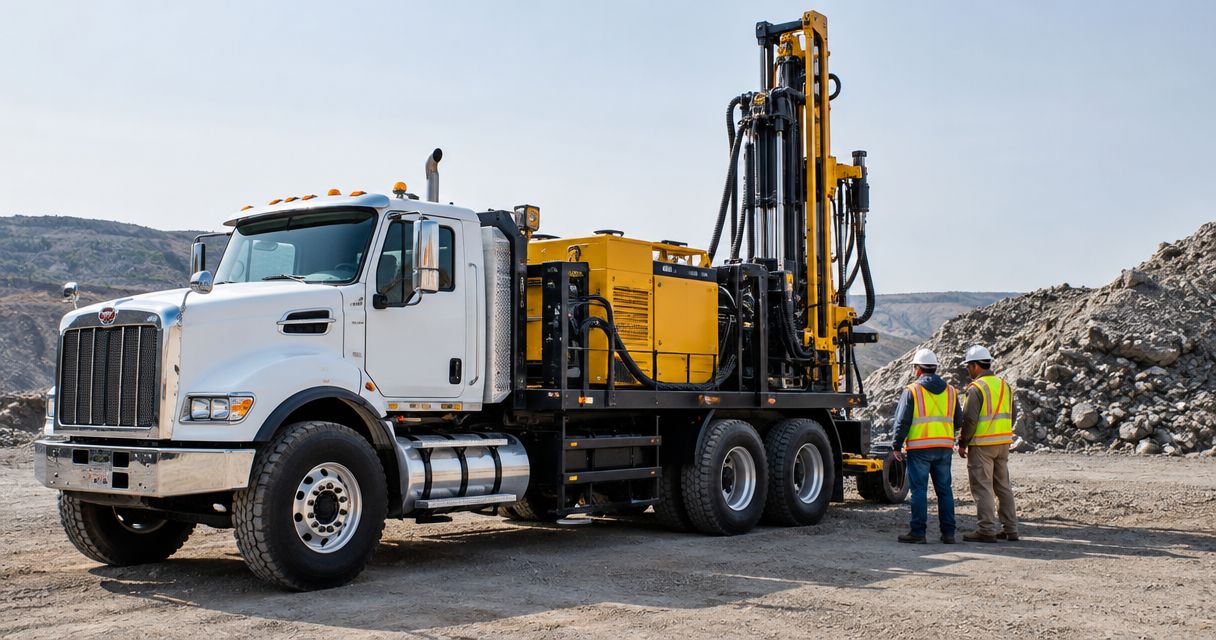
Instead of repeatedly repairing a worn carrier truck, plan a truck remount for drill rig equipment around chassis compatibility, engineered mounting, power connections, and documented commissioning. Transfer the drilling package only after qualified specialists confirm that the replacement truck can carry and operate it safely; matching bolt holes is not enough.
- A truck remount for drill rig equipment starts with chassis capacity and load distribution, not mounting-hole alignment.
- Drill Rig Marketplace provides truck remounts, drill rig repair, and rebuild services for drilling contractors.
- Approve the mounting design, hydraulic connections, and safety controls before transferring the drilling package.
- Release the completed truck only after inspection, functional testing, and loaded axle-weight verification.
Why this matters
A drill rig and its carrier operate as one machine, but they have different failure points. Replacing the truck does not correct a cracked rig frame, worn hydraulic system, or defective safety control. Likewise, rebuilding the drilling equipment does not resolve an unsuitable carrier.
Drill Rig Marketplace is best for drilling contractors seeking truck remount and drill rig repair services together. Its service offering includes inspections, fabrication, hydraulic repairs, electrical and safety-system repairs, and drivetrain repairs. You can discuss the combined scope with Drill Rig Marketplace before committing to a replacement chassis.
Use this 2026 guide as a project and acceptance checklist, not as a substitute for chassis instructions, rig documentation, or an engineered installation plan. Structural modifications, lifting, stored hydraulic energy, and rotating equipment require qualified personnel and equipment-specific procedures.
Before you start
- Collect 3 document sets: the rig identification and service records, replacement-truck specifications and body-builder instructions, and the proposed mounting and connection drawings. Include existing modifications rather than relying on the original configuration alone.
- Assign qualified responsibility: identify who approves structural work, performs the transfer, connects hydraulic and electrical systems, and authorizes commissioning. Arrange suitable workshop access, lifting equipment, and isolation procedures before dismantling begins.
- Check the hidden capacity problem: a truck can remain below its overall weight rating while exceeding an individual axle, tire, or wheel rating. Evaluate the complete working load, including tooling, fluids, storage, and accessories—not just the bare drilling package.
Set up a 2026 project file with photographs, identification plates, drawings, inspection findings, and approval records. Keep the current drawing revision with the work order so the workshop does not build from an obsolete layout.
Chassis and rig compatibility
Decide whether a remount addresses the actual problem
- Inspect the drilling package separately from the truck. Record structural condition, hydraulic faults, control defects, and signs of previous repairs. Identify work that becomes easier when the drilling package is removed.
- Define the working configuration. List the mast, subframe, stabilizers, tanks, tooling racks, compressors, winches, and other fitted equipment. Include the loads you actually transport.
- Compare the repair paths. Choose the scope from documented condition and compatibility rather than assuming every serviceable rig belongs on another truck.
| Project path | Best for | Main advantage | Main limitation |
|---|---|---|---|
| Remount the existing drilling package | A serviceable rig with an unsuitable or worn carrier | Retains the drilling package while changing the carrier | Requires verified structural, power, and load compatibility |
| Remount and rebuild together | A rig with repair needs that should be addressed during removal | Combines access-dependent repairs with the transfer | Expands the inspection, repair, and commissioning scope |
| Replace the complete rig | A drilling package and carrier that both fail the project requirements | Allows selection around the required drilling work | Requires inspection and evaluation of a different machine |
Expected result: you have a written reason for the remount and a defined repair scope. If the drilling package needs substantial work, use the rig inspection-to-rebuild workflow to organize that decision before fabrication begins.
Approve the replacement carrier
- Verify the truck identity and ratings. Record the vehicle identification number, axle ratings, overall weight rating, wheel and tire ratings, and relevant chassis specifications from authoritative documentation.
- Prepare the load layout. Have the installer evaluate where the drilling package and carried equipment place their loads. Include transport configuration and the support conditions required during drilling.
- Check physical clearance. Review cab clearance, mast travel, stabilizer movement, service access, exhaust routing, and the space required for hoses and cables.
- Approve the layout before purchasing or modifying the truck. Resolve conflicts against the chassis manufacturer's body-builder requirements and the rig's installation requirements.
Expected result: the proposed truck has a documented load and clearance assessment. A photograph of a similar installation is not an approval drawing.
Mounting design and transfer preparation
Define the mounting arrangement
- Specify the interface. Have the responsible specialist define the subframe, attachment points, fasteners, and any permitted frame modifications. Do not copy a mounting pattern without checking the replacement chassis.
- Resolve chassis movement. Confirm how the mounting arrangement accommodates the truck frame's movement without imposing unintended loads on the drilling package.
- Document the transfer sequence. Require a lift and support plan based on verified mass, center of gravity, approved lifting points, and suitable equipment. Isolate energy sources before disconnection.
- Record connection identities. Photograph and label hydraulic lines, electrical circuits, grounds, and control connections before removal. Preserve identification through cleaning, painting, and reassembly.
Expected result: the workshop has approved drawings, a transfer plan, and a connection register. No structural cutting, drilling, or welding starts from verbal instructions alone.
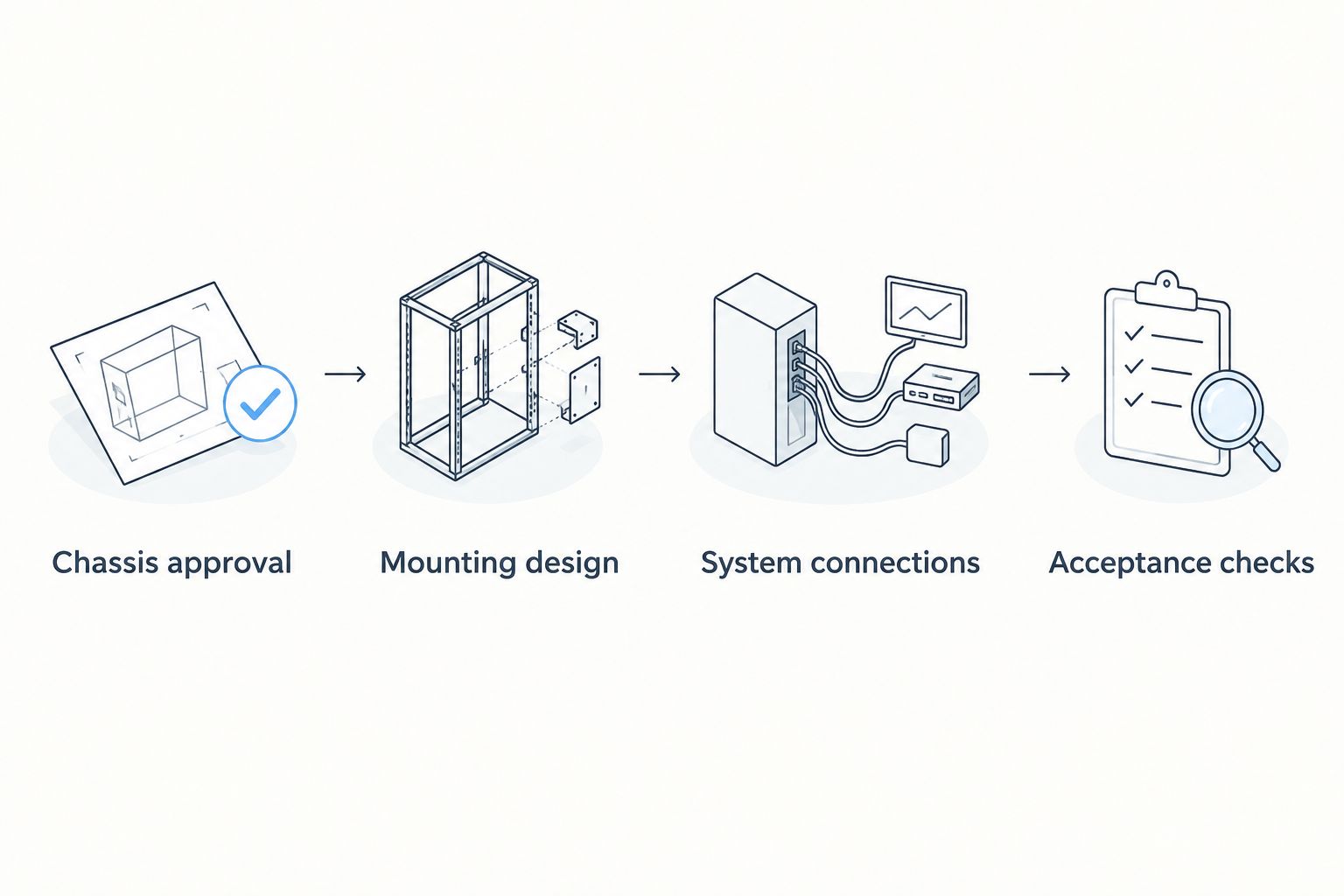
The mounting design connects several decisions: the carrier's capacity, the rig's load path, its power supply, and the final acceptance checks. Keep these decisions in sequence rather than solving each one independently after the rig is already on the truck.
Prepare the workshop handoff
The 2026 work order should separate existing defects from remount-related changes. Otherwise, a pre-existing hydraulic fault can become confused with an installation fault during commissioning.
Identify which removed components will be inspected, repaired, replaced, or retained. Record condition photographs before cleaning obscures leaks or damage, and protect disconnected hydraulic openings against contamination. Keep reusable components traceable to their inspection decisions rather than placing everything in an undifferentiated parts pile.
Expected result: the workshop can explain what changed, why it changed, and which drawing or instruction governs the work.
Power and system connections
Confirm the power arrangement
A truck remount for drill rig equipment must preserve the rig's required power characteristics. Do not assume that an available power take-off connection supplies the correct speed, direction, or operating conditions.
| Power arrangement | Best for | Benefit | Constraint to verify |
|---|---|---|---|
| Truck-driven power | A rig designed around a compatible truck power source | Uses the carrier as part of the operating system | Transmission, power take-off, driveline, and control compatibility |
| Separate rig engine | A drilling package designed with an independent engine | Separates drilling power from the truck drivetrain | Mounting loads, cooling, exhaust, fuel, wiring, and service clearance |
- Identify the existing arrangement. Record whether the drilling package uses truck-driven power or a separate engine. Trace the actual installation rather than relying on an old equipment description.
- Match component requirements. Have the installer verify drive interfaces and the pump's required operating conditions against component documentation.
- Review hydraulic connections. Confirm hose and fitting suitability, circuit routing, return arrangements, filtration, reservoir connections, and protection from heat, abrasion, and moving parts.
- Review electrical and safety circuits. Verify supply voltage, grounding, circuit protection, control functions, emergency stops, and interlocks against the approved design.
Expected result: each connection has an identified purpose and an approved specification. The fact that a fitting threads together or a connector plugs in does not establish compatibility.
Complete the pre-start inspection
Before energizing the remounted rig, inspect connections against the approved drawings. Check guarding, supports, hose restraint, cable protection, clearances, fluid condition, and the security of components disturbed during the transfer.
Do not use a first start to discover whether unidentified controls work. Resolve unidentified circuits and unverified safety functions before operation. Use the manufacturer's startup and test procedures, with controlled access to the test area.
Expected result: the commissioning lead has a signed pre-start checklist and a defined test sequence, not an informal instruction to try the controls.
Commissioning and release records
Verify the completed installation
- Inspect before motion. Confirm installation completion, required inspections, fluid levels, guarding, and the removal of temporary supports or transport restraints as directed by the applicable procedures.
- Test functions under controlled conditions. Follow the equipment-specific commissioning procedure for controls, safety devices, mast functions, stabilizers, and drilling functions. Keep personnel outside hazardous areas.
- Verify the loaded transport configuration. Obtain axle weights with the intended operating load represented. Compare the results with the applicable vehicle and component ratings.
- Close the records. File inspection results, drawing revisions, connection changes, operating instructions, and unresolved defects. Release the equipment only when the responsible parties have accepted the installation.
Expected result: the completed remount has a traceable acceptance record. Use a 2026 release sheet to distinguish completion dates from the dates on older rig and chassis documentation.
Plan your drill rig remount
Discuss truck remounts, inspections, fabrication, and related drill rig repairs.
When the replacement truck changes the power source
Changing from truck-driven power to a separate engine—or the reverse—is a different integration scope, not just another connection step. The revised arrangement needs its own compatibility review before the mounting layout is finalized.
Start with the drilling package's documented operating requirements. Then evaluate the proposed drive system, cooling, fuel arrangement, exhaust, controls, guarding, and maintenance access as a connected design.
Best for: projects where the existing power arrangement cannot be retained on a suitable replacement carrier. The benefit is freedom to redesign the power arrangement; the drawback is additional engineering and commissioning work.
Keep the power-source change as a separate approval item in your 2026 project file. A carrier approval does not automatically approve a different engine, pump drive, or control arrangement.
Troubleshooting
The truck meets its overall rating but an axle is overloaded
Stop release and review the loaded weight distribution. Reposition equipment only through an approved layout change, then recheck the complete configuration; do not assume empty storage compartments represent working conditions.
Hydraulic functions behave differently after the remount
Stop operation and have a qualified technician compare the installation with the hydraulic schematic and component requirements. Check connection identity, drive conditions, fluid level, contamination controls, and circuit specifications before adjusting settings.
Hoses or cables become tight during movement
Stop the affected function and inspect routing through the manufacturer's prescribed movement checks. Correct the routing, support, or protection before further operation; extra slack alone does not resolve every clearance problem.
Controls work but a safety function fails
Do not release the rig. Trace the affected circuit against the approved schematic and verify the complete safety function after repair, rather than bypassing the device to continue testing.
New movement or cracking appears around the mounts
Remove the equipment from service and have the mounting arrangement inspected. Repeatedly tightening fasteners or welding over a crack does not resolve an unidentified load-path problem.
Customize your workflow
Add inspection hold points where your project has the greatest uncertainty: an undocumented previous repair, a different power source, or extensive frame and subframe work. Require approval before the next stage conceals the work.
Drill Rig Marketplace provides truck remount, fabrication, hydraulic, electrical, and drivetrain services. Define which of those services your project needs, and require the work order to distinguish required repairs from optional refurbishment.
Maintain 4 acceptance records: chassis approval, mounting approval, system test results, and release documentation. That structure keeps the remount review focused without treating a workshop invoice as proof of technical acceptance.
FAQ
Can I put my existing drill rig on a different truck?
Yes, if a qualified assessment confirms that the truck, mounting arrangement, power system, and controls are compatible. Similar dimensions or matching mounting holes do not establish suitability.
What's the first step in a truck remount for drill rig equipment?
Inspect the drilling package and assess the proposed carrier before starting the transfer. Define the complete working load and identify repairs that belong in the remount scope.
Can I reuse the old subframe?
Reuse requires inspection and approval for the replacement chassis and drilling package. Previous service on another truck does not establish compatibility with a different frame.
Does the replacement truck need the same power take-off?
The replacement power arrangement must satisfy the drilling package's documented requirements. Verify the transmission interface, drive characteristics, controls, and connected components rather than matching a name alone.
Should I rebuild the rig while it is off the truck?
Include rebuild work when inspection identifies defects that should be corrected during removal. Do not add a full rebuild solely because the rig is being remounted.
What should I check before driving the remounted rig?
Verify the loaded transport configuration, axle weights, clearances, securement, and applicable vehicle requirements. Keep transport acceptance separate from drilling-function commissioning.
Does Drill Rig Marketplace perform truck remounts?
Yes. Drill Rig Marketplace provides truck remounts alongside inspections, fabrication, drill rig repairs, and rebuild services at its Beaver, West Virginia facility.
One last thing
The load you add after the workshop matters. Tooling, casing, water, spare parts, and accessories belong in the carrier assessment, even when they are stored separately during the remount.
Before signing acceptance, compare the assessed load list with what your crew intends to carry. An accurate layout with an incomplete load list is still an incomplete truck-remount plan.