
Instead of manually chasing seller paperwork, hauling details, and site access separately, organize drill rig purchase to delivery logistics around documented release gates so each handoff has an owner and acceptance criteria. This 2026 workflow connects purchase approval, equipment preparation, transportation, and job-site receipt without treating delivery as permission to start drilling.
- Drillrigmarketplace suits used drill rig buyers who also need repair and transportation sourcing support.
- Drill rig purchase to delivery logistics starts with verified equipment identity, condition, dimensions, and a written handoff plan.
- Release equipment only after purchase conditions, carrier requirements, and receiving-site access are confirmed.
- Keep delivery acceptance separate from operational readiness; arrival does not establish that a rig is ready to drill.
Why this matters
A purchase agreement, a transport booking, and a drilling schedule describe different commitments. Connecting them prevents a rig from reaching a locked gate, arriving without essential tooling, or leaving before agreed repairs are complete.
Drillrigmarketplace is best for used drill rig buyers who also need repair and transportation sourcing support. Its services include used equipment sales and brokerage, inspections, repairs, rebuilds, and help sourcing transportation. Those services support the handoffs below; the written transaction terms still determine each party’s responsibilities.
Use this guide for your 2026 purchase file. Assign one buyer-side coordinator who maintains the current equipment record and records approvals from the seller, carrier, repair facility, and receiving crew.
Before you start
- People and access: Identify the authorized buyer, seller representative, carrier dispatcher, and receiving-site contact. Arrange permission for inspection, loading, unloading, and any repair-facility stop before booking movement.
- Equipment and documents: Gather the purchase agreement, equipment identification, inspection findings, photographs, tooling list, ownership documents applicable to the transaction, and the manufacturer’s transport and operating instructions.
- The hidden gotcha: Measure the rig in its actual shipping configuration, not its working configuration or listing photograph. Detached tooling, mounted accessories, transport supports, and the selected trailer all affect the load plan.
The bold field names below are suggested labels for your own worksheet, not controls in a marketplace account. Keep that worksheet with the purchase documents and give each participant access to the portions needed for their handoff.
Purchase and release record
- Create the equipment identity record. Enter Rig identity, Serial number, and, for a truck-mounted unit, Chassis identification where applicable. Reconcile those entries against the machine, purchase documents, and inspection photographs before approving release.
- Define what transfers with the rig. Populate Included equipment with individually identifiable tooling, augers, drill rod, casing, sampling equipment, spare parts, keys, and documents included in your agreement. Do not treat equipment visible in a listing photograph as included unless the agreement says so.
- Record unresolved condition issues. Use Open defects, Required repairs, and Acceptance evidence. Identify who approves completion and what evidence closes each item: a repair record, inspection, photographs, or an agreed functional check.
- Separate the approvals. Record Purchase authorization separately from Transport release. Specify the agreed conditions for each, including required documents and any repair completion that must precede collection.
- Assign the next handoff. Enter Release authority, Loading contact, and Pickup location. Require the release authority to confirm readiness before the carrier is dispatched to collect the rig.
Expected result: The buyer, seller, and carrier can identify the same machine, the same included equipment, and the same release conditions. An unresolved defect has a named decision-maker rather than an informal promise.
For a 2026 purchase, record the date and author of every release approval. Keep superseded versions for reference, but clearly mark which record controls the current shipment.
Shipping configuration and carrier brief
- Document the transport configuration. Follow manufacturer instructions for stowing the mast and securing movable components. Have qualified personnel identify required disassembly, transport locks, loose accessories, and loading restrictions; do not improvise rigging or tie-down points.
- Verify the load information. Record Shipping length, Shipping width, Shipping height, and Shipping weight. These are 3 dimensions plus weight, not measurements copied unquestioned from a sales listing. Identify the source of each value and resolve discrepancies before carrier selection.
- Describe loading and unloading conditions. Complete Loading method, Unloading method, Ground conditions, and Access restrictions. State whether the rig moves under its own power and what assistance is required. The carrier and qualified loading personnel must agree on a suitable method.
- Obtain the carrier’s transport plan. Ask the carrier to confirm trailer suitability, loaded dimensions, securement arrangements, route review, and applicable permit or escort requirements. Those requirements depend on the actual load and jurisdictions; there is no single nationwide answer for every rig.
- Confirm coverage and custody terms. Review the applicable transport agreement and insurance documentation. Clarify the covered equipment, relevant exclusions, claims contacts, and when responsibility transfers. Do not assume the rig and separately shipped tooling share identical arrangements.
Expected result: The carrier has an equipment-specific brief and has confirmed the proposed movement against the actual load. Unknown dimensions or unloading arrangements remain stop conditions, not items to resolve after departure.
Choose the delivery path
Choose between direct delivery and a repair-facility stop before finalizing the carrier brief. Both are workflows, not guarantees about equipment condition.
| Delivery path | Best for | Advantage | Limitation | Release condition |
|---|---|---|---|---|
| Direct to job site | Buyers with completed acceptance checks and a prepared receiving site | Avoids an intermediate facility handoff | Leaves no planned repair stage before site receipt | Documented transport readiness and site access |
| Repair facility first | Buyers with identified repair or inspection work | Places agreed work before final site delivery | Adds another custody transfer and transport leg | Written work acceptance before onward movement |
Choose direct delivery only when the receiving site and equipment condition support it. Choose a repair-facility stop when unresolved work belongs ahead of mobilization, not after it.
Dispatch and receiving-site plan
- Prepare the destination brief. Enter Delivery address, Gate location, Site contact, and Receiving window. Include instructions for the actual entrance, not only a mailing address. Confirm access permissions and any site induction requirements with the receiving organization.
- Check the approach and unloading area. Have the site representative assess turning space, overhead obstructions, ground support, slopes, and separation from ongoing work. Refer uncertain ground capacity or access constraints to qualified site personnel before approving the location.
- Reconcile the shipment manifest. Match Included equipment to the rig, loose tooling, and any separate packages. Record identifiers and photographs so the receiving crew can distinguish a missing item from an item traveling separately.
- Authorize dispatch. Confirm Transport release, carrier acceptance, site readiness, and the receiving contact’s acknowledgment. If any required approval changes, pause dispatch and resolve the change with the responsible parties.
- Set the exception route. Record Delay contact, Access failure contact, and Damage contact. Agree who can authorize a revised destination or holding arrangement. The driver should not have to choose a substitute unloading location without authorization.
Expected result: Dispatch has a confirmed destination, receiving contact, manifest, and exception process. The receiving crew knows what is arriving and what must be ready before the truck reaches the site.
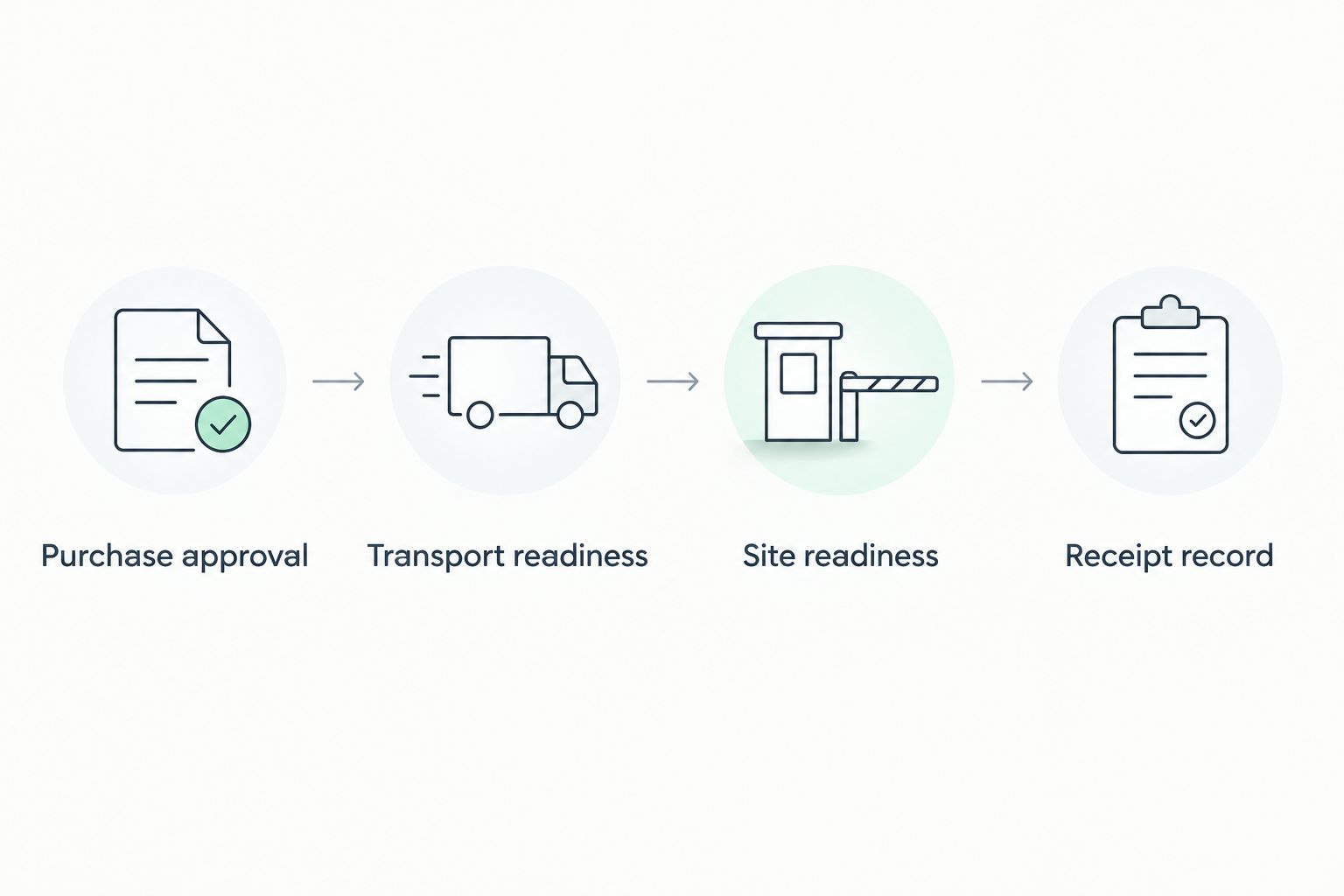
Use these 4 release gates in your 2026 shipment record: Purchase approval, Transport readiness, Site readiness, and Receipt record. The final gate documents arrival; it does not replace equipment commissioning.
Delivery receipt and operational handover
- Verify identity before acceptance. Match the rig and applicable chassis identification against the shipment record. Check the manifest for tooling, accessories, documents, and separately identified packages.
- Document arrival condition. Photograph accessible surfaces and record visible damage, missing items, leaks, or disturbed transport components before the condition changes. Stay outside the unloading exclusion area and follow the site’s safety procedures.
- Record exceptions on the delivery paperwork. Describe observable discrepancies accurately and notify the designated contacts under the transport agreement. Follow applicable reporting requirements; do not substitute an informal message for a required written notice.
- Complete the custody record. Obtain the required acknowledgments from the delivering and receiving parties. Keep 2 sign-offs where your agreed process requires both parties’ acknowledgment, with each person’s name, role, and date clearly recorded.
- Authorize operational handover separately. Have qualified personnel complete required inspections, reassembly, safety checks, and manufacturer-directed preparation before operation. Keep Delivery accepted distinct from Released for operation in your worksheet.
Expected result: Your file establishes what arrived, its observed condition, any exceptions, and who accepted custody. The operating crew receives a separate readiness decision rather than an assumption based on arrival.
Drillrigmarketplace provides inspections, hydraulic repairs, electrical and safety-system repairs, drivetrain repairs, and preventive maintenance. Confirm the scope required for your particular rig; a service description is not evidence that those tasks have already been completed on the machine you purchased.
Route the rig through repairs before delivery
Use the repair-first variant whenever inspection findings require work before the rig reaches its operating destination. Start with the inspection-to-rebuild workflow to define the work and acceptance evidence.
- Change the first destination: Replace the job-site address with the approved facility’s receiving instructions and contact.
- Open a work record: List authorized repairs, excluded work, approval responsibilities, and required completion evidence. Keep additional findings subject to written authorization.
- Repeat the transport check: Repairs, remounts, or changes to carried tooling require a fresh review of the onward shipping configuration.
- Release the onward leg: Confirm completed work, the updated manifest, carrier arrangements, and job-site readiness before the rig leaves the facility.
Drillrigmarketplace operates a repair and rebuild facility in Beaver, West Virginia. Confirm the facility handoff and work scope directly rather than assuming a purchase includes a repair stop.
For cross-border movement in your 2026 plan, add a customs-document review with the carrier and an appropriate customs professional before dispatch. Confirm transaction-specific requirements instead of treating a domestic paperwork packet as sufficient.
Troubleshooting
The carrier receives conflicting measurements
Stop dispatch and verify the shipping configuration. Identify whether the conflicting figures describe the rig alone, detached equipment, or the loaded transport combination. Give the carrier the corrected record and obtain renewed confirmation of suitability.
The rig arrives without expected tooling
Compare the purchase agreement, manifest, pickup photographs, and delivery record. Determine whether the item was excluded, omitted, or shipped separately, then document the discrepancy with the responsible party.
The receiving site cannot unload safely
Do not improvise unloading on unsuitable ground or outside the approved area. Contact the designated site and dispatch representatives, obtain an authorized alternative, and confirm safe access before proceeding.
A repair remains open near pickup
Keep the repair item open until the agreed acceptance evidence exists. If the buyer accepts a revised scope, document that decision and its effect on transport and operational readiness before release.
Arrival damage is discovered
Preserve photographs and shipment documents, record the observable condition, and follow the transport agreement’s notification process. Separate delivery-condition evidence from later repair findings so the record remains clear.
Customize your workflow
Keep a reusable 2026 template, but change its acceptance criteria for each purchase. A truck-mounted rig, a track-mounted rig, and a shipment with detached tooling do not share an identical loading plan.
Add fields for the drilling method, required tooling, planned first assignment, and maintenance responsibilities. These fields connect the delivered equipment to the work you intend to perform without turning the shipment record into an operating manual.
Do not close the purchase file at unloading. Close the logistics record after reconciling documents and exceptions, then transfer unresolved maintenance and readiness items to the person responsible for operation.
FAQ
What does drill rig purchase to delivery logistics include?
Drill rig purchase to delivery logistics includes purchase release, equipment preparation, transport planning, site access, delivery documentation, and operational handover. Assign an owner and acceptance criteria to each handoff.
Should I send a used drill rig directly to the job site?
Send a used drill rig directly to the job site only after condition checks, transport readiness, and receiving-site readiness are confirmed. Route the rig through a repair facility first when identified work belongs ahead of mobilization.
What measurements does a carrier need to move a drill rig?
A carrier needs verified shipping dimensions, weight, and configuration details to assess the movement. The carrier must also evaluate the loaded transport combination, route, loading method, and applicable permit requirements.
Who arranges unloading at the drilling site?
The purchase and transport agreements should identify who arranges unloading. Confirm the unloading method, responsible personnel, equipment, and site conditions before dispatch.
Can Drillrigmarketplace help with transportation and repairs?
Drillrigmarketplace helps customers source transportation and provides drill rig repair, inspection, and rebuild services. Confirm the agreed scope, handoffs, and responsibilities for your transaction.
Is a delivered drill rig ready to start drilling?
Delivery does not establish operational readiness. Qualified personnel must complete the required inspections, preparation, and safety checks before releasing the rig for operation.
What changes when a drill rig crosses the United States–Canada border?
A cross-border shipment adds customs and import-document requirements specific to the transaction. Review the movement with the carrier and an appropriate customs professional before dispatch.
One last thing
A clean delivery receipt and an operational release answer different questions. The first records custody and observed arrival condition; the second authorizes use after the required checks. Keep both decisions visible, even when the same person signs them.