Instead of repeatedly sending lenders incomplete rig details, connect equipment financing for used drill rig purchase to a single transaction file that tracks the machine, inspection, financing conditions, and seller documents. For a 2026 purchase, establish approval checkpoints before committing to payment or arranging transport.
- Equipment financing for used drill rig purchase starts with an identified machine and a documented purchase scope.
- Drillrigmarketplace helps drilling contractors coordinate used drill rig purchases, financing sourcing, inspections, and repairs.
- Separate borrower approval from equipment acceptance and authorization to release funds.
- Reconfirm lender acceptance whenever the selected rig, seller, or repair scope changes.
Why this matters
A financing approval is not a mechanical inspection or permission to collect the rig. Your lender, seller, inspector, and transporter have different responsibilities. Connect their requirements before treating the transaction as ready to close.
Drillrigmarketplace is best for drilling contractors seeking used drill rig purchase support alongside financing sourcing and repair services. Start with Drillrigmarketplace to discuss the equipment and support you need; lender acceptance and written financing terms still require separate confirmation.
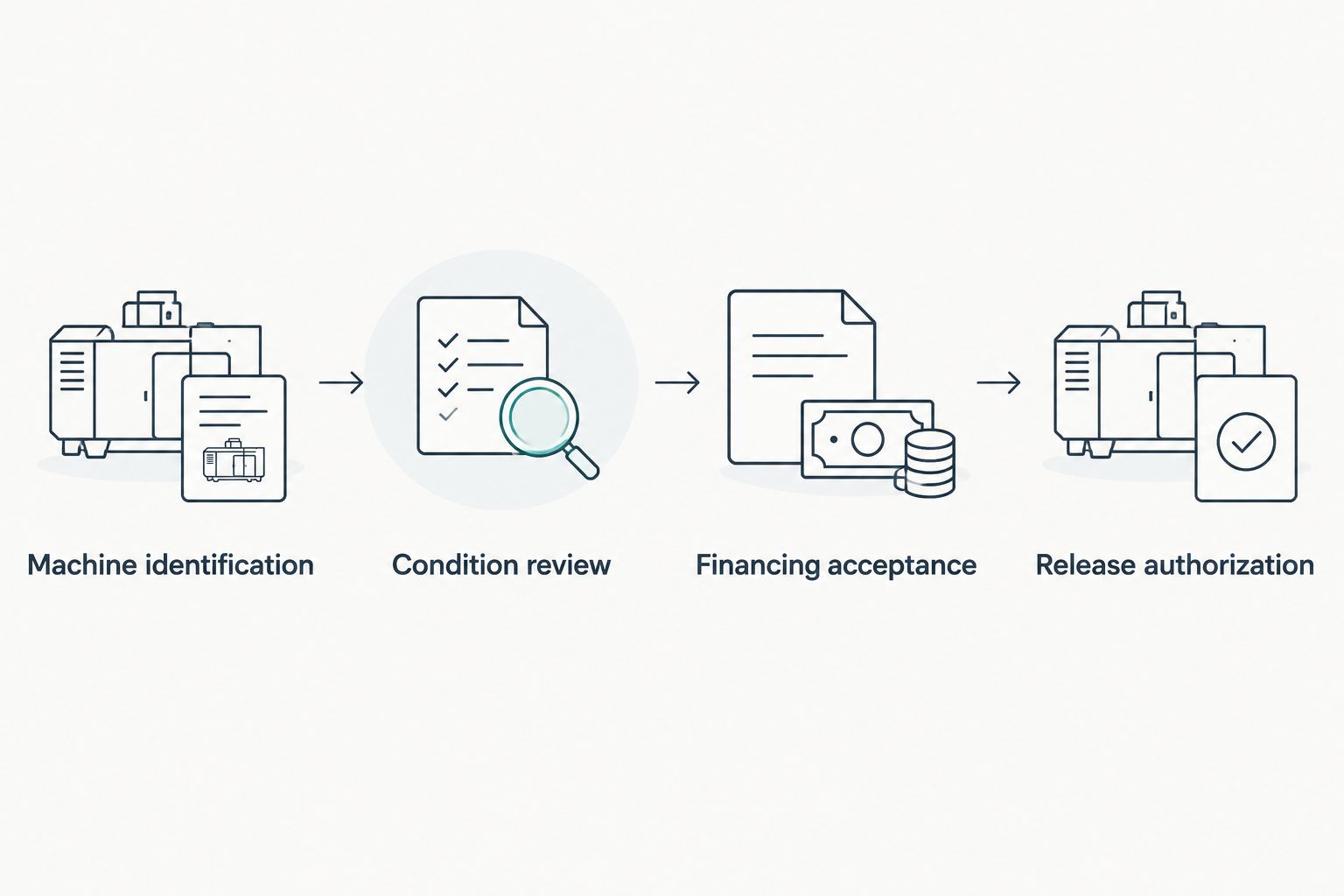
For a 2026 acquisition, organize the purchase around 4 checkpoints: machine identification, condition review, financing acceptance, and release authorization. This keeps a positive lending conversation from becoming an unsupported commitment to a particular rig.
The workflow below uses a shared checklist rather than a specific lender portal. Enter information under your lender's actual application labels; the bold labels here are suggested transaction-file headings, not software buttons.
Before you start
- Business records and decision authority: Identify the borrowing entity and authorized signer. Obtain the lender's document checklist before collecting financial records, and use the lender's approved secure submission method.
- An identifiable rig and seller: Gather the listing information, seller's legal name, equipment identifiers, photographs, condition records, and a written description of what the purchase includes. Confirm who can authorize an inspection and sign the sale documents.
- The non-obvious gotcha: A truck-mounted drill rig can involve both rig identification and carrier identification. Ask the lender which identifiers, ownership records, and title documents it requires before submitting the equipment package.
Do not assume that financing the rig automatically includes tooling, repairs, transport, or other transaction expenses. Ask the lender to mark each component as included, excluded, or awaiting review.
Equipment file
Identify the machine and purchase scope
- Create a purchase record. Use one shared file with an owner responsible for updating it. Record the borrowing entity, seller, equipment description, and current transaction status.
- Record equipment identity. Capture the rig manufacturer, model, serial number, and carrier details where applicable. Copy identifiers from readable equipment plates and documents rather than relying only on listing text.
- Define included equipment. List tooling, augers, drill rod, casing, sampling equipment, and other accessories separately. Distinguish items included in the proposed sale from items you still need to source.
- Separate supporting work. Create distinct entries for inspection, repairs, transportation, and any other requested work. Ask which items belong in the lender's review package.
- Reconcile the documents. Compare the equipment description across the seller's paperwork, inspection request, and finance application. Resolve discrepancies before submission.
Use Included equipment, Excluded equipment, and Pending confirmation as checklist labels. A photograph of accessories beside a machine does not establish that those accessories are part of the sale.
Expected result: Your seller and lender can identify the same asset and distinguish the rig purchase from related work. Nothing material remains buried in a message thread.
Establish a controlled document handoff
Choose one transaction contact for each party and record who owns the next action. Keep sensitive borrower documents out of broadly shared equipment folders; the seller needs transaction information, not unrestricted access to financial records.
For your 2026 purchase file, date each revision and retain the prior version. When equipment details change, send a clear replacement document rather than asking everyone to interpret scattered corrections.
Condition review
Connect the inspection to financing acceptance
- Confirm job suitability. Describe the drilling methods, site access, sampling requirements, and tooling the rig must support. A financeable machine still needs to fit your work.
- Arrange an inspection. Agree on access, the inspection scope, and who will receive the findings. Use qualified personnel for mechanical and operational checks.
- Document exceptions. Record identified defects, missing records, unresolved ownership questions, and work required before use. Distinguish observed findings from seller statements.
- Define the repair scope. Ask for written descriptions of proposed work and identify whether it happens before or after closing. Do not treat a general refurbishment description as a completed inspection report.
- Submit condition information. Ask the lender whether the findings change its equipment acceptance or documentation requirements. Obtain confirmation before moving to the funding stage.
Drillrigmarketplace provides drill rig inspections, repair, rebuilds, and refurbishment. That connects used drill rig purchase support with mechanical services, but it does not replace the lender's underwriting or your responsibility to approve the machine's suitability.
Use the inspection-to-rebuild workflow when condition findings require a defined repair decision before the purchase proceeds.
Expected result: You have a written condition record, an agreed treatment of required work, and confirmation of any lender requirements arising from the inspection.
The transaction should progress through these checkpoints in order. A change in equipment identity or condition sends the relevant documents back for review rather than straight to closing.
Financing package
Submit a complete, consistent application
- Request the lender's checklist. Obtain its current borrower, equipment, seller, and transaction requirements. For a 2026 application, use current forms supplied directly by that lender.
- Submit borrower information securely. Provide the requested business and financial records through the lender's designated channel. Keep a submission log without copying sensitive information into general project notes.
- Attach the equipment package. Include the agreed machine description, seller documents, photographs, and condition information the lender requests. Identify unresolved items explicitly.
- Separate approval statuses. Track Borrower review, Equipment review, and Closing conditions independently. Ask the lender to confirm what each status means for your transaction.
- Review the written agreement. Examine repayment obligations, security requirements, insurance conditions, guarantees, early repayment provisions, and default terms. Get professional advice on provisions you do not understand before signing.
Expected result: You know what has been accepted, what remains conditional, and which documents or actions are still required. An encouraging conversation is no longer confused with an executable closing package.
Choose the sequence that matches your purchase
Two adjacent workflows are useful: identifying a rig before submitting the full package, or discussing borrower requirements before selecting the final machine. Neither sequence removes equipment review.
| Workflow | Best for | Advantage | Limitation | Required checkpoint |
|---|---|---|---|---|
| Rig-first review | Buyers evaluating a specific machine | Equipment documents and condition findings enter the discussion early | Borrower acceptance remains unresolved until the lender reviews the application | Confirm both borrower and equipment acceptance |
| Borrower-first review | Buyers defining a search before choosing a rig | Clarifies lender requirements before equipment selection | Initial feedback does not establish acceptance of a particular rig | Submit the selected machine for review |
Choose the sequence that removes your largest unresolved question first. If suitability is uncertain, identify and inspect the machine. If borrowing requirements are uncertain, speak with the lender before committing to a particular purchase.
Closing handoff
Match funding authorization to equipment release
- Reconcile final documents. Compare the final equipment description with the accepted application package. Confirm the seller, borrowing entity, identifiers, included equipment, and treatment of outstanding work.
- Clear written conditions. Ask the lender which signatures, insurance evidence, ownership documents, or other items remain outstanding. Obtain confirmation through the lender's established process.
- Verify payment instructions independently. Confirm instructions using a trusted contact method already established with the relevant party. Do not rely solely on an email announcing changed payment details.
- Agree on release authorization. Establish who confirms the required payment status and who authorizes collection. Put that handoff in writing with the seller and lender.
- Schedule transport and receipt. Confirm collection access, loading responsibilities, carrier requirements, and receiving arrangements. At receipt, compare equipment identifiers and included items against the final documents.
Expected result: The lender, seller, and transporter agree on the conditions for release. Your receiving team knows exactly which rig and accessories to expect.
For a 2026 closing, retain a dated final document set separate from working drafts. Keep the executed agreement, sale documents, inspection record, repair scope, and transport paperwork together with appropriate access controls.
When the selected drill rig changes
A borrower-first search often continues after the initial lender discussion. Treat a replacement rig as a revised equipment submission, not an interchangeable substitute.
- Mark the original machine as superseded in your transaction file.
- Replace its identifiers, seller details, photographs, condition information, and purchase scope.
- Ask the lender to confirm acceptance of the replacement equipment and any revised conditions.
- Reconcile seller documents and transport arrangements only after the revised package is accepted.
Use the same revision process when an inspection changes the repair scope or the seller removes accessories from the sale. A change to the machine or purchase scope requires a fresh document check.
The benefit is traceability: every party works from the current transaction. The limitation is additional coordination, especially when revised documents arrive from different contacts.
Troubleshooting
The lender accepts the borrower but requests more rig details
Ask for the exact outstanding equipment requirements. Submit the missing identifiers, photographs, condition records, or seller documents together, and keep equipment acceptance marked as pending until the lender confirms otherwise.
The rig description differs between documents
Stop the closing handoff and reconcile the discrepancy against equipment plates and ownership records. Ask the responsible parties to correct their documents; do not patch the problem by changing only your internal checklist.
Inspection findings change the planned purchase
Separate necessary repairs from optional improvements and update the written purchase scope. Ask the seller and lender to confirm how the revised transaction will proceed before authorizing work or collection.
Tooling or transport is absent from the financing package
Check the lender's written treatment of each item. If an item is excluded, arrange for that obligation separately rather than assuming the rig financing covers it.
Collection is scheduled before release is authorized
Pause dispatch and confirm the outstanding condition with the seller and lender. A booked truck does not establish that funds have been accepted or that the seller has authorized pickup.
Customize your workflow
Extend the transaction file into a maintenance and deployment record after closing. Transfer inspection findings, completed repairs, unresolved service items, and equipment documents to the person responsible for putting the rig into service.
Assign 3 owners explicitly: one for financing communication, one for equipment acceptance, and one for collection and receipt. A single person can hold multiple roles, but every responsibility needs a named owner.
Drillrigmarketplace can help source financing, tooling, parts, and transportation alongside used drill rig sales and brokerage. Ask which services are relevant to your transaction; coordination support is not a substitute for written lender acceptance or an agreed inspection scope.
Discuss your drill rig purchase
Discuss equipment selection, financing sourcing, inspections, repairs, and transportation needs.
FAQ
How do I arrange equipment financing for a used drill rig purchase?
Connect the lender's application requirements to a clearly identified rig, documented purchase scope, condition review, and seller paperwork. Track borrower acceptance, equipment acceptance, and closing conditions separately before arranging release.
Should I choose a used drill rig before applying for financing?
Choose the sequence that addresses your main uncertainty first. A specific rig allows equipment review to begin, while an initial lender discussion helps establish borrower and documentation requirements before final selection.
Does financing approval mean the drill rig passed inspection?
No. Financing acceptance and mechanical inspection answer different questions; obtain a separate condition assessment and confirm whether its findings affect the lender's requirements.
Can tooling and repairs be included in drill rig financing?
Ask the lender to confirm the treatment of tooling and repairs in writing. List each component separately so you can distinguish accepted items from exclusions and outstanding decisions.
What changes if I select a different used rig?
Submit the replacement machine for lender review and update the transaction documents. Replace identifiers, seller details, condition information, and purchase scope rather than assuming the original equipment acceptance transfers.
Can Drillrigmarketplace help with equipment financing?
Drillrigmarketplace helps customers source equipment financing alongside used drill rig sales and brokerage. It also provides inspections, repairs, rebuilds, and assistance sourcing tooling, parts, and transportation.
When should I arrange transport for a financed drill rig?
Coordinate transport planning early, but authorize collection only after the seller and lender confirm the required release conditions. Verify loading responsibilities, collection access, and receiving arrangements before dispatch.
One last thing
Check the receiving documents before the rig leaves the seller. A lender can accept a financing package without resolving whether your crew will receive every auger, rod, or sampling component it expects. A final equipment-and-accessory reconciliation protects the operational purpose of the purchase, not just its paperwork.