
Instead of repeatedly sending photos and answering the same condition questions, use a documented handoff to trade in a used drill rig: confirm that the receiving business accepts trades, assemble the equipment record, approve written terms, and coordinate the replacement before releasing your old rig. This 2026 workflow keeps inspection findings, ownership paperwork, tooling, and transport in the same decision process.
- To trade in used drill rig equipment, confirm acceptance before arranging inspections or transport.
- Drillrigmarketplace combines used drill rig sales and brokerage with repair services; confirm trade-in terms directly.
- Compare trade-in, brokerage, and direct-sale routes before committing your replacement rig.
- Document rig identity, condition, included tooling, ownership, and handoff responsibilities in writing.
Why this matters
A trade-in is not complete when someone expresses interest; it is complete when the written agreement defines acceptance and handoff. Your old rig and its replacement have separate inspection, ownership, and transport requirements. Connect those requirements before either machine moves.
Drillrigmarketplace provides used drill rig sales, brokerage, inspections, and repair services. Drillrigmarketplace is best for drilling contractors seeking used drill rig sales and repair support from the same business. Confirm whether a trade-in arrangement fits your specific equipment; sales and brokerage services alone do not establish trade acceptance.
For your 2026 replacement plan, choose the transaction route before preparing the final paperwork:
| Route | Best for | Advantage | Limitation |
|---|---|---|---|
| Trade-in, if accepted | Contractors coordinating disposal with a replacement | Links the outgoing and incoming equipment negotiations | Requires agreement on both machines and the acceptance conditions |
| Brokerage | Owners seeking help marketing a used rig | Adds an intermediary to the selling process | Does not itself secure a replacement or synchronize delivery |
| Direct sale | Owners who want to manage buyer discussions themselves | Keeps negotiation and equipment presentation under your control | Leaves buyer screening, documentation, and handoff coordination with you |
Choose the route that fits your operating schedule, not just the route with the simplest opening conversation. A linked transaction still needs separate acceptance criteria for each rig.
Before you start
- Gather authority and ownership records. Identify the legal seller, the person authorized to sign, rig identification, carrier identification where applicable, ownership documents, and any lender requirements. Separate the drilling unit from its truck or other carrier in your records.
- Prepare inspection materials and access. Collect service records, photographs, known-defect notes, meter readings, and an attachment inventory. Arrange a safe inspection location and a qualified operator for any permitted demonstration.
- Resolve the tooling gotcha. Mark every auger, rod, casing section, sampler, pump, and loose component as included or retained. Equipment shown in photographs is not automatically part of the transaction; put the agreed contents in writing.
Do not begin with a transport booking. Begin with confirmation that the recipient will consider your rig, what information is required, and who can approve the transaction.
Equipment record
Build the rig's identity and condition file
- Record equipment identity. Copy the manufacturer, model, and serial information from identification plates. Record the truck VIN separately when applicable. Photograph the plates so the reviewer can compare your transcription with the machine.
- Capture 6 photo groups. Cover the complete rig, identification plates, mast and feed assembly, operating controls, powertrain and hydraulic areas, and included tooling. Add close-ups of damage rather than relying on distant views.
- Separate readings from history. Record each meter reading with its photograph date. State whether service records support the machine's operating history; do not present an uncertain meter reading as verified lifetime use.
- List known defects and modifications. Include leaks, damaged components, control faults, structural repairs, remounts, and nonstandard alterations. Describe symptoms without claiming an unconfirmed diagnosis.
- Define the outgoing package. Create an itemized included-equipment list and a separate retained-equipment list. Identify missing components explicitly.
Use suggested document headings such as Equipment identity, Condition record, and Included equipment. These are working-document labels, not website fields or submission requirements.
Expected result: A reviewer can identify the rig, understand its disclosed condition, and distinguish the machine from the accessories surrounding it.
Keep the record together rather than scattering it across text messages. When a detail changes, update the main document and identify the revision date. Your 2026 transaction file should show which version supports the current discussion.
Inspection scope
Agree on what the assessment will establish
- Ask whether the transaction route is accepted. Confirm trade-in consideration for your equipment before treating the discussion as an offer. If trade-in is not accepted, ask whether brokerage or a separate sale is appropriate.
- Request the assessment requirements. Establish whether the initial review uses documents, photographs, an onsite inspection, or a facility inspection. Confirm who arranges access and who authorizes any work.
- Separate observation from testing. Ask which systems will be visually inspected and which will receive an operational check. Define the conditions and limits of any demonstration before starting the equipment.
- Set a repair-authorization boundary. Require your approval before repairs, disassembly, or other work beyond the agreed inspection scope. Keep inspection findings distinct from proposed corrective work.
- Record unresolved findings. Mark inaccessible components, incomplete tests, and unverified history as open items. Ask how each open item affects acceptance.
Expected result: Both parties understand what has been checked, what remains unknown, and what must happen before an agreement becomes final.
Drillrigmarketplace offers drill rig inspections, repairs, and rebuilds at its Beaver, West Virginia facility. Those services support condition assessment, but an inspection does not itself establish a trade-in agreement. Use the rig inspection-to-rebuild workflow when findings require a separate repair decision.
Do not authorize cosmetic work as a substitute for resolving an unknown mechanical condition. Ask for the finding, the proposed remedy, and your approval requirement as separate entries.
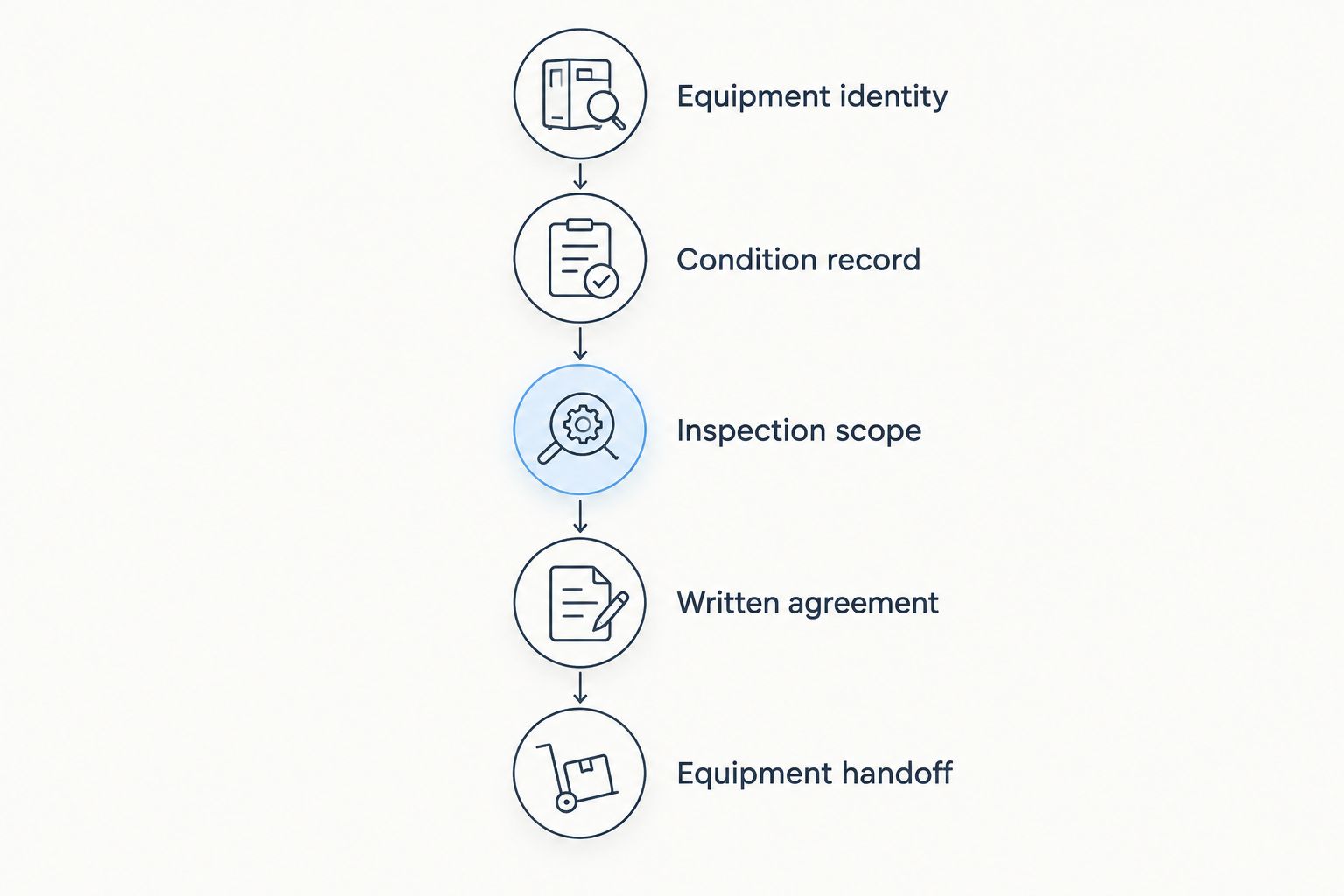
Written agreement
Separate the outgoing rig from the replacement
- Identify both machines independently. Use the relevant serial information and carrier identification. Avoid descriptions that rely only on a manufacturer name or a photograph.
- Write down the acceptance conditions. Identify remaining inspections, required documents, approved repairs, and any lender release requirements. State who confirms that each condition has been satisfied.
- Attach the equipment inventory. Include tooling, loose parts, mounted accessories, and expressly excluded items. Match the attachment to the current photograph set.
- Document settlement responsibilities. Ask the parties handling the transaction to specify payment, lender payoff if applicable, ownership transfer, and release of possession. Have your accountant or legal adviser review transaction-specific tax and contract questions.
- Define changes and cancellation. Record what happens if inspection findings change the agreement, the replacement fails acceptance, or the planned handoff cannot proceed.
Expected result: You have a written agreement that explains each machine's role, outstanding conditions, and the responsibilities required to complete the exchange.
For a 2026 trade-in, do not rely on a message saying the parties will settle the details later. An unresolved included-equipment list or lender requirement is still an unresolved condition, even after everyone agrees on the general transaction.
Keep replacement suitability separate from trade acceptance. A business agreeing to consider your old rig does not establish that the replacement meets your drilling methods, tooling requirements, access constraints, or transport needs.
Equipment handoff
Coordinate inspection, transport, and release
- Confirm the replacement's acceptance status. Complete the agreed review before releasing equipment that your crews still need. Record unresolved replacement defects and the agreed response.
- Assign transport responsibilities. Identify who arranges the carrier, supplies actual transport dimensions and weight, prepares the rig, and handles loading and unloading. Have the responsible transport provider confirm route and permit requirements.
- Approve the release sequence. Coordinate ownership paperwork, settlement confirmation, lender instructions where applicable, and possession. Follow the written agreement rather than an informal pickup request.
- Photograph the outgoing condition. Capture the machine and included equipment before loading. Match loose items against the signed inventory and record any discrepancy before departure.
- Inspect at receipt. Compare the arriving machine and accessories with the agreed description. Record discrepancies promptly through the process established in the agreement.
Expected result: Each party knows when possession changes, what travels with the rig, and which records confirm delivery.
Use 3 handoff checkpoints: before loading, at release, and at receipt. These are documentation checkpoints, not a substitute for qualified loading personnel or transport requirements. Never enter a suspended-load area or demonstrate equipment outside an agreed safe procedure.
Alternative workflow: keep drilling while selling separately
A separate sale or brokerage arrangement suits contractors who need to keep the outgoing rig working while evaluating a replacement. The advantage is scheduling flexibility; the limitation is that the outgoing sale and replacement transaction remain separate commitments.
- Record the machine's current condition. Establish the baseline used in discussions with prospective buyers or the broker.
- Disclose continued operation. Agree on when to update photographs, meter readings, and condition notes while the machine remains in service.
- Set a release condition. Define whether release depends on replacement acceptance, a specified contractual milestone, or another agreed event.
- Update the record before handoff. Disclose new faults, repairs, damage, or changes to included tooling before final acceptance.
Expected result: The selling record reflects the rig that will actually be delivered, not merely the rig that was first photographed.
Drillrigmarketplace provides used drill rig brokerage as well as sales. Ask how continued operation should be handled in your specific arrangement; do not assume an initial assessment remains unchanged after further use.
Troubleshooting
The identification records do not match
Pause the transaction and compare identification plates, ownership records, and carrier documents. Correct the discrepancy with the appropriate issuer or adviser before signing transfer documents; do not resolve it by copying the preferred number into every form.
The assessment changes after inspection
Request the findings and identify which disclosed or newly discovered conditions changed the proposal. Revisit the acceptance terms before authorizing work or transport. Keep the earlier proposal and revised agreement clearly separated.
The included tooling is disputed
Compare the written inventory with the photographs and physically identify the disputed components. Update the agreement before loading. A verbal statement that the rig comes with everything is not an adequate equipment list.
The lender release is unresolved
Contact the lender for transaction-specific payoff and release instructions. Coordinate those instructions with the parties handling settlement. Do not treat possession of the machine as evidence that every ownership obligation has been cleared.
The replacement is not ready for acceptance
Use the delay or cancellation provisions in the written agreement. Do not release your working rig merely because transport has been arranged. Reconfirm the handoff sequence after the replacement's status changes.
Customize your workflow
Add a replacement-requirements sheet before evaluating incoming equipment. List drilling methods, expected tooling interfaces, site-access needs, carrier constraints, and inspection priorities. Have the relevant specifications verified for the actual machine rather than assuming compatibility from its model family.
For your 2026 plan, divide that sheet into required, preferred, and verify before acceptance. Keep the required list short enough to guide a decision. A replacement that fails an essential operating requirement does not become suitable because the outgoing transaction is convenient.
If the inspection reveals repair needs, compare a repair-and-retain decision with replacement before committing. Drillrigmarketplace provides hydraulic, electrical, safety-system, drivetrain, remount, and refurbishment services; ask for a defined scope rather than assuming every repair belongs in the trade-in process.
FAQ
How do I trade in a used drill rig?
Confirm that the receiving business accepts trades, then submit identification, condition records, photographs, and an included-equipment inventory. Complete the agreed inspection and written acceptance terms before arranging release.
Does Drillrigmarketplace accept every used drill rig as a trade-in?
Do not assume that every used drill rig qualifies for a trade-in. Drillrigmarketplace provides used equipment sales and brokerage; ask directly whether your machine and proposed transaction fit a trade arrangement.
What paperwork should I prepare for a drill rig trade-in?
Prepare equipment identification, applicable ownership records, seller authorization, service history, and an included-equipment inventory. Gather lender instructions where applicable and distinguish the drilling unit from its carrier.
Should I repair my old drill rig before trading it in?
Agree on the inspection findings and proposed repair scope before authorizing work solely for a trade-in. Keep necessary safety decisions separate from optional refurbishment and ask how repairs affect acceptance.
Can I keep using my drill rig while negotiating a trade?
Agree on continued operation before relying on an assessment or acceptance proposal. Update condition records and meter readings, and disclose new damage, faults, or changes to included equipment.
Are augers and drill rods included in a trade-in?
Augers and drill rods are included only when the parties agree to include them. Attach an itemized inventory and identify retained tooling before inspection and loading.
When should I release my old rig to the buyer?
Release your old rig according to the written agreement after the required acceptance, ownership, settlement, and lender conditions are satisfied. Confirm replacement acceptance first if your operating plan depends on it.
One last thing
Walk around the outgoing rig with the retained-equipment list before loading begins. Remove only the items the agreement says you are keeping, then check the included-equipment list separately. This final physical check connects the paperwork to the machine leaving your yard.