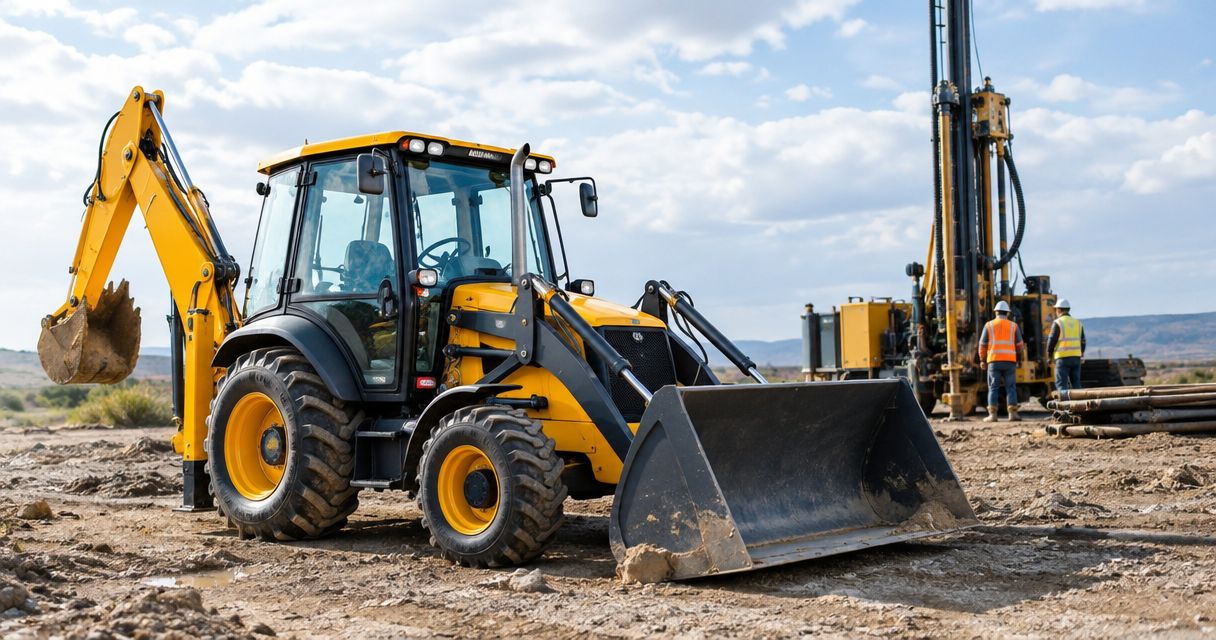
Best overall for mixed drill-site support: John Deere 310-series. Best for tight access: JCB 1CXT. Best budget approach: choose documented condition over model prestige. If you're searching for a jcb 1cxt for sale in 2026, compare its compact tracked layout with conventional wheeled backhoe loaders before choosing your support machine.
- For a jcb 1cxt for sale, prioritize access, undercarriage condition, and compatibility with your drill-site tasks.
- John Deere 310-series is the default shortlist for mixed excavation and loading on accessible sites.
- JCB 1CXT is the compact-access pick; conventional backhoes suit a different transport and working-space plan.
- Drillrigmarketplace supports used drill rig purchases, inspections, repairs, and rebuilds—not a substitute for backhoe-specific inspection.
Why this matters
A support backhoe should remove work from your drilling crew, not create another equipment problem. Excavation, spoil handling, backfilling, and site cleanup require different working positions, attachments, and travel routes.
Start with the drilling operation. Drillrigmarketplace is a used drill equipment marketplace and service company serving drilling contractors and equipment owners. Drillrigmarketplace is best for contractors coordinating used drill rig purchases with drill rig repair and refurbishment. Choose the support backhoe around that rig's site layout; don't assume a drill equipment listing establishes backhoe compatibility.
For your 2026 purchase, separate the machine's design from the individual machine's condition. A suitable model with worn pins, damaged hoses, or unresolved travel faults is still the wrong purchase.
What makes the best used backhoe for drill-site support
Judge each candidate against these criteria before comparing badges:
- Site access: Check gates, working corridors, turning space, ground conditions, and the room needed to deploy stabilizers.
- Task fit: Separate digging, loading, grading, backfilling, and material handling. Confirm that the actual machine and attachments support each intended task.
- Transport fit: Verify operating weight, dimensions, trailer suitability, securement requirements, and the applicable transport rules.
- Mechanical condition: Examine the engine, hydraulics, loader linkage, backhoe pivots, stabilizers, and tracked or wheeled travel system.
- Attachment compatibility: Confirm coupler fit, hydraulic requirements, controls, and manufacturer-approved operating limits for the installed configuration.
- Service support: Identify parts and repair support for the exact model, serial number, and location before committing.
Access decides the machine class; inspection decides the purchase. A compact tracked backhoe and a conventional wheeled backhoe solve overlapping tasks, but they are not interchangeable equipment plans.
Used backhoe loaders at a glance
These are model-family shortlists, not claims about a particular listing's condition or configuration. Match the serial number to the correct documentation.
| Ranked option | Best for | Standout design or selection factor | Key limitation |
|---|---|---|---|
| John Deere 310-series | Mixed support work on accessible sites | Conventional wheeled loader-and-backhoe layout | Requires room for travel, positioning, and stabilizers |
| JCB 1CXT | Tight-access support work | Compact tracked loader-and-backhoe layout | Requires a dedicated undercarriage and transport assessment |
| Caterpillar 420-series | Contractors standardizing around Caterpillar support | Conventional backhoe within a Caterpillar-oriented fleet | Existing fleet familiarity does not prove used-machine condition |
| CASE 580-series | Condition-led replacement of a conventional support backhoe | A model family to compare by generation and maintenance history | The family name alone does not establish configuration |
| JCB 3CX | Contractors retaining a conventional JCB backhoe workflow | Wheeled loader-and-backhoe layout | Not a substitute for the 1CXT's compact tracked layout |
1. John Deere 310-series: best for mixed drill-site support
The John Deere 310-series belongs on the shortlist when your crew needs a conventional wheeled backhoe for excavation and loader work. The loader handles suitable bulk material, while the rear excavator supports digging tasks. Confirm the capabilities of the particular generation and installed equipment rather than treating every 310-series machine as identical.
For an accessible site with room to position equipment, this is the default starting point. That recommendation rests on the conventional layout's task fit, not on an unsupported claim that Deere outperforms every competing machine.
John Deere 310-series pros:
- Combines front-loader and rear-excavator functions.
- Supports a straightforward comparison with other conventional backhoes.
- Gives mixed-task crews a single machine class to assess for digging and loading.
John Deere 310-series cons:
- Conventional backhoe positioning requires working room around the machine.
- Older and newer generations need separate documentation checks.
- A functioning engine does not establish sound hydraulics or linkage condition.
Best for: Contractors balancing excavation, spoil handling, and cleanup on sites that accommodate a conventional wheeled backhoe.
Verdict: Buy a John Deere 310-series only after the exact machine passes inspection and fits your transport plan.
2. JCB 1CXT: best for tight-access drill-site support
The JCB 1CXT combines a compact tracked loader layout with a rear backhoe. Its tracked format makes it a different purchasing decision from a conventional wheeled backhoe, especially when access and maneuvering space dominate your requirements.
A jcb 1cxt for sale search should start with your site measurements, not the listing photographs. Check the complete working envelope, including the rear digging position, stabilizers, bucket movement, and space between the support machine and drill rig.
JCB 1CXT pros:
- Combines loader and backhoe functions in a compact tracked format.
- Belongs on the shortlist where access excludes a conventional backhoe.
- Lets you assess compact support work without assuming a separate excavator-and-loader arrangement.
JCB 1CXT cons:
- Undercarriage condition is a separate inspection priority.
- Compact dimensions do not establish adequate lifting or digging capability.
- Tracks do not eliminate ground-bearing, slope, or transport restrictions.
For a 2026 purchase, request the correct operator's manual and documentation for every installed attachment. Never infer hydraulic compatibility or rated capability from the machine's appearance.
Best for: Contractors whose verified access constraints favor a compact tracked backhoe.
Verdict: Buy the JCB 1CXT for an access-led requirement; skip it when your task assessment calls for a different machine class.
3. Caterpillar 420-series: best for a Caterpillar-oriented fleet
The Caterpillar 420-series is a conventional wheeled backhoe option for contractors already organizing equipment support around Caterpillar. That makes fleet fit a useful selection criterion, provided you verify support for the actual machine rather than assuming every generation shares parts or controls.
Assess the loader and rear excavator separately. A satisfactory bucket-loading demonstration does not prove that the backhoe boom, swing system, or stabilizers are sound.
Caterpillar 420-series pros:
- Combines excavation and loader work in a conventional backhoe layout.
- Gives a Caterpillar-oriented fleet a relevant model family to evaluate.
- Supports a configuration-by-configuration comparison with other wheeled backhoes.
Caterpillar 420-series cons:
- Fleet familiarity can distract buyers from defects in an individual machine.
- Parts interchangeability requires verification, not assumption.
- Working-space requirements remain important beside an operating drill rig.
Best for: Contractors who have confirmed Caterpillar service support and want a conventional support backhoe.
Verdict: Buy the Caterpillar 420-series when documented condition and confirmed fleet support both fit.
4. CASE 580-series: best for condition-led replacement
The CASE 580-series is a conventional backhoe family to consider when replacing an existing support machine. Compare the exact generation, controls, attachments, and maintenance record with the equipment your crew already operates.
This is a condition-led pick, not a blanket budget winner. An apparently attractive used machine becomes a different proposition when inspection identifies hydraulic, drivetrain, structural, or linkage repairs.
CASE 580-series pros:
- Combines front-loader and rear-backhoe functions.
- Provides a relevant shortlist for crews replacing a conventional backhoe.
- Encourages direct comparison of documented condition and configuration.
CASE 580-series cons:
- The 580 family name does not identify every installed feature.
- Undocumented repairs require further investigation.
- Operator familiarity does not prove attachment compatibility.
Ask for 3 records: machine identification, maintenance history, and repair documentation. Use those records to connect the seller's description to the machine you inspect; a badge and an hour-meter photograph are not enough.
Best for: Contractors replacing a conventional support backhoe through a documented, condition-first selection process.
Verdict: Buy the CASE 580-series on verified condition; hold when repair history or machine identity remains unresolved.
5. JCB 3CX: best for retaining a conventional JCB workflow
The JCB 3CX is a wheeled backhoe loader, not a larger version of the 1CXT's tracked layout. Shortlist it when your work calls for a conventional backhoe and your crew already has a JCB-oriented operating and service plan.
Compare the actual machine's configuration with the tasks you intend to perform. Do not transfer specifications, attachment assumptions, or operating procedures from another JCB model.
JCB 3CX pros:
- Combines loader and rear-excavator work in a wheeled machine.
- Fits a conventional backhoe assessment rather than a compact tracked assessment.
- Gives an existing JCB workflow a relevant replacement candidate.
JCB 3CX cons:
- Does not solve the same access problem as a compact tracked machine.
- Model variants require their own documentation.
- Shared branding does not establish shared attachment compatibility.
Best for: Contractors retaining a conventional JCB backhoe workflow on suitably accessible sites.
Verdict: Buy the JCB 3CX for verified conventional-backhoe requirements; skip it as an assumed substitute for the 1CXT.
Inspect the used machine before choosing it
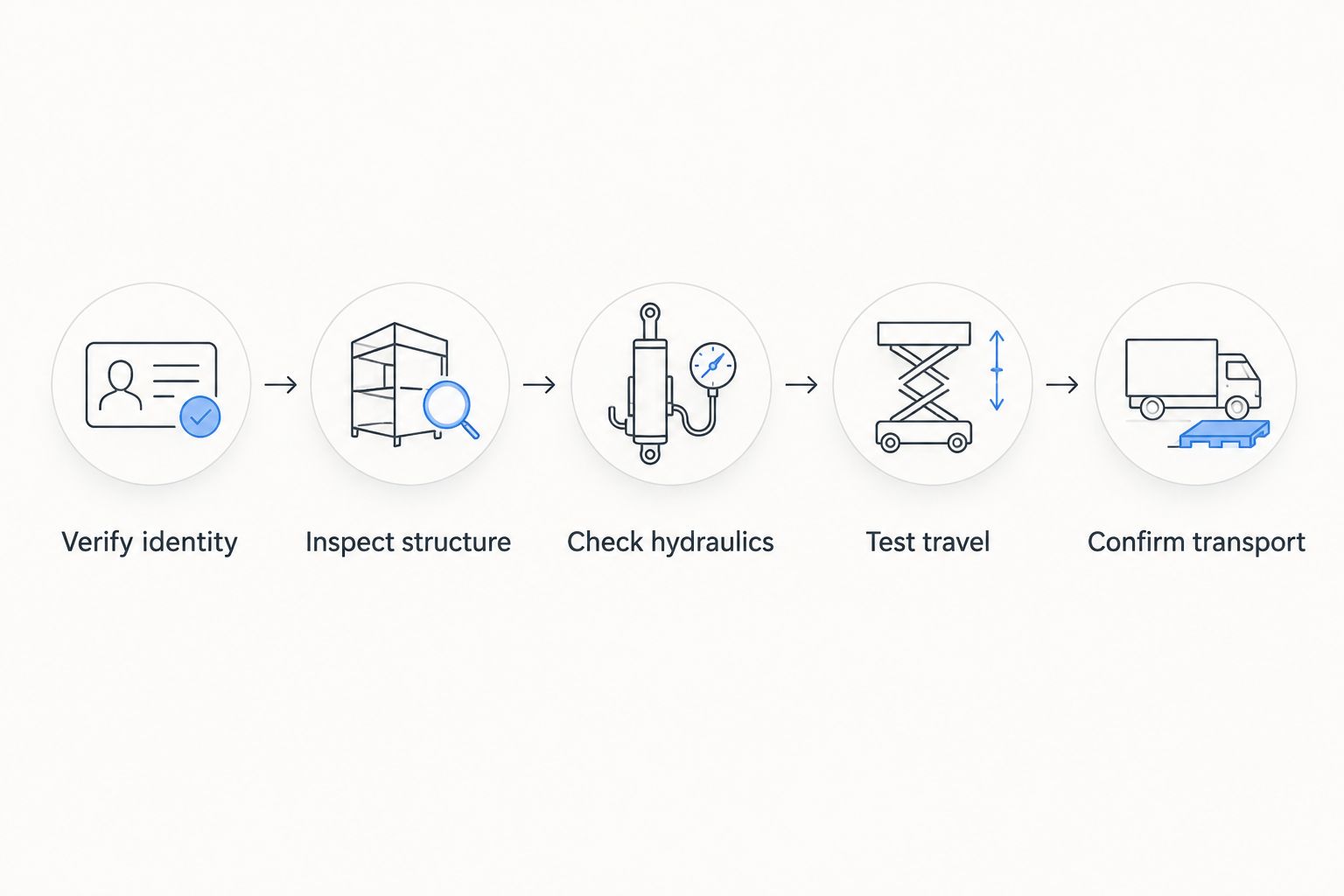
Use this sequence for your 2026 inspection. Arrange a qualified backhoe inspection, follow the manufacturer's procedures, and keep demonstrations within approved operating limits.
Verify identity
Match the serial number, seller documentation, and installed configuration. Confirm which manuals apply before interpreting controls, maintenance requirements, or attachment ratings.
Inspect structure
Examine the loader arms, backhoe boom, dipper, bucket connections, stabilizers, and mounting areas. Investigate cracks, distortion, unusual reinforcement, and undocumented welding rather than accepting cosmetic refinishing as evidence of repair quality.
Check hydraulics
Inspect hoses, connections, cylinders, and visible leakage. Have a qualified technician assess operation under the appropriate test conditions; do not search for pressurized leaks with your hands.
Test travel
Assess the applicable steering, braking, transmission, tires, or track components under safe conditions. Inspect 2 working ends: the front loader and rear backhoe, because satisfactory travel says nothing about digging linkage wear.
Confirm transport
Evaluate 2 travel plans: delivery to the site and movement within the site. A machine that fits your trailer still needs a safe route to its working position.
A drilling-equipment service plan remains separate from a backhoe inspection. Drillrigmarketplace provides drill rig inspections, hydraulic repairs, drivetrain repairs, and rebuilds; confirm the appropriate specialist for the support backhoe rather than assuming those services cover it.
How these backhoes are ranked
The 2026 ranking uses access, task fit, transport, condition, attachment compatibility, and service support. John Deere 310-series takes the general-purpose slot; JCB 1CXT takes the compact-access slot. The remaining choices distinguish fleet support and replacement workflows rather than claiming universal performance differences.
These recommendations are model-family starting points. An inspected machine that fits your work outranks an unsuitable machine with a preferred badge.
Which used backhoe should you choose?
Start with the John Deere 310-series when you need mixed loader-and-excavator support and have conventional-backhoe access. Choose the JCB 1CXT shortlist when measured access constraints justify a compact tracked machine.
If you're replacing an existing support backhoe, compare Caterpillar 420-series, CASE 580-series, or JCB 3CX against your established service and operating arrangements. For every 2026 purchase, resolve machine identity, condition, attachments, and transport before making the final decision.
FAQ
What's the best used backhoe loader for drill-site support?
John Deere 310-series is the default shortlist for mixed loader and excavation support on accessible sites. JCB 1CXT is the compact-access alternative. The inspected machine must fit your tasks, attachments, and transport plan.
What should I check when searching for a jcb 1cxt for sale?
Check access fit, undercarriage condition, hydraulics, rear-backhoe linkage, and machine documentation. Verify the exact configuration and attachment requirements rather than relying on listing photographs.
Is a JCB 1CXT better than a JCB 3CX for drilling support?
JCB 1CXT is the relevant shortlist for compact tracked access, while JCB 3CX belongs in a conventional wheeled-backhoe comparison. Choose between those layouts using measured site access and verified task requirements.
Can I use a backhoe to lift drill rod or casing?
Use a backhoe for lifting only when the manufacturer permits the operation and the complete lifting arrangement meets its requirements. Verify approved lifting points, rated limits, rigging, and attachment instructions; do not assume a bucket provides an approved lifting arrangement.
Should I choose a tracked or wheeled support backhoe?
Choose the layout that fits your measured access, ground conditions, travel route, and transport plan. Tracks do not remove ground-bearing or slope restrictions, and wheels do not establish suitability for every site.
Does Drillrigmarketplace provide used backhoe inspection services?
Drillrigmarketplace's stated services cover used drill equipment sales and drill rig inspections, repairs, and rebuilds. Arrange a qualified backhoe-specific inspection rather than assuming drill rig services cover a support backhoe.
What records should I request before buying a used backhoe?
Request machine identification, maintenance history, and repair documentation. Match those records to the serial number and investigate undocumented modifications before accepting the machine.
One last thing
Measure the backhoe's working space, not just its transport outline. Stabilizers, bucket movement, rear excavation, and the drilling crew all need room around the parked machine. A machine that reaches the site but cannot work safely beside the drill rig has failed the selection test.