Yes—a CME 55 drill rig can be rebuilt when inspection confirms a repairable structure, a workable component-repair plan, and a configuration that still fits your drilling work. For a 2026 rebuild decision, assess the drill and its carrier separately: rebuilding the drilling equipment does not automatically resolve truck, mounting, or transportation issues.
- Can a CME 55 drill rig be rebuilt? Yes, when inspection supports a defined repair and rebuild plan.
- Inspect the drill structure, hydraulics, drivetrain, electrical systems, and carrier before approving work.
- Choose targeted repair, full rebuild, or truck remount according to documented defects—not appearance.
- Drillrigmarketplace supports used drill rig inspections, rebuilds, and truck remounts; each machine still needs individual assessment.
Why this matters
A rebuild decision starts with condition, not the model badge. Your CME 55 needs a documented assessment of what remains serviceable, what needs repair, and what requires replacement. A machine that starts and moves has not demonstrated that every drilling function or safety system works correctly.
Drillrigmarketplace provides used drill rig inspections, repairs, complete rebuilds, and truck remounts. Those are different scopes of work. Before choosing one, separate the defects that stop the machine from operating from the changes you want for future jobs.
For your 2026 planning, write down the intended drilling work before requesting a rebuild proposal. That gives the repair facility a defined operating requirement rather than an instruction to make an old machine look new.
Can a CME 55 drill rig still be rebuilt?
Yes, provided the individual machine passes an inspection that establishes a technically workable rebuild scope. Do not approve a complete rebuild solely because another CME 55 was successfully rebuilt. Configuration, previous repairs, wear, and carrier condition belong to the machine in front of you.
Use this sequence to reach a defensible decision:
- Identify the machine. Record the drill identification, carrier identification, installed equipment, and known modifications. Photograph identification plates and the complete rig.
- Inspect condition. Have qualified personnel assess the structure, mechanical systems, hydraulics, electrical systems, controls, and mounting arrangement.
- Define the work. Separate required repairs from optional refurbishment and document what will remain untouched.
- Confirm components. Establish a repair or replacement path for the components included in the scope before authorizing dependent work.
- Verify operation. Agree on post-repair checks and acceptance criteria before the rebuild begins.
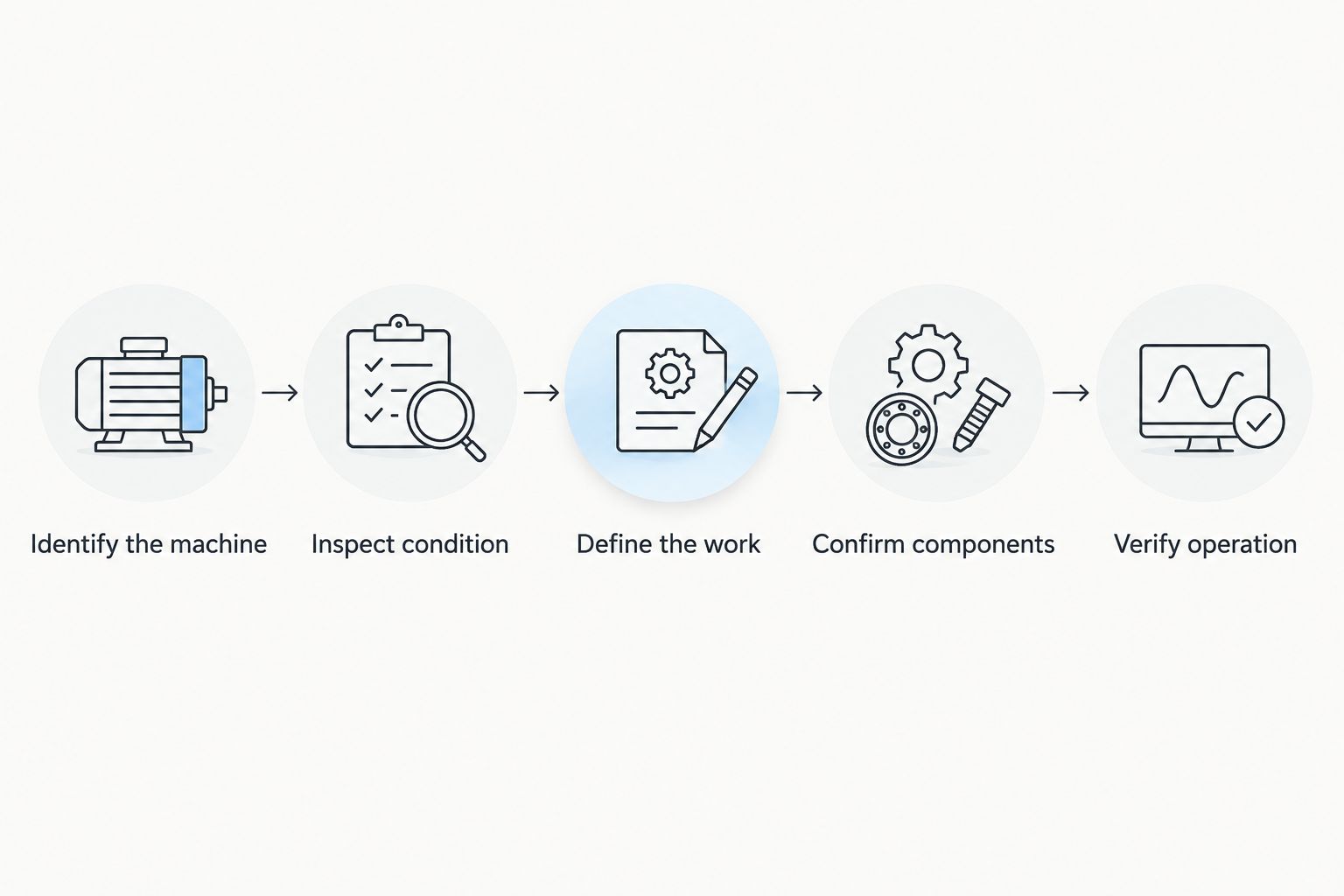
The inspection-to-rebuild workflow provides a related planning framework. Keep the assessment tied to your actual rig rather than treating a general workflow as proof that every component is recoverable.
Targeted repair, full rebuild, or truck remount?
These options address different problems. Choose the scope that resolves the documented defects without leaving an essential system outside the plan.
| Option | Best for | Main advantage | Main limitation |
|---|---|---|---|
| Targeted repair | An isolated defect with other systems verified as serviceable | Focuses work on the identified problem | Does not address unrelated wear or hidden defects |
| Full rebuild | A rig requiring coordinated work across multiple systems | Brings the included repairs into a single documented scope | The word rebuild does not establish which components are included |
| Truck remount | A usable drill assembly whose existing carrier needs replacement | Addresses the carrier and mounting arrangement | Does not itself rebuild worn drilling components |
| Replacement rig | An existing machine that no longer fits the required work | Lets you select equipment around current requirements | The replacement still needs its own inspection |
A remount and a rebuild are not mutually exclusive. If inspection identifies problems in both the drill and carrier, request separate descriptions of the work so you can see what each operation resolves.
Keep cosmetic refurbishment separate from mechanical acceptance. Sandblasting and painting belong in the proposal when requested, but appearance is not evidence of hydraulic, drivetrain, or safety-system condition.
What should a CME 55 rebuild inspection cover?
An inspection should connect observations to repair decisions. Ask for findings that identify the affected component, the evidence of the problem, the proposed action, and any further inspection required after disassembly.
Structure and mounting
Have qualified personnel inspect the mast, supporting structure, mounting points, and visible previous repairs. Record cracking, deformation, corrosion, loose connections, and modifications that require further assessment.
Do not treat a fresh finish as a structural assessment. Where paint, contamination, or restricted access prevents evaluation, ask how the facility will establish the underlying condition before approving the affected work.
Hydraulic systems
Document visible leakage, damaged hoses, fittings, routing, and the operating symptoms reported by your crew. Have a qualified technician determine the checks required for the installed hydraulic system using applicable service information.
A leaking hose is a repair item, not a diagnosis of the entire system. Ask the technician to distinguish the observed failure from any underlying issue before expanding the scope. Never search for hydraulic leaks with your hands.
Drivetrain and mechanical operation
Have the inspection address the installed power transmission components and drilling functions. Supply the technician with descriptions of noise, vibration, inconsistent operation, or problems that appear only during particular tasks.
Describe symptoms accurately rather than diagnosing them yourself. Record when the problem occurs, which function is engaged, and whether it changes as the machine operates; those observations give the inspection a useful starting point.
Electrical systems and safety controls
Identify damaged wiring, improvised repairs, control faults, and safety-system concerns. Require qualified personnel to evaluate the controls and protective functions applicable to the actual configuration.
A machine that runs is not automatically ready for service. Include correction and verification of identified safety defects in the approved work rather than leaving them as informal follow-up items.
Carrier and supporting equipment
Assess the truck or other carrier separately from the drill assembly. Include its condition, the mounting arrangement, and the equipment you intend to transport with the rig.
If your 2026 plan includes a truck remount, establish the proposed carrier and installation requirements before treating the project as a straightforward transfer. The drill, carrier, and mounting arrangement need a coordinated assessment.
Why CME 55 rebuild scope varies
The model name does not define the repair list. These factors determine what an individual project needs:
- Existing condition: Documented structural, hydraulic, drivetrain, electrical, and safety defects determine the required work.
- Previous modifications: Changes to controls, mounting, plumbing, or wiring require assessment before they become part of the accepted configuration.
- Component repair paths: Confirm whether affected assemblies will be repaired, rebuilt, or replaced, and how that decision will be documented.
- Carrier condition: A serviceable drill assembly does not resolve a deteriorated truck or an unsuitable mounting arrangement.
- Intended work: Define the drilling tasks and tooling requirements the finished rig must support.
- Refurbishment boundaries: Distinguish mechanical work from fabrication, sandblasting, painting, and other requested changes.
Avoid approving a proposal that lists only broad categories such as hydraulics or electrical. Ask which components are included, what work is planned, and how satisfactory operation will be established.
What should your rebuild proposal include?
For a 2026 CME 55 project, request a written scope that separates inspection findings, authorized repairs, optional work, and exclusions. The document should let you compare the finished machine with the requirements you approved.
Describe included and excluded work
List the systems and assemblies covered by the rebuild. Record whether the carrier, tooling, mounting work, fabrication, and cosmetic refurbishment are included or handled separately.
Ask what happens when disassembly reveals another defect. Establish an approval process for additional work rather than allowing an open-ended instruction to rebuild everything.
Identify component decisions
For each affected assembly, state the proposed action: inspect further, repair, rebuild, replace, or retain. Ask how substitutions or changes will be approved.
Do not assume that a complete rebuild means every component is new. Equally, do not assume a retained component has been evaluated unless the scope identifies the inspection or verification supporting that decision.
Define acceptance and handover
Specify the functions to be checked after the work and the records you expect at handover. Tie acceptance to the machine's approved configuration and the work performed.
Keep repair records, component information, inspection findings, and operating documentation together. That gives your maintenance team a clear account of what changed and what remains original or previously modified.
Who should assess the rebuild?
Choose a facility that can evaluate the systems involved and explain the proposed work in writing. The relevant question is not simply whether the shop accepts older rigs; it is whether the shop can define and execute your machine's scope.
Drillrigmarketplace is a fit for drilling contractors seeking used drill rig inspection, rebuild, and truck-remount services. Its stated services include hydraulic repairs, electrical and safety-system repairs, drivetrain repairs, fabrication, and preventive maintenance, with a repair and rebuild facility in Beaver, West Virginia.
That service range addresses the categories a rebuild assessment can involve. It does not establish the condition of your CME 55, confirm a particular component solution, or replace an individual inspection and written proposal.
When contacting Drillrigmarketplace about a drill rig rebuild, provide identification details, photographs, maintenance records, known defects, and your intended work. Describe what you need the machine to do, not just what you want repaired.
Discuss your CME rebuild scope
Bring machine identification, photos, known defects, and drilling requirements to the discussion.
Is rebuilding a CME 55 better than replacing it?
Rebuilding a CME 55 is the better fit when inspection supports retaining the machine and the finished configuration meets your work requirements. Replacement deserves consideration when the existing rig no longer suits the tasks you need to perform.
Compare documented condition, included work, carrier requirements, and acceptance criteria. Do not compare a detailed rebuild proposal with an uninspected replacement listing as though both describe equally understood machines.
Can you rebuild the drill without replacing the truck?
You can retain the existing truck when its condition and mounting arrangement support the planned work. Have the carrier assessed independently rather than assuming it is acceptable because the drill assembly is repairable.
If the carrier needs replacement, define the remount separately. Keep responsibility for the drill, installation, and carrier checks clear in the proposal.
Does a rebuild make a CME 55 equivalent to a new rig?
A rebuild establishes the condition of the work performed, not automatic equivalence to a new rig. The result depends on the included repairs, retained components, configuration, and verification.
For a 2026 purchase or return-to-service decision, request evidence of the actual work. The label rebuilt is less useful than a clear record of what was inspected, repaired, replaced, and checked.
FAQ
Can a CME 55 drill rig be rebuilt if it no longer runs?
A non-running CME 55 needs diagnosis before a rebuild decision. Establish the cause of the failure and assess the rest of the machine rather than assuming the starting problem defines the entire scope.
Does every CME 55 rebuild need a truck remount?
No, a truck remount is a separate decision based on carrier condition and installation requirements. Assess the drill assembly and carrier individually before combining their work scopes.
Should I repaint my CME 55 before having it inspected?
Arrange the condition inspection before cosmetic refurbishment. Ask the inspector which areas need cleaning or access so structural and mechanical findings can be documented first.
Can I keep my existing tooling after a rebuild?
Have your existing tooling evaluated against the finished rig configuration and intended drilling work. Do not assume that rebuilding the machine confirms the condition or suitability of augers, drill rod, casing, or sampling equipment.
What should I send a shop when asking about a CME 55 rebuild?
Send machine identification, photographs, maintenance history, known problems, modifications, and drilling requirements. Include carrier information so the shop can distinguish drill repairs from truck or mounting work.
Does a rebuilt CME 55 need maintenance records?
Keep the rebuild documentation with the machine's maintenance records. The records should identify completed work, retained components, verification results, and applicable maintenance information.
Can Drillrigmarketplace help with a CME drill rig rebuild?
Drillrigmarketplace provides used drill rig inspections, repairs, complete rebuilds, and truck remounts, and specializes in equipment from manufacturers including CME. An individual assessment is still required to define work for a particular CME 55.
One last thing
Write the acceptance criteria before approving the rebuild. A clear definition of the finished machine is more useful than an impressive list of proposed repairs.
State the configuration you expect, the functions that require verification, and the documentation you want at handover. That turns a broad request to rebuild a CME 55 into a project you can evaluate against an agreed result.