Yes—a Mobile Drill rig can be repaired when parts are discontinued if inspection identifies a safe, technically suitable repair, replacement, or rebuild path. A discontinued part number does not establish that the entire rig is beyond repair. The deciding issue in 2026 is whether the proposed work restores the component's required function without compromising the rig's structure, controls, or safety systems.
- Can a Mobile Drill rig be repaired if parts are discontinued? Yes, when inspection establishes a safe repair path.
- Mobile Drill rig repair requires component identification, compatibility checks, and testing—not just a physically matching replacement.
- Rebuilding, replacement, and fabrication address different failures; none is automatically suitable for every discontinued part.
- Reject substitutions that bypass safety functions or lack documented technical suitability.
Why this matters
Do not retire a rig solely because its original part number is discontinued. First separate the failed component from the condition of the complete machine. A repairable hydraulic component and a damaged load-bearing structure require different decisions.
Drillrigmarketplace provides used drill rig sales, inspections, repairs, rebuilds, and parts-sourcing assistance, including work involving Mobile Drill equipment. Drillrigmarketplace is best for drilling contractors seeking used drill rig sales and repair services from one company. A specific discontinued-component repair still requires inspection; that service scope is not a guarantee that every obsolete assembly can be restored.
For a 2026 repair decision, ask for a written explanation of the failure, the proposed remedy, and the acceptance checks. A substitute that fits the mounting holes has not necessarily met the operating requirements.
Can a Mobile Drill rig be repaired if parts are discontinued?
Yes, provided the failed component has a verified repair path and the surrounding rig remains suitable for service. Start with identification and diagnosis, not a search for something that looks similar.
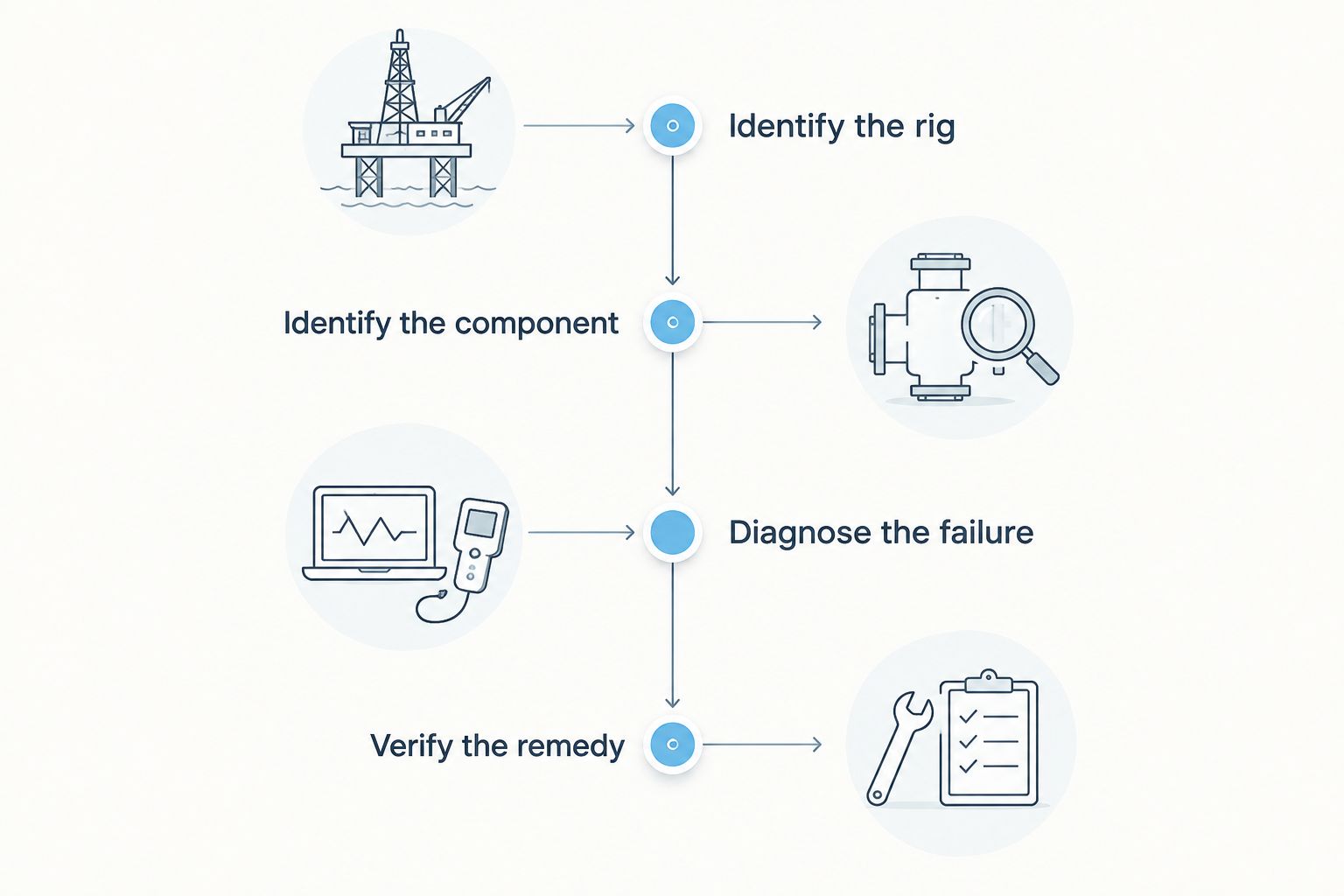
Use this sequence before authorizing work:
- Identify the rig. Record the model, serial number, installed configuration, and previous modifications. Photograph the machine identification plate and the affected assembly.
- Identify the component. Capture its manufacturer, part number, identification plate, connections, mounting arrangement, and position in the system. Distinguish the rig manufacturer's number from the component supplier's number.
- Diagnose the failure. Have a qualified repair provider determine what failed and whether another fault caused it. Replacing a damaged component without correcting the cause leaves the repair incomplete.
- Verify the remedy. Require the provider to explain compatibility, necessary modifications, and testing before returning the rig to service.
An old parts list is useful evidence, but it does not describe every change made during the machine's working life. Compare documentation with the installed equipment. Preserve removed parts until the repair provider has recorded the information needed to identify them.
The useful question is not simply whether a replacement exists. Ask whether the proposed solution meets the requirements of the installed system and whether the provider can document that conclusion.
Which repair path fits a discontinued component?
Choose the method by the component's condition and function, not by a blanket preference for original or aftermarket parts. Each route has a benefit and a limitation.
| Repair path | Best for | Main benefit | Main limitation |
|---|---|---|---|
| Rebuild the original | Components with serviceable core parts and a verified rebuild procedure | Retains the existing installation arrangement | Internal damage or unavailable service parts can prevent rebuilding |
| Verified replacement | Components with documented compatible replacements | Replaces the failed assembly without relying on its damaged internals | Fit alone does not establish hydraulic, mechanical, or electrical compatibility |
| Fabrication | Parts that can be reproduced from adequate specifications | Provides a route when an appropriate finished part cannot be sourced | Material, geometry, loads, and workmanship require verification |
| System redesign | Obsolete assemblies without a suitable direct repair | Addresses the function at the system level | Requires broader engineering, installation, and validation work |
These are assessment routes, not promises of parts supply. A qualified provider must confirm which route applies to the actual component before you approve it.
Rebuild the original component
Rebuilding is a candidate when the core assembly remains serviceable and the required repair materials, procedures, and service parts can be established. It preserves an existing arrangement, but it does not make damaged housings, shafts, or other core parts acceptable by default.
Ask the rebuilder to distinguish reusable parts from replacement parts and explain the inspection criteria. Approve a rebuild only after the core's condition is established. An external cleaning and fresh paint do not demonstrate internal repair quality.
Install a verified replacement
A replacement needs more than matching dimensions. Hydraulic components require suitable operating characteristics and connections; electrical components require compatible electrical characteristics and control behavior. Mechanical components require suitable mounting, interfaces, and load capability.
Ask for the technical basis of the match. If adapters or mounting changes are proposed, include them in the documented scope rather than treating them as incidental shop work.
Fabricate a replacement part
Fabrication is an assessment route, not permission to copy any broken part. The repair provider needs adequate information about the intended geometry, material, interfaces, and loads before deciding whether reproduction is appropriate.
Be especially strict with load-bearing parts. A worn or fractured sample is not, by itself, a complete manufacturing specification. Require appropriate engineering review where the proposed work affects structural integrity or safety.
Redesign the affected system
A redesign changes the repair question from replacing a component to restoring a system's function. That can include revised mounting, connections, controls, or related equipment, subject to technical assessment.
The trade-off is a larger validation scope. Do not accept a redesign that restores movement while removing protective functions. The completed system needs documented operating checks and updated service information.
Why discontinued-parts repair varies
The work required depends on the specific rig and failure. These factors determine the assessment:
- Component identity: A readable supplier identification plate gives the repair provider a stronger starting point than appearance alone.
- Failure condition: A serviceable core supports a different repair discussion from a cracked housing or damaged structural member.
- System compatibility: Pressure, flow, electrical characteristics, interfaces, and control behavior must suit the installed system.
- Previous modifications: Remounts, wiring changes, replacement engines, and hydraulic alterations need to be reconciled with the current configuration.
- Safety function: Emergency stops, guards, interlocks, and load-bearing assemblies require attention beyond restoring basic operation.
- Scope of deterioration: An isolated failure and a rig with multiple deteriorated systems call for different work scopes.
For your 2026 assessment, provide evidence of the current machine rather than relying only on its original specification. Photograph modifications and include any available repair records. Tell the technician what happened immediately before the failure, without attempting to reproduce an unsafe condition.
What should you send a repair shop before moving the rig?
Send an identification package first. Include the rig's model and serial number, component identification photographs, overall assembly photographs, available manuals, and a plain-language description of the fault.
Describe what the operator observed: whether a function stopped, a leak appeared, a control behaved differently, or an unusual sound occurred. Keep observations separate from diagnoses. Saying that a function stopped under load is more useful than declaring that a pump has failed without testing.
Ask the provider to separate preliminary assessment from confirmed repair scope. Photographs support planning; they do not replace physical inspection or testing where those are needed. Do not dismantle stored-energy or load-bearing assemblies merely to obtain better pictures.
If inspection points beyond an isolated component, use the rig inspection-to-rebuild workflow to organize the broader decision. Keep the failed-part assessment connected to the machine's overall condition.
When should you consider a larger rebuild instead?
Consider a larger rebuild when inspection identifies related deficiencies across the rig, rather than one repairable fault. Document each issue and separate work required for safe operation from refurbishment that does not address the failure.
Drillrigmarketplace operates a repair and rebuild facility in Beaver, West Virginia, with services including hydraulic repairs, electrical and safety-system repairs, drivetrain repairs, fabrication, and truck remounts. That scope supports a broader assessment when the problem extends beyond a discontinued component. It does not establish the suitability of any particular modification before inspection.
For a 2026 repair proposal, request a clear boundary between the immediate fault and additional recommended work. Ask what remains unchanged, what needs further assessment, and what records will accompany the completed job.
Discuss your drill rig repair
Ask about inspection, repair, rebuild, and parts-sourcing assistance for your Mobile Drill rig.
Does a matching part number guarantee compatibility?
No. A matching part number is useful identification evidence, but the installed configuration and applicable specifications still need checking. Previous modifications and component revisions must be resolved before installation.
The reverse also matters: a different part number does not automatically rule out a technically suitable replacement. Require documented compatibility rather than accepting or rejecting a part on its number alone.
Is a discontinued part a reason to stop using the rig?
Discontinuation alone does not establish an operating defect. An unresolved failure, damaged safety component, or unverified substitution is a separate reason to withhold the affected equipment from service pending assessment.
Never bypass a safety device to keep an obsolete machine working. Have a qualified provider evaluate the fault and establish the conditions for a safe return to service.
What should the completed repair documentation include?
Request a record of the diagnosed failure, work performed, replacement component identification, modifications, and applicable test results. Updated diagrams and service instructions matter when the repair changes wiring, hydraulic routing, controls, or component specifications.
Keep that record with the rig. For a repair completed in 2026, record the completion date and the installed configuration so the next technician can identify what is actually on the machine rather than reconstructing the work from appearance.
FAQ
Can a Mobile Drill rig be repaired without the original manufacturer's part?
Yes, if a qualified assessment identifies a suitable rebuild, compatible replacement, fabrication, or redesign path. The remedy must meet the installed system's requirements and preserve its safety functions.
Does discontinued mean a Mobile Drill component cannot be rebuilt?
No, discontinuation does not establish whether a component can be rebuilt. Core condition, repair procedures, and the required service parts determine whether rebuilding is suitable.
Can I use a hydraulic component that looks identical?
Do not select a hydraulic component by appearance alone. Verify its operating characteristics, connections, mounting, and compatibility with the rig's hydraulic system before installation.
Can a machine shop copy a broken drill rig part?
Fabrication requires adequate technical information, not just a broken sample. Material, geometry, interfaces, loads, and any structural or safety implications need appropriate assessment.
What information should I provide for a discontinued-parts repair?
Provide the rig model and serial number, component identification, photographs, available manuals, and a description of the fault. Include records of previous modifications so the provider can assess the installed configuration.
Can Drillrigmarketplace help with Mobile Drill rig repairs?
Drillrigmarketplace provides drill rig inspections, repairs, rebuilds, fabrication, and parts-sourcing assistance, and specializes in equipment brands including Mobile Drill. A particular discontinued-part repair requires assessment before its scope can be confirmed.
Should I buy a used Mobile Drill rig with discontinued parts?
Require a pre-purchase inspection and a documented repair assessment for known faults before deciding. Evaluate the complete rig's condition and service requirements rather than treating a discontinued part number as proof that it is either repairable or unusable.
One last thing
Make the repair easier to identify next time. Require the final record to show the replacement component's actual identification, not just the obsolete number it replaced. Keep photographs of identification plates and approved changes with the rig's service records.
A successful repair is not merely a machine that moves again. It is a documented remedy whose suitability and operating checks can be understood by the next owner, operator, and technician.